



Africa’s Strategic Partnership with BRICS and other Emerging Countries, is a must-read book to fully grasp aspects of the current Middle East Crisis
The adversary geopolitics of the Global North and the Global South, is unpacked in this newly released book, published of Fanele/Jacana Media.
By Edward Tsumele, CITYLIFE/ARTS Editor
I got this book about two weeks ago, and because I was busy with another book to read and review, I put it aside for future reading. But not anymore. You see, the war between Iran, and subsequentlypulled in the US after its early Sunday morning bombing of what the US said are nuclear installations in Iran, has made the reading of this book an urgent matter.
With a title Africa’s Strategic Partnership with BRICS and other Emerging Countries, this book is edited by Siphamandla Zondi, Director of the Institute for Pan African Thought and Conversation at University of Johannesburg, and Hellen Adogo, who is a researcher at the same institute.
The book as the title suggests, is an attempt by several contributors, academics who are experts in their respective areas of specialisation, and most of whom have produced outstanding scholarship, peer reviewed and published in credible academic journals, to weave together political theories about how countries in the Global South are coming together to form strategic partnerships.
These partnerships are multi-layered, but mostly economic, political and quasi-military collaborations in some cases. South Africa on the African continent, is therefore a proactive player in these intricate alliances as due to its political and dominant economic currencies, the country is seen and regarded by other countries that form the Global South as a leader on the African continent.
South Africa’s importance in Africa with reference to the Global South is well demonstrated by the fact that until recently, when BRICS expanded to include other countries, South Africa was the only country on the African Continent that was a member of BRICS. However since the last meeting of BRICS held in South Africa, more countries have been allowed membership of the grouping, including Iran. The grouping however remains exclusive, favouring mostly those countries who economies are big and their political currency of strategic importance in geopolitics to enable the Global South to counter balance the dominance of the Global North, led by the US and its European partners.
“This book provides the platform for a discussion from various Southern purviews of 10 significant strategic partnerships that Africa has built with others-mostly emerging powers –with a view to acquiring insights into what shapes them, how they are managed, what policy issues are addressed and what outcomes are merging from them,” writes Zondi as a way of contexualising how the book came about and what it looks at and why.
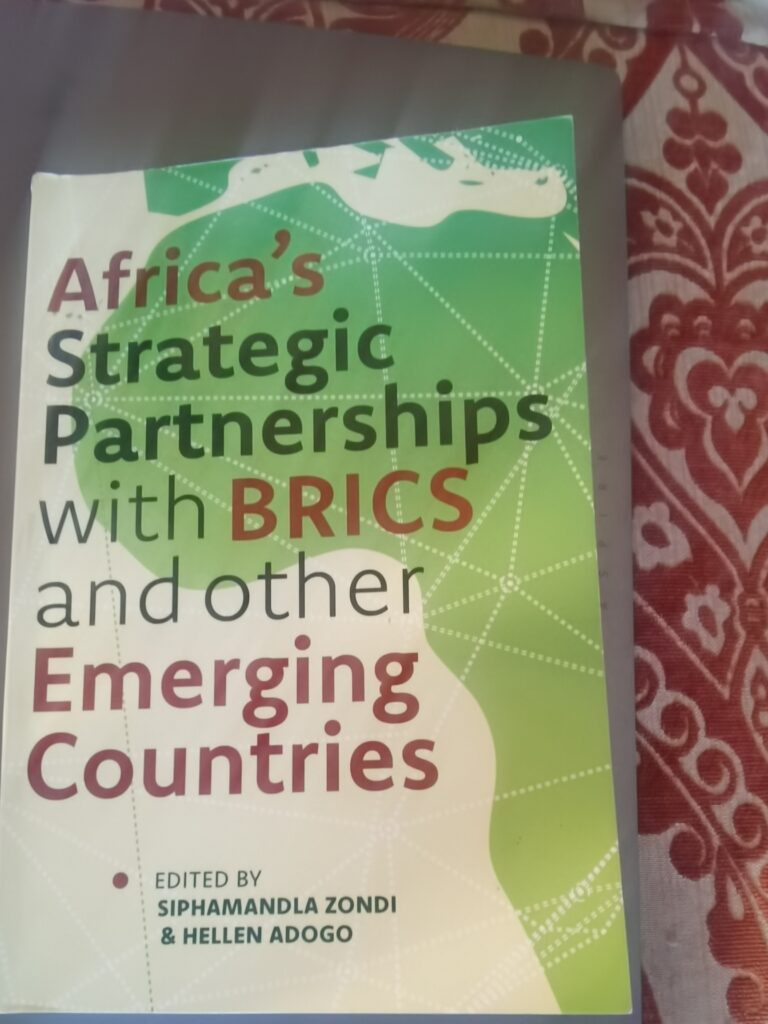
The book goes own to investigate 10 partnerships that Africa has forged with the Global South, including with Russia, Brazil, India, China, Turkiye, South Korea and Iran.
In fact it is the chapter about Iran’s forging of partnerships with Africa which has become especially relevant right now due to the current situation of hostility and war that is raging in the Middle East, which made the reading of this book urgent to me. This is because I wanted to understand, howdo that strategic partnershipbetween Iran and Africa fit in into the context of what is going on right now.
“In chapter 12 of the book, Amin Naeni and Ali Fathollah-Nejad show that Iran’s pursuit of strategic relationships with Africa is part of the country’s effort to thwart Western sanctions and direct its assertive foreign policy at the Global South generally. Its security and commercial interests led to its selection of East Africa as an entry point to its commercial diplomacy, but rivalry with Saud Arabia and inadequate resources are limiting the expansion of Iran’s relationship with Africa,” concludes Zondi.
In Chapter 13 of the book, ThembisaFakude weighs in evaluating the limited of influence of Iran on the African continent, particularly outside factors, such as the sanctions imposed by Western Powers, Saudi Arabia’s influence on the continent, as well as the role that its arch-enemy Israel plays in some of the African countries. There is also the generally suspicious attitude of Africa towards Iran’s role in Africa.
Reading this, I was therefore, left wondering whether Africa could be sucked into the war that is raging on between Iran on one hand, the US and Israel on the other, especially if the war becomes full-blown, pulling in other countries, such as China and Russia for example.
In other words, in the case of a full-blown Third World, where would side would Africa be?
Given the analysis above, it is unlikely that Africa would actively, militarily be involved. I cannot help but speculate given the learned thinkers’ analysis of the relationship between Africa and Iran before this current situation that Iran finds itself in.
This is reinforced by the fact that Fakude argues that currently the relationship between Iran and Africa is not as solid as intended to be, especially because “the external factors have also contributed to making this strategic partnership a fragile one,” Fakude concludes.
This is a book worth reading, particularly if one wants to understand the adversary geopolitics of the Global North and the Global South, especially in the context of the current Middle East crisis.
Besides Zondi, Fakude, Adogo, Amin Naeni and Ali Fathollah-Nejad, the other contributors to Africa’s Strategic Partnership with BRICS and other Emerging Countries, are Gustavo de Carvalho, Hyomin Jung, Irina Yarygina, Isaac Khambule, Kenny Dlamini, Mary Abura, Masumi Owa, Mehmet Ozkan, Motoki Takahashi, Norman Sempijja, Paulo Mora Brito, Sunusha Naidu, Scarlett Cornelissen, Suweon Kim, Tuseku Dieudonne (TD) Tumba, Tycho van der Hoog, Ying Wang, Zhenjiang Zhang, Bhaso Ndzende, Candice Moore, Chidochase Nyere, Aparajita Biswas and Adeoye Akino.
.NEWSFLASH: At the time of publishing this review Donald Trump had announced a cease fire between Israel and Iran amid doubts by some whether such a cease fire could hold this late when a lot of damage has been done to each of the adversaries so far.