

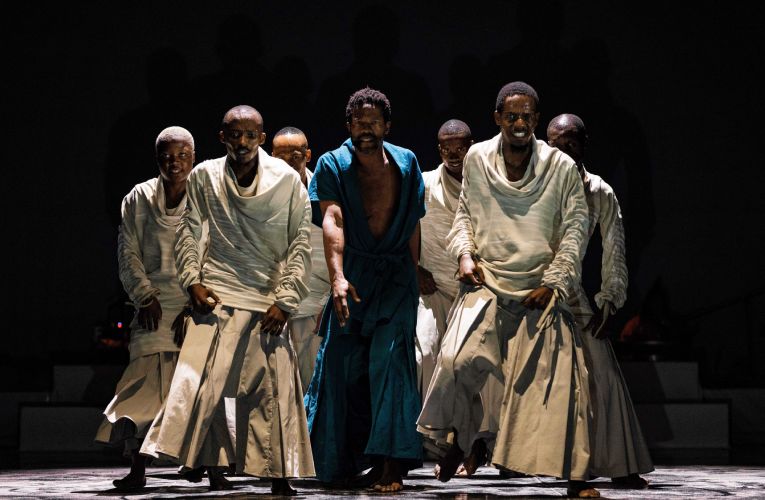
Celebrated choreographer Greg Maqoma’s show wraps the audience in a world of sound, breath, rhythm and memory
By Funeka Bambalele

Over the years, every time the legendary choreographer and dancer, Gregory “Greg” Maqoma unveils a new dance work, I find myself convinced it is his finest creation yet.
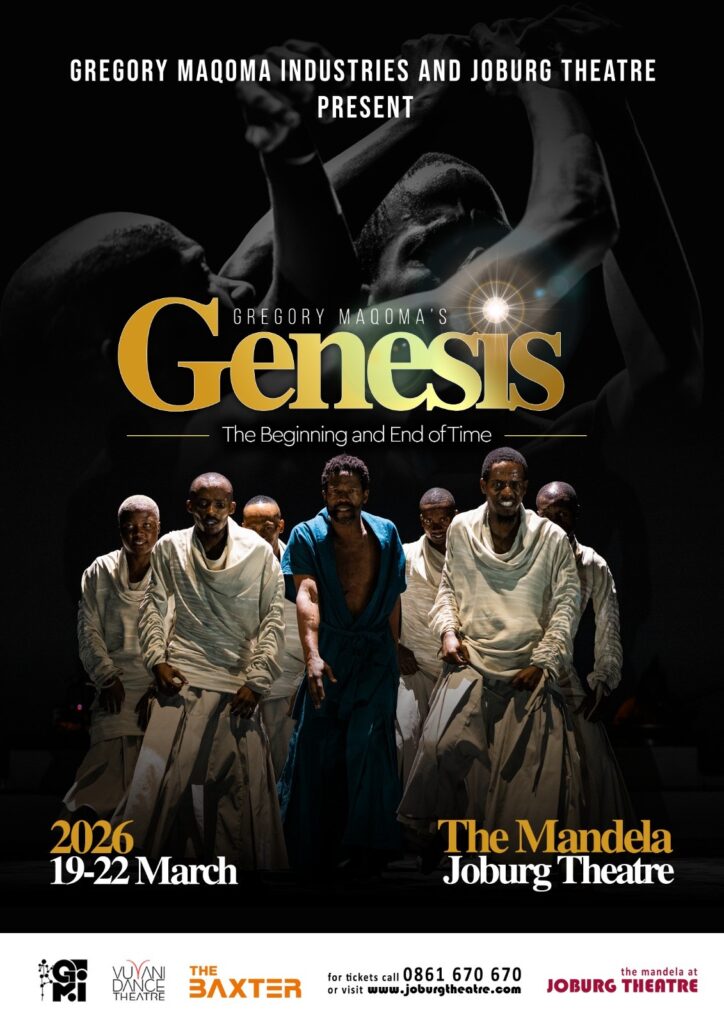
And every time, he proves me wrong. He is one of the few artists who consistently give more than you expect, and on Thursday night, March 19, 2026, at the opening of GENESIS: The Beginning and End of Time, I found myself in that familiar dilemma once again. The unfortunate part is that by the time you read this article, the show would have already lowered its curtain. I’m sorry if you missed the show. There will however be a next time.
Presented on the Nelson Mandela stage at Joburg Theatre, Braamfontein, the evocative and soul‑stirring production was nothing short of mesmerising. From the first note to the final movement, the show wrapped the audience in a world of sound, breath, rhythm and memory. The singing was haunting, the choreography electrifying, and the collective energy on stage so powerful it emotionally moved the audience.
GENESIS interrogates the cyclical nature of history, the complexities of human existence, and the eternal struggle for liberation. It draws from the revolutionary ideas of Aimé Césaire, Frantz Fanon and Steve Biko, and from the poetic resistance of Nina Simone.
Through a seamless fusion of movement, text and music, GENESIS becomes a powerful inquiry into the forces that shape human destiny. The work does not simply ask why history repeats itself — it embodies that repetition through cycles of rhythm, gesture and collective breath, revealing how unresolved traumas echo across generations.
Maqoma shows that the past is not a distant archive but a living presence, one that continues to shape, haunt and even threaten the future when its wounds remain unhealed. At the same time, the piece insists that within this very past lies a reservoir of strength: ancestral memory, cultural knowledge and spiritual resilience that can be activated to reclaim agency.
By drawing on these deep-rooted sources of power, GENESIS challenges audiences to recognise and resist the new, often subtle forms of imperial domination that persist in contemporary life. The work becomes both a warning and an invocation — urging us to confront the cycles that bind us while imagining pathways toward liberation.
The show poses difficult, almost unanswerable questions. It asks what it means to be born into a fractured inheritance, to carry histories that were broken before we arrived. It confronts the weight of generational curses, those patterns of pain and silence that seep through bloodlines, demanding to know how we might interrupt them, heal them, or finally lay them to rest.
And perhaps most poignantly, it asks how we forgive time itself — time that wounds, time that erases, time that repeats its cruelties with unnerving precision. These questions are not delivered as statements, but as invitations: to reflect, to reckon, and to imagine new ways of being beyond the shadows of what we have inherited.
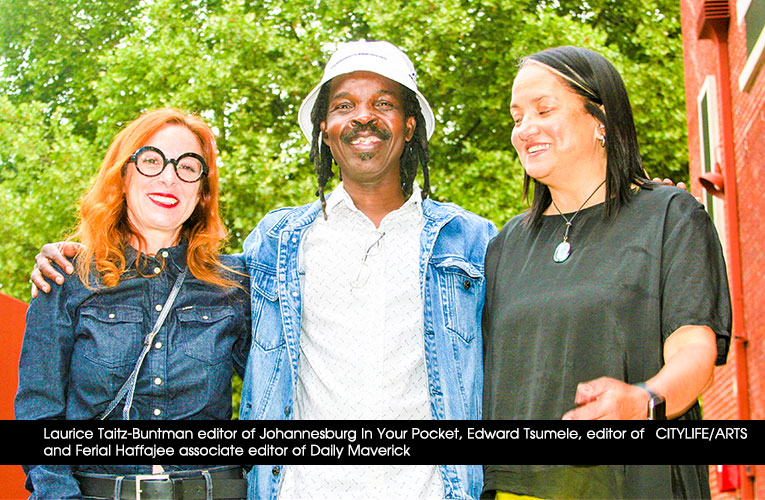
The language woven through GENESIS is deeply poetic, echoing the lyrical intensity which impressed the acclaimed poet and wordsmith Maakomele “Mac” Manaka who was clearly having fun — weaving his playful energy into the room.
In the show, Maqoma uses the geology of time idea to show that time is not linear but stratified. Geology of time suggests that time behaves like layers of earth — compacted, sedimented, and never fully erased. Just as the ground beneath us holds fossils, minerals and buried histories, the human body and collective memory hold the remnants of past experiences, past violences, past joys.
Maqoma is joined by a formidable creative team: poet and fabulist Karthika Naïr, movement analyst Shanell Winlock‑Pailman, the musicians of Ukhoikhoi, and musical director Nhlanhla Mahlangu.
The production’s visual and sonic landscape is equally striking. Set Designer Willy Cessa crafts an environment that feels both ancient and futuristic. The dancing was out of this world, a breath-taking display of precision, emotion and sheer physical poetry. Anelisa Phewa and Bongiwe “Mthwakazi” Lusizi were nothing short of extraordinary — each commanding the stage with a presence so powerful it felt almost otherworldly.