

Travelogue: Sampling the views and history of world-famous Serowe, made famous by South African-born writer Bessie Head
In this travel feature Shoks Mnisi Mzolo, retracing the footsteps of liberation struggle history and foraging museums in the land of millions of cows, classic literature, precious stones and wandering elephants.
By Shoks Mnisi Mzolo
The 300km journey from Francistown to Serowe, Botswana, is uneventful. The terrain is mostly monotonous. Livestock grazing at a distance is visible from here on the A1 – the national road that starts just east of this point, towards Zimbabwe, to proceed past Gaborone to the border with South Africa. We encountered a roadblock before turning right at Palapye: a police officer waved the bus driver off soon after exchanging greetings with him, and, along A1, two veterinary checkpoints for foot-and-mouth control.
From A1, I spot railway tracks and Motloutse River – almost parallel. According to archaeologists, Motloutse was a site of gold mining in the 1200s, the age of the Kingdom of Mapungubwe and Great Zimbabwe – two of Southern Africa’s ancient states.
Centuries later, in 1971, Botswana’s first diamond mine, the game-changing Orapa, began its life. Maru was also published in that year. Jwaneng was to become the world’s richest diamond mine by value. More on the book and the precious stone later. Botswana is renowned for its wildlife aplenty: buffalo, elephant, leopard, lion and rhino – the Big Five – as well as giraffe, hippo, impala, jackal, kudu lechwe, monkeys and zebra. Bird safari is as significant. Tourism is booming.
An astonishing 12% of the US$20.35-billion GDP is from tourism, which accounts for a tenth of the job market. At nearly 12,000 km² and teeming with north of 100,000 elephants, Chobe is larger than Jamaica. Botswana’s west is home to the expansive Central Kalahari, spanning a massive 52,800 km². That’s three times the size of Gauteng and equivalent to Burundi and Rwanda combined.
Nevertheless, cattle are the only four-legged beasts claiming Botswana’s horizon these days. However, there was a time when sights of wildlife were familiar. For one, Nelson Mandela and his comrade Max Mlonyeni felt they “were on safari” when smuggled to Botswana in January 1962. They saw “all manner of animals, including a battalion of baboons,” recalled Madiba, or, in those years, David Motsamayi, adding that they had even seen a lion. These days, you’ll have to visit wildlife parks for such sights or venture north, where it doesn’t take much to spot a giraffe or to see elephants crossing the road.
Mandela had travelled to Botswana en route to Algeria for military training. As an aside, Madiba received his first passport ever, in Ethiopia, from Emperor Haile Selassie. From the 1960s to the 1980s, Botswana was an oasis for freedom in a repressed region: Hage Geingob, Thabo Mbeki, Jacob Zuma, Samora Machel and multitudes of other freedom fighters transited to exile through these lands. Others, like one-time Turfloop student and Soweto teacher Onkgopotse Tiro, perished here – slain by Pretoria’s cross-border bloody machinery.
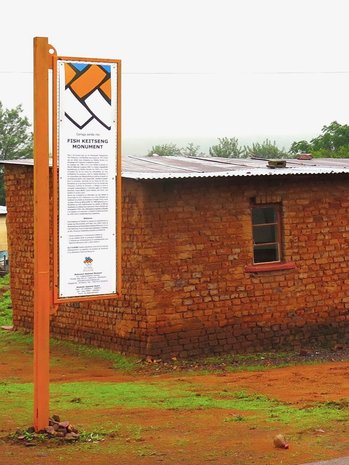
A house that once sheltered Machel in Lobatse is now a museum. Nearby is the Fish Keitseng home that offered sanctuary to Zuma, Mbeki and Mandela as refugees. Up in Algeria is a new Nelson Mandela Stadium that cost a cool €300-million. Dedicated to an Algerian-trained guerilla, Madiba, the 40,000-seater stadium was officially inaugurated in 2023.
Serowe, King Khama III and Bessie Head
Back to my destination, Serowe, a village founded in 1902 by King Khama III. In the 1990s, it was among sites cited by Unesco as possible examples of living heritage. Nothing came of that, but such a mention underscores Serowe’s historical richness. Thataganyana Hill and Khama’s home, now a museum, are must-sees for anyone keen on the story of the charming village and its people and the country’s march from disparate polities into the nation it is today.
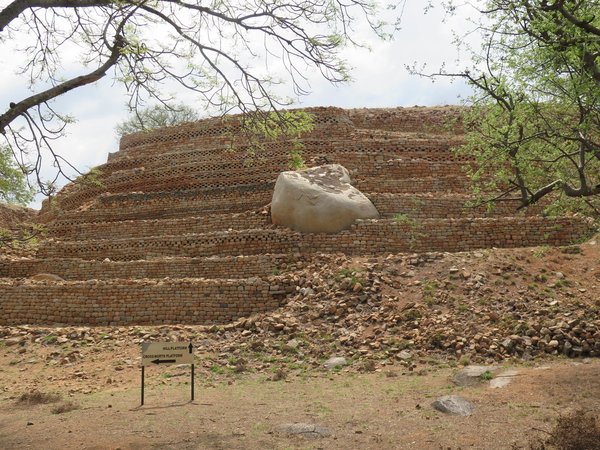
While Botswana was a portal to decolonisation for Southern Africa’s political activists, my reason is to track the rhymes of the past few centuries and ancient history. My previous stop, Khami Ruins – though just 200 km from Francistown, my base, took me back when those lands were home to an ancient civilisation. As any villager will proudly note, three of Botswana’s ex-presidents hailed from Serowe. Teacher-journalist-novelist Bessie Head, one of the region’s literary giants, settled here after fleeing apartheid in her native South Africa in March 1964. It was in her new country that her literary career was birthed and bred, and where many of her works are set. Also, it was in Serowe that artist John Koenakeefe Möhl, shunned in the south because of his heritage, bloomed.
My thoughts return to some of Head’s erudite works – and Möhl’s inimitable landscape paintings – as our bus advances in a southerly direction. Meanwhile, mercury climbs northwards to breach 30°C before 10 am on a Thursday one October.
Short green-brown trees claim the frame once in a while. Distant hills materialise once in a while. The land is mostly flat and dry. For one, the Shashe River, which hems Botswana and Zimbabwe before emptying into an arc-shaped Limpopo, is dry in parts, mimicking a sandy playing pitch. On that note, the sight of cattle is a tribute to Batswana’s ancient and modern water-gathering techniques. Semi-desert conditions aside, the trip is meditative. My emotion is that of going on a blind date. Serowe had been on my to-do list for decades. As I later learned, the history-rich village is clean, slow, crowded and likeable.
Upon arrival, I met Gase Kediseng and Kabo Jone (pronounced Johnny) at the Khama III Memorial Museum. Both are vested in Botswana’s centuries-long journey from pre-unification. Associate curator Kediseng, with facts and trivia on the tip of her tongue, joined the museum a quarter of a century ago. Jone, an ex-school teacher from Serowe and my guide for today has been here since 2010.
The single-storey museum was home to King Khama, Queen Semane, and their children, including Sekgoma II (the monarch’s son and successor). The museum chronicles the story of Khama, who led his Bangwato community from a dry Palapye. The latter was Khama’s capital from 1889 to 1902. It was at some point in those years, during the Anglo-Boer War, that the Zuid-Afrikaansche Republiek pursued Palapye. Khama was resolute. Records from the University of Botswana show that before sending his men to mount defence against ZAR, he warned the Boer belligerents to not dare enter these climes “with armed men” and to refrain from “my cattle-posts.”
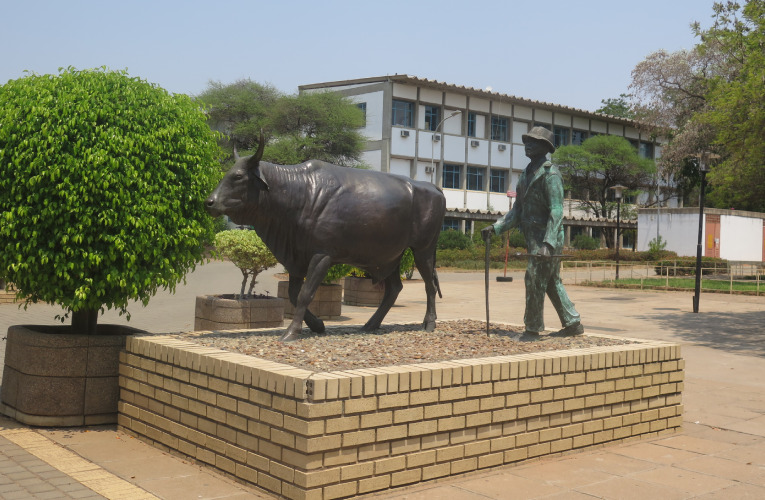
The economic and social importance of cattle endures amid worsening desert-like climate. The museum’s Kediseng harks to the ways people used to access water to sustain livestock. In fact, on the premises stands a borehole that, a century later, still provides water for the property.
Though set to defend their lands against belligerents, Botswana were welcoming to those who sought safety. That is how Bessie Head wound up here. During her stay in Palapye, where she sojourned as a typist, the New Statesmen published one of her works, “A Woman from America”. Unbeknownst to Bessie Head, she had begun the walk to the global stage. Accolades and recognition followed until she died in 1986 (aged 48) and posthumously. This year marks 40 years since her passing and, thankfully, her work continues to nourish one generation after another.
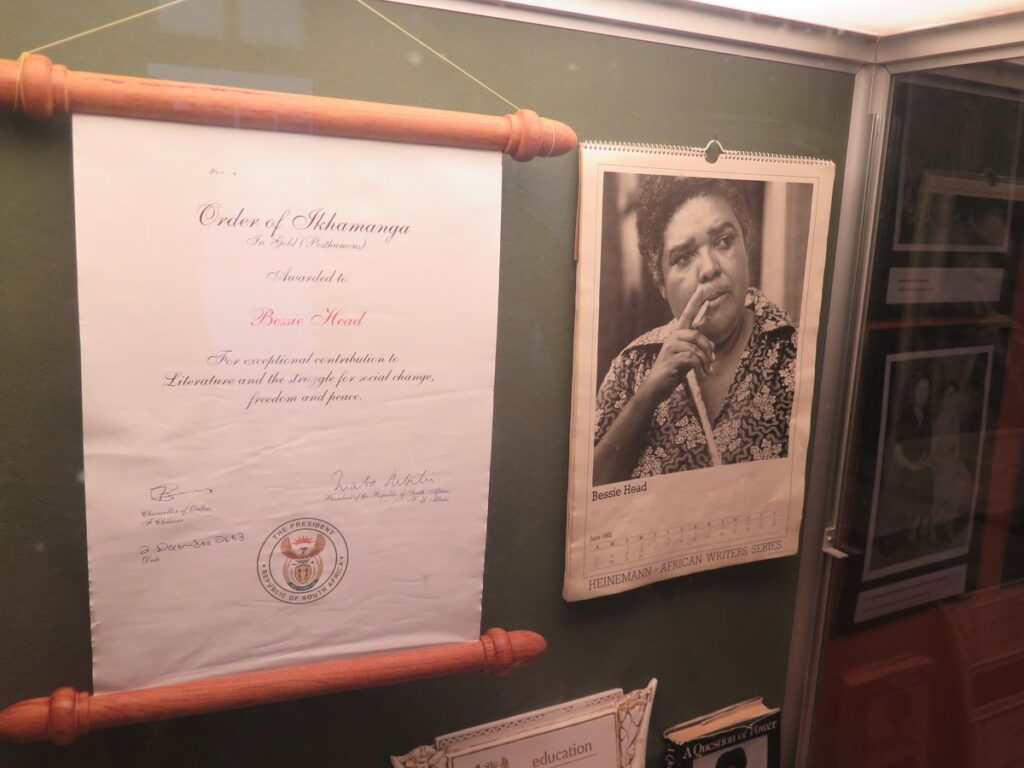
It was in 2003 that Head was awarded the Order of Ikhamanga, the presidential award for excellence. Head is survived by a list of literary works appearing in many languages (from English to Japanese and Swedish). Further, the 1990s saw the publishing of her works like A Woman Alone: Autobiographical Writings. Added to stints in Palapye and Pretoria, the Pietermaritzburg-born Head worked as a journalist in Cape Town and Johannesburg as a teacher in Durban and Serowe.
The latter vaguely resembles Dilepe, a fictitious village in her Maru – a story of bigotry and love set in Botswana. The book was published 55 years ago. While similarities between the author and Margaret Cadmore, a teacher in Maru, are apparent, Head’s reality is detectable in Makhaya, a political-activist protagonist in When Rain Clouds Gather – her debut novel, published in 1968.
In real life, Bessie Head faced über prejudice, a recurring theme in her works. Like Trevor Noah, whose birth was considered a “crime”, the author was born to African and European parents.
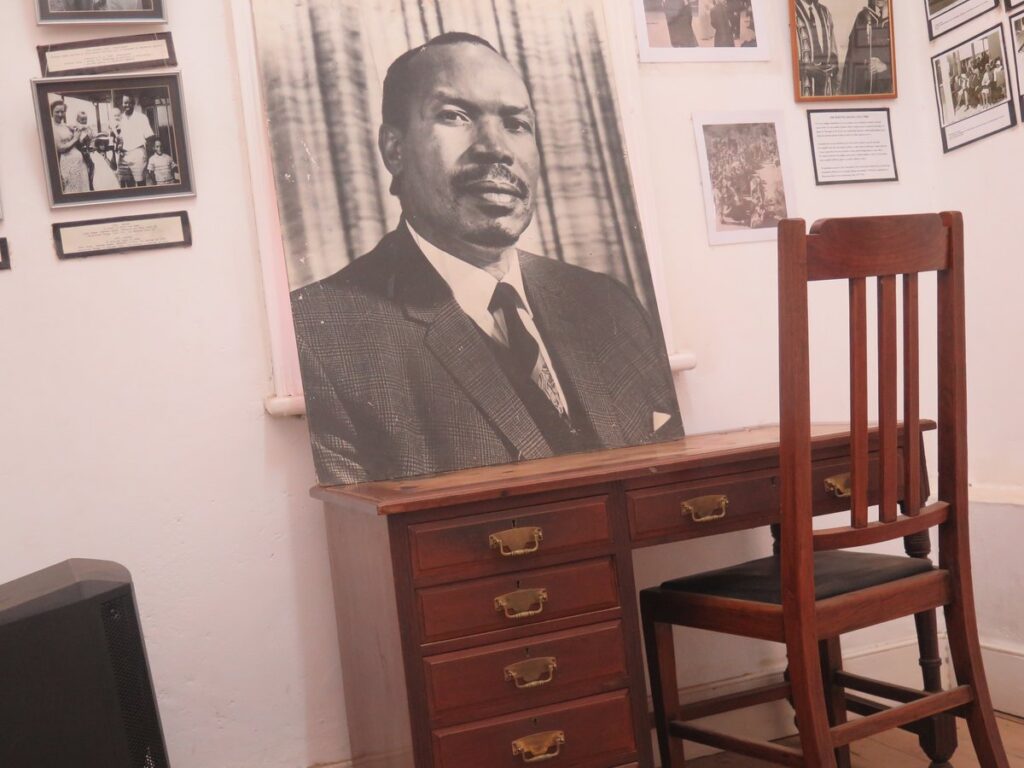
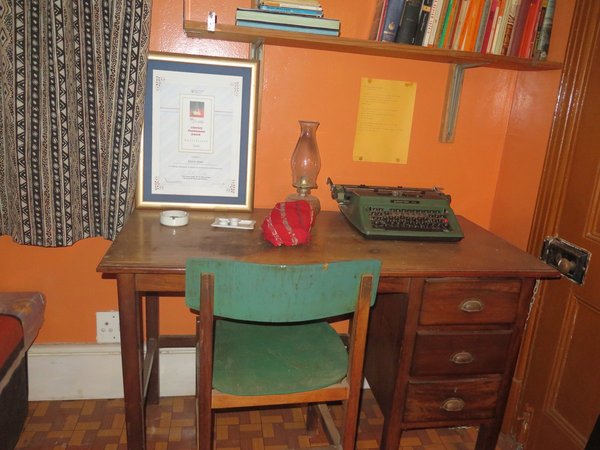
Unlike Noah, though, Head never met any of her parents’ families. She was separated from her mother when the author was born on July 6th, 1937, in Pietermaritzburg in then-Union of South Africa. That polity that – under the dictatorship of Barry Hertzog and King George VI of England – also occupied Namibia. Given that discriminatory system in then-union, Head endured prejudice from a young age. That’s more than 1,000-km south-east of this world-famous village. The museum in Serowe is a repository of her papers and preservation of her story. Adorning the walls of the Head section are images of the author over time. On her desk are different effects, not least two main but humble assets: a typewriter and a kerosene lamp.
Although their oeuvres are not similar, the author’s work brings to mind Buchi Emecheta. It must be the underlying and essential tone of women’s hardship. They both transcended their sufferings to be counted among the finest.
Inside Khama III Memorial Museum
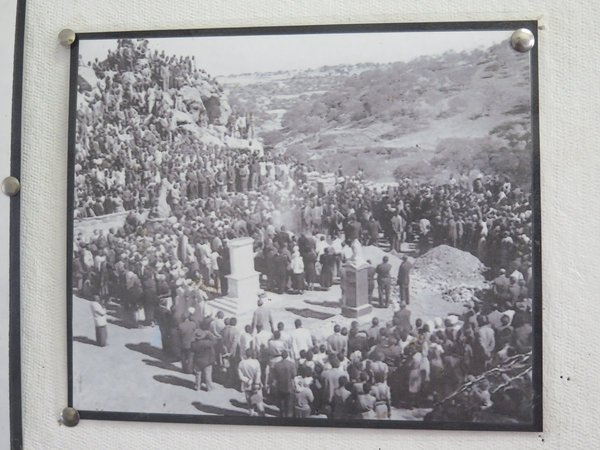
In the main section of the museum, black-and-white and coloured photos, with the aid of an insightful guide, bring to life Seretse Khama – the future first president and scion of the monarch. It also takes visitors to the era of the trials and tribulations his family endured, as told by Michael Dutfield in A Marriage of Inconvenience: The Persecution of Ruth and Seretse Khama, and apartheid-era Pretoria’s blot on that page of history.
Jone explains how Pretoria and London conspired to persecute the man for his “crime”: marrying Ruth Williams. Yes, interracial marriages were considered a crime even in Botswana – the land which had escaped colonialism’s worst.
As regent-king, Seretse’s uncle, Tshekedi Khama, also got a taste of racism as soon as the imperialists found a pretext to strike. British admiral Edward Evans “ordered 200 marines, fully armed” on a 1,800 km journey from Cape Town to Serowe, noted Dutfield. Here, Tshekedi was publicly axed for “exceeding his authority by punishing a white man”.
Next is a photo of the nation’s first all-male Cabinet. “Only 11 people,” Jone remarks. “Look around to see what they achieved.” I do so and concur. But there are a lot of other things that have gone wrong. I later discovered that while the country’s GDP per capita is among Africa’s highest, the Cabinet has grown disproportionally, and the number of people languishing in poverty hovers at 15%. Botswana is sparsely populated and has had a legitimate, stable political setup since attaining independence in 1966.
Coupled with falling life expectancy (from 67 years to 61 last decade versus Mauritius, at 74-75), poverty levels are an indictment. Head would have gasped at the number of people who remain “attached to hunger struggles ’til sunrise”. In recent decades, Botswana’s leaders have merely tinkered at the edges of the problem. The Guardian Sun writes of alarming dropout rates amid free schooling—iffy prospects lurk. Factors like poverty are blamed for dropouts, underscored by a 54% plunge in secondary school enrolments versus primary school enrolments. A vicious Catch-22 situation is at play.
Back to the beginning of my visit to the museum, a British researcher – with Caribbean and African roots – is sifting through some old papers as part of the museum’s digitisation project. At this point, Jone leads me to a plain pink-and-white room for community events. Then, it’s off to a room with woven baskets of all sizes. Adorning the walls are relics from the 1800s and portrayals depicting ancient village life.
Politics meets economics
Switching to politics and economics, Jone, flashing a knowing smile, reminds me that diamonds were discovered here in the post-colonial era. “God hid our mineral resources [from Britain],” he says, singling imperialist Cecil Rhodes, whose legacy of dispossession and looting continues to haunt the 21st century. To Britain’s question of how the country would survive without mineral resources, ruling classes pointed to hoofed assets.
“They said, ‘We have cattle, and that is how we’ve survived for generations. We’ll keep surviving’,” Jone notes. The importance of such assets is underscored by the fund-raising campaign in the 1970s to build the campus of the University of Botswana – the country’s first. The clarion call was “Motho le motho, kgomo”.
It underscores the role of the beast among the post-colonial society’s building blocks. “It was only after independence that we discovered diamonds,” explains Jone before he taps the province of imagination. “What would have happened if the diamond was discovered while Rhodes and his company (still) ran the show?” But, over-dependence on diamonds remains an issue. Distributing wealth to lower levels has been slow, leaving the door wide open for social ills such as substance abuse, teenage pregnancy and so on.
Jone explains that Rhodes’ open aggression and looting prompted Khama, Bathoen, and Sebele – monarchs of neighbouring Setswana-speaking polities – to meet Victoria II of England in 1895 to get her to “protect” their lands from grabbers. The trio had learned from Lesotho’s Moshoeshoe I, who sued for peace in 1852 after routing the Anglo for the second time. Fast forward to the 1890s, colonial land grabs ruled. So did the subjugation and demolition of African states. The death of King Lobengula ka-Mzilikazi during the war with the Brits opened doors to colonialism for Zimbabwe. A few years later, Germany had unleashed “collective punishment” on Namibians for resisting slavery. In 2023, more than 100 years later, Measure of Men retraces that era.
The South did not escape slavery either, from Cape to Limpopo. Botlhale Tema’s People of Welgeval offers an eye-level perspective on South Africa’s serfdom and human smuggling. The story of slavery that bled Congo requires a library of its own — two decades of Belgium’s Leopold II era of mutilations and massacres claimed millions of lives in Congo.
So, by all accounts, the Botswana leaders had very few options. “This was a big deal for the chiefs. They wanted to go [to London] on their own,” Jone says of the 1895 voyage. “They fastened their shoes and set off, saying only: ‘Maybe we’ll come back alive, maybe not’.” It was a troubled period.
Dumelang Mma-Swaneng, Rra-Swaneng
Although Botswana’s desert-like climate has worsened today, bovines outnumber their two-legged cousins. The museum’s Kediseng later explores how people accessed water to sustain livestock. Migration was another way, as exemplified by the exodus to Serowe. It was here, an area they named after a water-rich plant, that they found water. On the museum’s premises stands a borehole which, a century later, still provides water for the property.
Five hours later, I surrender to the present on a tour that included Thataganyana Hill. Traffic is building up, and the temperature is cooling down. Newspapers speak of heated national politics.
While atop Thataganyana, I spotted the famous Mma-Swaneng and Rra-Swaneng hills, notable for standing side by side (like mother and father, hence Mma and Rra), and the sizeable world-famous village: home to three of Botswana’s former presidents and one of the region’s most-celebrated authors. Up there, stillness is palpable.
.Shoks Mnisi Mzolo is a roving storyteller with a background in arts & culture and financial journalism. He also works as an independent researcher and is an avid traveler.