





Photography exhibition shows ancient Italian shrines co-existing with modern communities in towns and cities
CITYLIFE/ARTS, therefore recommends that you go visit Edicole Sacre & Postcards in Italy, in Melville and discover a different side of Italy through photography. You might even be surprised how ancient Italian cultures have common resonance with African cultural practices, such as building an indumba through which you can communicate with the ancestors.
By Edward Tsumele, CITYLIFE/ARTS Editor
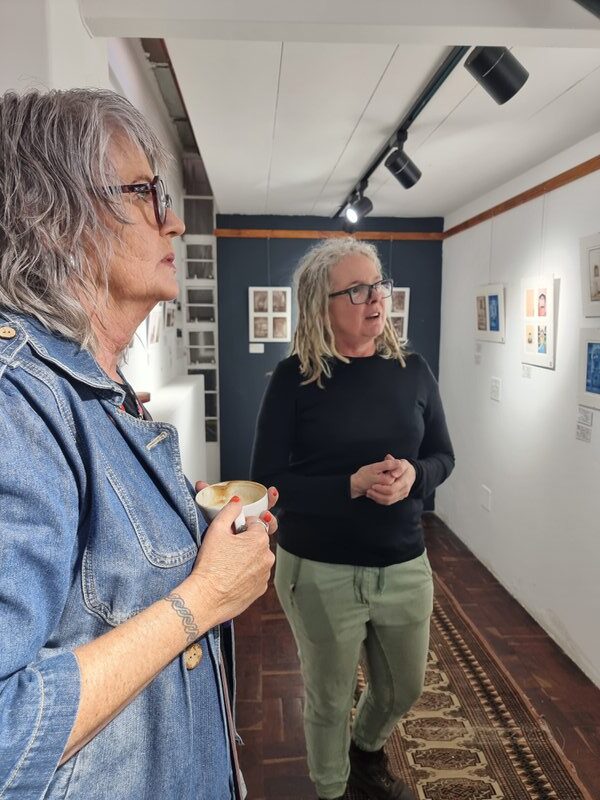
Main Picture: A guest (R) passionately engaging photographer Genevieve Maynard (L) while a child’s attention is drawn to a photograph on the wall.
Italy. Well, ordinarily, a lot of us when we think of this European country images of Italian Mafia meeting conspiratorially in dark corners and drug endemic night clubs, start emerging in our heads. We may not admit such wild thoughts publicly, but reality is they do get triggered in us subconsciously. You can blame such thoughts on the movies that have been made, and have portrayed Italy as one of the global headquarters of the mafia.
While that must be the first thing that comes into your head, it is however not the only thing.
The Catholic Church. It does not really matter whether your faith lies with the Roman Church, but you will nevertheless immediately associated Italy with the Catholic Church. It is where its headquarters are, and it has the biggest followers of a religion in the World, headed by the powerful Pope.
A place where modernity meets ancient. The truth about Italy though is that it is diverse. Top fashion brands have been created there. Top art, has been created there. After all, one of the most distinguished artists that ever lived on earth, Leonardo, hailed from Italy. The most prestigious global art showcase, the Venice Biennale, takes place there. Regarded as the most prestigious art showcase, where the best of the best of artists from around the world, are usually selected to represent their country there. And so, the biennale, is as much about showcasing artistic talent, as it is about national pride, and countries normally regard it as a diplomatic tool to engage with the rest of the civilised world, through parading their best art, featuring their leading current conversations seizing the contemporary world through their art.
In short, Venice biennale, is an event which every country that takes itself seriously, with regards to its level of civilisation, should not miss participating on the platform, which takes place every two years.
It is therefore understandable when last year many were left disappointed by an official decision that saw South Africa unrepresented at Venice Biennale. Despite all plans that were put in place in preparation for South Africa’s participation at the biennale, it did not happen at the end. The South African curators charged by the Department of Sport, Art and Culture, to man the South African pavilion, were left instead holding on straws when that executive decision was reached. The South African pavilion after so many years of successful participation by South African artists, remained empty during the biennale. It is said to have cut an odd structure among busy stands, representing their countries through their art, according to those who visited Venice this year.
The reasons are complex, but basically, the DSAC decided rather that the pavilion would rather be empty instead of being busy like those of the rest of the countries participating. Reason being that as the sponsoring government department for the pavilion, Minister of Sport, Arts and Culture, Gayton McKenzie did not agree with the choice of the artist to represent South Africa at the Biennale, Gabrielle Goliath. He disapproved of some aspectsof the content of the work she created for the pavilion. Not that the work was substandard, but rather, in his eyes, it was too controversial to be displayed there.
At a glance, the work should have been hailed as it raised a number of current issues seizing South Africa at the moment –Gender-Based Violence and the conflict in Gaza, raising the violence affecting especially children in the ongoing Gaza conflict between Israel and Palestinians. In fact, that aspect of her installation is said to have caused the minister’s ire.
But today, this article is not about that, but Italy, its culture and traditions.
You see, Italy’s towns and cities are sites where the ancient world, lives parallel to the modern world. Apparently, not in contradiction with each other’s existence, but telling the country’s past as powerful as it tells the country’s present and projected future.
I have not been to Italy myself, but viewing Genevieve Maynard’s exhibition titled Edicole Sacre & Postcards in Italy, which opened on Saturday, August 29, 2026 at Gallery 1903 @Die Pienk Kerk, 24 Chatou Road, Melville, just managed to place me right in the heart of Italian culture. Both ancient and modern. The exhibition, is running till September 23, 2026.
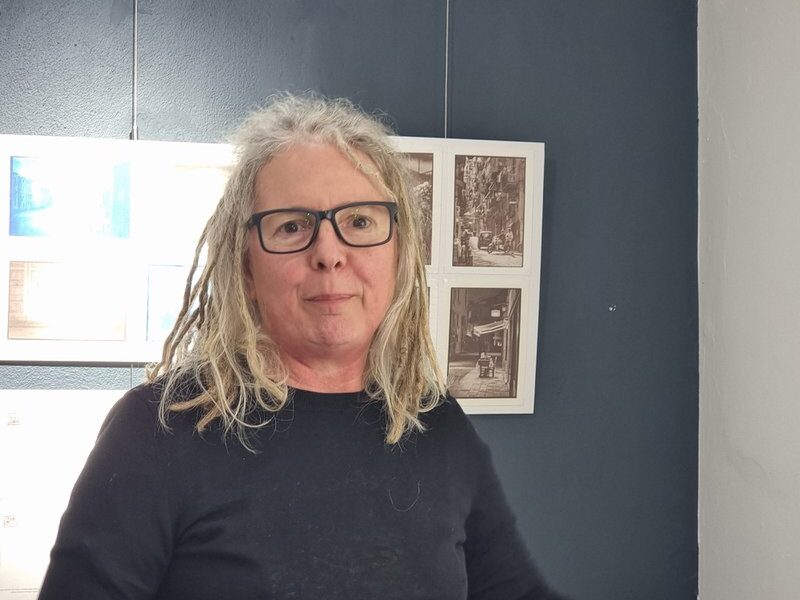
The exhibition brings together two bodies of photographic work, created across Italy over the past eight years, using hand-printing processes.
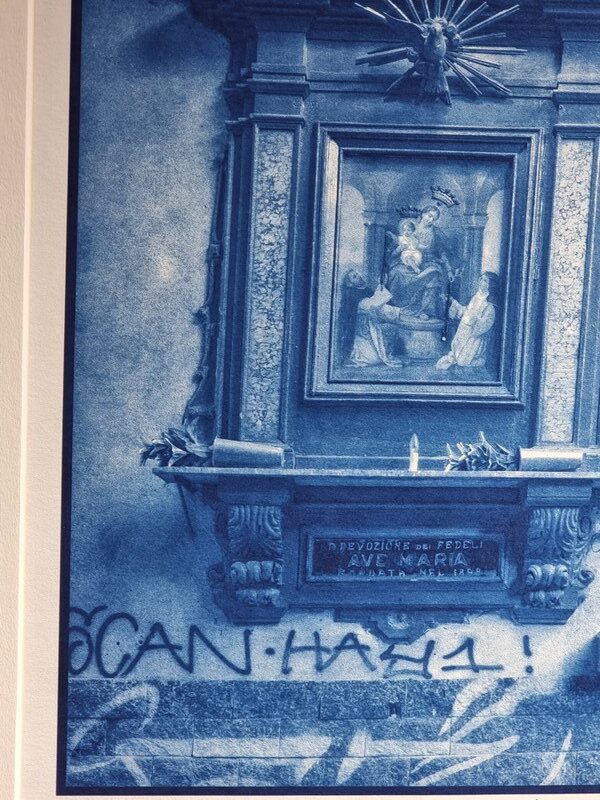
Edicole Sacre explores Italy’s road shrines and their connections to the community, culture and faith. The shrines, according to Genevieve, are scattered around big towns, small towns and cities, and exist undisturbed by modernity, which mainly defines life in modern Italy.
These photographs, some in small format, while others are in medium format, have been meticulously hand-printed, creating a feeling of the past. An ancient Italy that comes out vigorously. It is as if one is taking a tour of what ancient Italy looked and felt like through viewing a number of these photographs depicting shrines. These small but historically significant places are fascinating records of history. That is quite clear.
What is not immediately clear, but soon shows itself unmistakeably as you start focussing on each work, lingering a bit longer with each work, is that in them, you can also see modern Italy.
For example, a photograph of one particular shrine, that shows images of Christ and other objects that formed part of what was clearly a home of a religious family, there is also graffiti that has been painted on the shrine. However, the graffiti has not been painted over the objects in this shrine, but below. Clearly with the artist respecting the sanctity of these shrines. It is as if the graffiti artist understood that he could not cross a certain line, when it comes to the boundary between the dead and the living.
So what you make out of this exhibition, especially the part that depicts the shrines, some of them over 100 years old, is modern Italy’s capacity to accommodate the past. There is a sophisticated level of accommodation of each other. The past and present are co-creating the future. The co-existence of these two civilisations is smooth, achieving a level in remarkability in that the inherent tension between these two worlds has been contained and harnessed to map out the future together than working against each other.
“Of course there has been reports in Naples, a city notorious for being a predominantly home for the Italian Mafia. A recent news report carried a story whereby the Italian mafia built their shrine on top of a building that is 2000 years old. The authorities of course acted, forcing them to pull down their structure on this historically valuable building,” said Genevieve.
The Postcards in Italy portion of this exhibition, offers a different perspective on the Italian landscape, inspired by Pictorialism and the New Italian Landscape movement associated with photographer Luigi Ghirri.
The series touches on the romantic side of Italian life, inviting the viewer to slow down and experience Italy beyond the hurried pace of modern tourism.
With Italian heritage through his great-grandfather and regular visits to his family in Italy, the photographer brings a deeply personal connection to the landscapes and communities captured in these works.
Though the curators of this exhibition have framed it as an exhibition aimed at the Italian diaspora in South Africa, it is an exhibition that many South Africa would find connection with, especially when it comes to the issue of the respect for these that have passed on and the shrines that some build in their homes, are ways in which they communicate with their ancestors, a widely practiced culture in South Africa by especially black communities.
CITYLIFE/ARTS, therefore recommends that you go visit Edicole Sacre & Postcards in Italy in Melville and discover a different side of Italy through photography. You might even be surprised how ancient Italian cultures have common resonance with African cultural practices, such as building an indumba through which you communicate with your ancestors.
.Edicole Sacre &Postcards in Italy, is on from 29 August -23 September, 2026, at Gallery 1903@Die Pienk Kerk, 24 Chatou Road, Melville.