





It is official: Music icon Sipho “Hotstix” Mabuse’s biography Soweto Jive is on its way onto the bookshelves
“This is not going to be a classical biography. I feel honoured to be the one writing this biography that I have been working on in the past two years, having held several conversations with Hotstix Mabuse as well as researching archival material about Mabuse. The next phase will involve interviewing fellow musicians of his, family and friends,”Mahala said.
By Edward Tsumele, CITYLIFE/ARTS Editor
Pictures: Courtesy of JIAS
Soweto born, raised and based music icon, Sipho ‘Hotstix’ Mabuse, is highly regarded for his resilience, the ability to adapt his craft and stay in the game, in a career stretching over six decades.
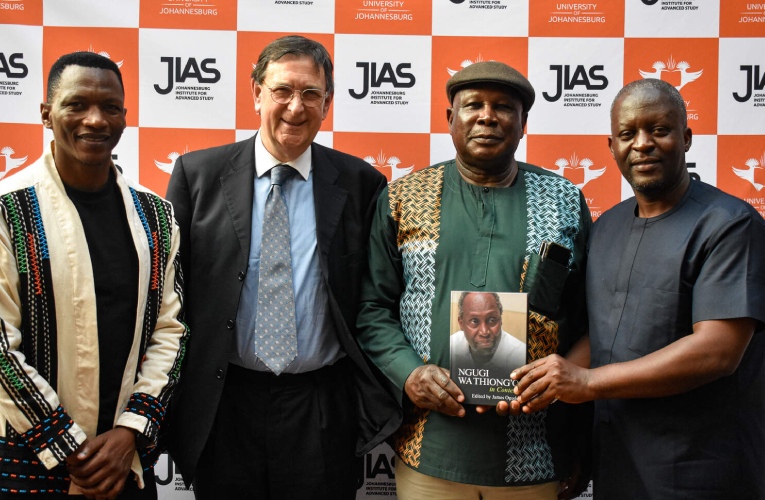
His life and times, are currently being documented to be released in a biography being written by academic and author Siphiwo Mahaha. Mahala is associate professor in the English department at University of Johannesburg, and is currently acting director of Johannesburg Institute for Advanced Study (JIAS), affiliated to UJ.
However Mabuse’s biography, is not going to be a classical biography, a packed UJ APK Library, Chinua Achebe Auditorium, was told on Tuesday, 15, September 2026. This was at a seminar titledSounds of Soweto – The Decolonial Rhythms and the Multicultural Roots of Sipho “Hotstix” Mabuse’s Music, hosted by JIAS in collaboration with UJ library.
Mahala used the seminar to introduce his manuscript about the life and times of Mabuse, titled Soweto Jive. Once completed, the manuscript will culminate in the publishing of this much awaited biography of one of the country’s revered music icons from Soweto. The book will be published by UJ Press, through the Vice Chancellor’s African Biographies Project.

In his elaborate presentation, Mahala was clear that Soweto Jive, was a biography that is different from other usual biographies about famous people in public imagination. His is a biography that approaches documenting the 75 year old musician’s life in a way different from how often biographies are written and published.
“This is not going to be a classical biography. I feel honoured to be the one writing this biography that I have been working on in the past two years, having held several conversations with Hotstix Mabuse as well as researching archival material about Mabuse. The next phase will involve interviewing fellow musicians of his, family and friends,”Mahala said.
The audience, which predominantly comprised young people, mostly students, academics, activists, and the media, were given an insightful glimpse into Mahala’s thinking around the project.
Linking Mabuse’s music to Decoloniality Theory
The nature and complete perspective of his approach to producing this biography, will only emerge once the book is out and in the hands of critics. However, from Mahala’s presentation, it can safely be concluded that, Mahala is treating the project as indeed more than a biography, but a scholarly work drawing from decoloniality theory, which in the past recent years, has attracted a number of scholars as a tool to delink African intellectualism from the Western convention of framing knowledge production and learning. In a way, this intentional academic exercise by an increasing crop of decoloniality scholars, is an attempt to rescue African-centred knowledge production from its traditionally entrenched epistemological practices emanating from the West.
From his presentation, Mahala appears to be intending positioning the writing of the Soweto music icon’s biography, within the broad framework of the struggle of Soweto residents’ long held yearning to define their identity and the right to practice their rich cultures without the stifling environment created by the Apartheid government and imposed on township folk prior to 1994.
Mahala therefore, it would seem from his presentation, intends to locate Mabuse’s art practice, within the framework of the struggle for freedom and self-determination, not only by Soweto residents, but by the broader population of South Africa during the struggle for freedom. Studying Mabuse’s music, its message and influences, therefore, appear to be part of what will formulate central parts of this book.
Hence during his presentation, Mahala framed Soweto as more than just a geographic place, but an idea not confined to its geography, but going beyond as far as examining issues of self-determination, and the right for people to practice their diverse cultures, without the interference of Western cultural practices are concerned.

So Mabuse’s music, it seems, Mahala intends to position it in the biography as part of the struggle for freedom by the oppressed. The music that Mabuse produced, is thought of in the framing of this biography project by Mahala, as rooted in and influenced by the aspirations of the people of Soweto, a place he has lived in for a long time, and which has shaped his development as a musician and an underground political activist during the struggle.
And indeed, Mabuse played an underground, and even a risky role during the struggle for freedom. Such as passing information from those exiled to their families and underground operatives back home. This is as he travelled to perform around the world, including traversing the US, and UK, among other places. It is in these areas where Mabuse got in touch with South African exiles, Mahala explained.
Mabuse therefore, took advantage of his ability to move freer than others from South Africa at the time, because of his role as a musician who had access to spaces and places with little suspicion raised of being involved in the struggle. Yet in reality, he was an underground fighter. An activity he carried out secretly as he entertained several people on stage around the world at the same time, alongside his underground political work.
For example, a story was told of how Mabuse managed to fool police on the road block who stopped the vehicle the band was travelling in towards Botswana, searching it, but missed a stake of grenades and other war weapons hidden in compartments in the speakers. That must have been a close shave with the authorities for Mabuse and his fellow band mamebers.
The formation of The Beaters
Mahala in his presentation sketched the journey of how Mabuse and his colleagues formed a popular group called The Beaters while they were still high school students in Soweto. It is a group that became so popular and some band members, such as Mabuse had to leave school to focus on the music.
Harari
Mahala told of how the Beaters morphed in to Harari, when they relocated to then Rhodesia, that became Zimbabwe in 1980, where they were based in then Salisbury, now Harare. They were a big hit in that part of southern Africa, living in the townships but ironically, mainly performing for affluent whites in their posh hotels in segregated Rhodesia of yesteryear.
“I would though like to correct the misconception that is repeated several times by various people, when it comes to the name Harari. The band was not named after a township in Salisbury. There is a phrase in Shona that goes like munhu Harari. It means a person does not sleep. Indeed during our time in Rhodesia, we were so busy performing in fully packed venues for white people, we did not sleep,” Mabuse explained how the Beaters morphed into Harari, once they were in Zimbabwe, till 1983, when the band broke up, came back home, and Mabuse pursued a solo career till today.
Mabuse in response to Mahala presentation went on explain the road that The Beaters travelled in their musical quest, including being owed royalties by a recording company that had signed them.
“That is why young musicians today, must always seek legal advice before they signed a contract,” Mabuse counselled.

However, there were also humorous moments during the conversation.
“People often ask me why is that I have not moved to the suburbs. I actually I lived in the suburbs when it was not fashionable to do so during apartheid. I once lived in Parkhurst. The point I want to make is that I like living with the people so that I can create music that is informed by the daily experiences of our people in the township.
However though Mabuse spoke of the danger of young artists being burnt, especially when it comes to the issue of contracts, such as the one The Beaters experienced when they were not paid their royalties, there were also moments of light.
“When we signed with an international American recording company, we were paid an advance fee,” he took a deep breath, seeming to survey the room for a reaction, and when uncertainty on the faces of the audience was the answer given to him, he continued. ”Guess how much it was?” The room was quiet before he went on.
“It was US500 000 dollars.” The room went silent again. But this time, not due to uncertainty, but in shock as it sunk in that US 500 000 dollars paid to young Soweto musicians in their teens, was quite a lot of money.
But Mabuse was not done yet. He is a man of banter as he went on to explain how he ended up playing drums for The Beaters.
“We had played at a school the previous day and we met to discuss the show. And one of the band members acknowledged that we had done well, but the absence of a drummer in our band was being felt.
“Well, I said I could play the drums. I actually played rums from there, and I was actually hot at the time. That is how I ended up with the name Hotstix.”
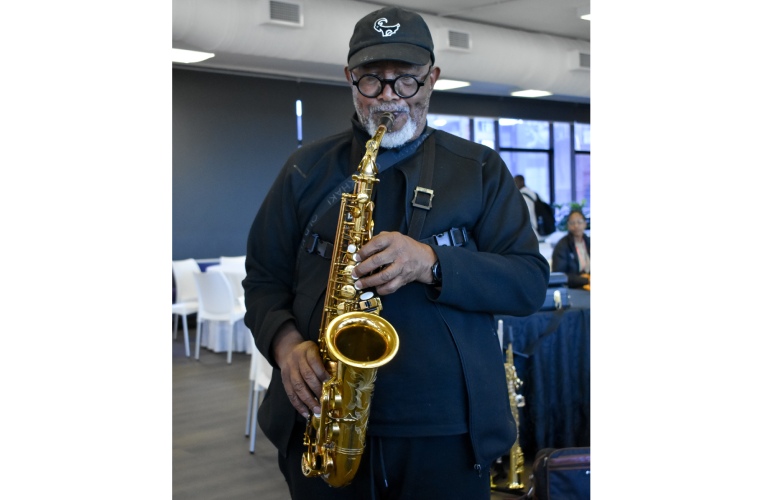
And of course, as a solo artist, has blazed a successful career as a multi-instrumentalist at ease with the saxophone, the flute, the piano today, and his repertoire is rich, with a number of hits, particularly his most popular song Burnt out.
And just incidentally, one of the audience member, who was in Zimbabwe in exile when Mabuse and his band were living there, confessed that she loved particularly Burn out, to the extent that she missed him whenever it played, and she was therefore proud to be a South African by merely hearing that song.
“In response, Mabuse asked his keyboard player to perform with him Burn out. Suddenly there was a mini-make-shift jazz club, complete with an ephemeral dance floor in the Chinua Achebe Auditorium, with the said lady leading the choreography as others joined from where they were seated.
And so, it is now official, Mabuse’s biography, Soweto Jive, penned by Prof. Siphiwo Mahala, is on its way. You better watch out for it soon.