



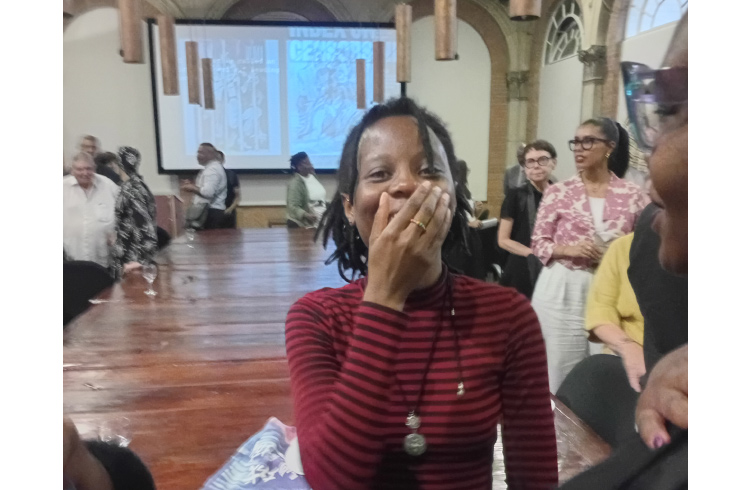

Poet and literary scholar Nelson Ratau makes literary history by launching two books on one day at Johannesburg Institute for Advanced Study
The launch became a site of dynamic academic rigour, intellectually engaged conversation, and most importantly, a discussion which centred African indigenous knowledge, situating it within the broader framework of global epistemologies, as opposed to its often marginalised position that the Western convention of knowledge practice and production, often relegates it to.
By Edward Tsumele, Winner of NHC Heritage Journalism Award 2026
Picture by Molelekeng Mothusi/JIAS
In the 1990s when the late medical doctor and writer Gomolemo Mokae launched two books on the same day, that literary feat made the headlines.
Understandably so. Writing is hard and it takes more than just talent, but also discipline, dedication, and sadly is a lonely undertaking. Very lonely in fact. Ask any writer, he or she will tell this.
Fast forward to Thursday, November 5, 2026, young academic and poet, Dr Nelson Ratau, repeated Mokae’s literary achievement three decades ago, when he launched two books at the Johannesburg Institute for Advanced Study (JIAS), an affiliate of University of Johannesburg in Westdene, Johannesburg.
The two books are Barefoot and Bright, a poetry anthology that traces three phases of his life, focussing on the role she played in his life as a single mother, till adulthood, when she passed on, and Every Worldview is Superstitious, an examination of Ben Okri’s literary works.
The launch became a site of dynamic academic rigour, intellectually engaged conversation, and most importantly, a discussion which centred African indigenous knowledge, situating it within the broader framework of global epistemologies, as opposed to its often marginalised position that the Western convention of knowledge practice and production often relegates it to.
I have not yet bought and read his two books, but will soon do, because hearing him unpack what he regards as relegating African writers to an inferior position within the academy, at our universities, was enough provocation to trigger me to want to know what more he saying in his two books:
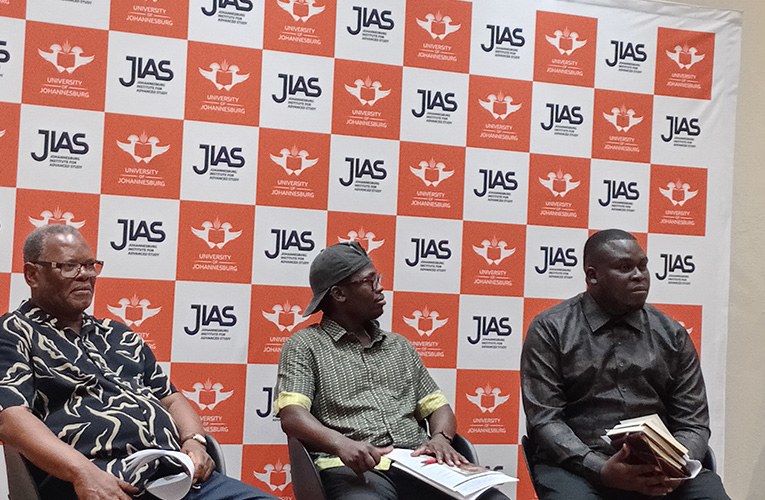
To assist him, he had fellow travellers, intellectual giants on their own right, and some of the sharpest minds on the local intellectual scene, young intellectual spark, Prof Moffat Sebola, and well known political commentator and academic Prof. Sipho Seepe.
Both fellow discussants in their brief introductory lectures, for their presentation had the appearance of such, instead of just a reflection on the writer and his work, they positioned Ratau’s writing within the decoloniality frame, from his poetry to his incisive critique of African literature in general, and the literary work of Nigerian born novelist Ben Okri, Wole Soyinka and Ngugi WaThiongo, among others.
Basically, Ratau’s scholarly and literary ideas are based on the assumption that the Western normative epistemic practices, often relegate whatever knowledge Africans have had over many years, based on their experience of life, observations, and their philosophical basisi as largely irrelevant in global knowledge production, but just superstition.
However, Ratau counters that in his books, and in fact suggest that all knowledges start as sets of assumptions, based on a particular society’s belief systems, culture and philosophical self-definition of who they are and the whole question of their existence.
“What I am doing with my work is that I am building an African archive. That is why I am examining Ben Okri’s work so that students can read his work and understand that his work is full of African myths. And when we talk about African myths in this context, we are not talking about the antithesis of truth. In fact, the Europeans in their impositions of their culture to us, they did not know that they were also superstitious. This is because there was no empirical evidence from which they could build their knowledge in the first place,” Ratau supported why he believes that superstition is in fact, a universal phenomenon imbedded in the evolution of all human societies.
Seepe weighed in and suggested that Africa underdeveloped intellectually because its scholars always sought Western affirmation for their scholarly work, a practice that manifests itself through rankings and publishing in academic journals whose editorial control is in the hands of the Western academy. He call that mimicking the Western scholars with no regard to carrying out originl research based on finding solutions to local problems for the benefit of immediate African communities.
“’This has resulted in a situation whereby what the African scholar produces in the form of an academic paper is in fact, an extension of what the question a professor (in the West) asked, and therefore, is not the original work produced by an African researcher to find a solution to a local problem,” he argued.
Sebola, who had been a classmate of Ratau at University of Limpopo in 2012, said that Ratau’s poetry has the ability to answer questions that the academy fails to answer, referring particularly to the multi-dimensional praxis of a poet.
“’A poet can write himself into a poem as a witness to trauma. But a poet can also write as someone who has encountered trauma personally. For example, in Rantau’s anthology, he writes about his mother, referring her as the Village Queen. In that context, he is a witness,” he said.
This was indeed an intellectually stimulating conversation, that felt more than a book launch, but a diagnosis of what has gone wrong in South Africa in academic halls, where the culture of intellectual inquiry, according to Seepe, has died in the past 32 years, replaced by managerialism, that is rewarded over scholastic research.
Seepe however, praised the emergence of young thinkers and academics in halls of learning, such as Ratau and Sebola, making the claim that despite the decline of an African scholar since 1994, the future looks bright.
“Unfortunately, the position of Vice-Chancellor is tied to a higher salary as compared to teaching. We therefore, now find corporate language within the academy whereby a Vice-Cahncellor gets paid well, just like the CEO of a company. That is why when their terms are finished, they never go back to their departments to teach. Therefore, a person like Ratau, a scholar, should remain in teaching, and not in a managerial role. But unfortunately, that is where a higher salary is located,” reflected Seepe.
Indeed,m this discussion was robust and left no stone unturned, and there were no holly cows, as an academic discussion should be.
Perhaps, at this junction it is appropriate to refer to the participants’s CVS, as read by Acting Director of Johannesburg Institute for Advanced Study, Professor Siphiwo Mahala, by way of introducing the three discussants.
Sipho Seepe
Prof Sipho Seepe is a higher education and strategy consultant. He was, until recently, the Deputy Vice-Chancellor: Institutional Support at the University of Zululand. He holds two masters, one in Physics (Wits) and a Master’s in Technology-in-Education from Harvard University, Massachusetts. He also holds a PhD from Northwest University. He is a recipient of several scholarships, the most prestigious being the Harvard Fellowship and the Senior Research Fulbright Fellowship. He has written extensively on matters of public interest.
Moffat Sebola
Prof Moffat Sebola is an Associate Professor of Languages at the University of Limpopo. He received numerous research awards, including the Vice Chancellor’s Excellence Award as an emerging researcher in 2022 at the University of Limpopo and Best Researcher in the School of Languages and Communication Studies at the University of Limpopo’s Vice Chancellor Awards in 2026. He currently serves as the Chief Editor of the Southern African Journal for Folklore Studies. He also writes poetry, with two of his anthologies, Edges of Sunset and Echoes of Memory, currently under review.
Nelson Ratau
Dr Nelson Ratau is a South African literary scholar, writer, storyteller and poet whose work explores African literature, postcolonial and decolonial theory, and cultural studies. His research focuses on African worldviews and the works of Ben Okri. He lectures in Literature, where he teaches courses in African literature, postcolonial literature, postmodernism and intertextuality. His teaching foregrounds African epistemologies, oral traditions, and decolonial approaches to literary studies.
Every Worldview is Superstitious Every Worldview is Superstitious offers an incisive critique of Ben Okri’s oeuvre, one of Africa’s most distinguished contemporary literary voices. In his delineation of Okri’s work, Ratau foregrounds the imperative of engaging African narratives through Africa-centred epistemological frameworks. His analysis eschews the reductive binaries of modernist and realist dispositions, instead it engages the ontological dimensions that underpin African modes of storytelling. More than a critical appraisal of Okri’s remarkable body of work, this book is an essential read for understanding the epistemological and ontological discourses that undergird African worldviews.