








In The Missing Pages Siphiwo Mahala has weaved our sometimes fractured everyday life into a coherent literary gem worthy your time
By Edward Tsumele
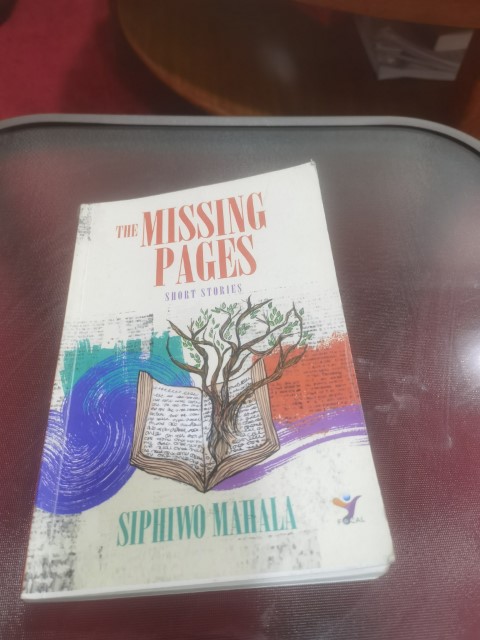
There are a number of reasons why the newly published collection of short stories, The Missing Pages, written by novelist, short story writer, playwright and academic Siphiwo Mahala must find favour with those who love local literature. This is an anthology that should not only find itself on one’s bookshelf only to be forgotten among other books waiting to be read.
For one, these stories are in many ways, a reflection of life, ordinary people’s lives and how they grapple with this mystery called life in a world that is governed by several dynamics. These include the contradictions prevalent in the capitalist system of the modern world we live in, the contradictions, tensions and contrasts between modernity and our stubbornly deeply entrenched African traditions that follow us everywhere, politics, history, culture, racial and class tensions.
You will find all these elements, neatly embedded in the stories that are part of this anthology. However the way these dynamics play out on the pages of this anthology, is nuanced. So nuanced that in some cases, you will not even know that you are reading a story about the intersection of race and class, till you are done reading the whole short story. And when you reflect, you then realise actually, this is what it is all about. That is what good fiction does when created by a skilful writer. It does not tell, but show. There is more showing than telling in these stories constituting The Missing Pages.
For example, the story titled Asylum, at face value, is about a woman from Grahamstown, who has a mental illness, forcing her to be hospitalised miles away from her home. But before you know it, you are confronted with the issue of the intersection of race and class. This happens during a key moment in the narrative. That is during a confrontation between the patient, who is black and a hospital clerk, who is white. This confrontation between the two women is over a disagreement between the two- that is the patient’s desire that the clerk, even in the absence of her doctor, Dr Williams, who is away,” and according to the patient Nobuntu Landu, “ he is “out there enjoying with his family.” The disagreement is over the insistence by the patient and her husband that she should be temporarily discharged from hospital, and just like her doctor, enjoy Christmas with her family.
Soon the discussion escalates to a confrontation that has racist overtones from both sides. It is however this confrontation and what the two characters, Nobuntu and the hospital clerk Veronica, that subtly reveals the fractured character of the society inhabited by the characters.Therefore, through this confrontation, the reader gets to know more about the society in which the story is set.
You do not have to be told by the writer that the society in which this story is set has issues of racism and class. These issues come out as part of the narrative as these characters confront each other. I think that is a smart literary device to employ on the part of the writer.
However at this stage, and as far as the Asylum story is concerned, I leave it there as you will have to read this beautifully woven story for yourself to get the rest of it. However, allow me to say this: In this story, you will encounter suicide, and I will not tell you who the victim is, as you will have to find out for yourself.
The point is, in this short story collection, you will also be taken deep into the complicated life of those that live a dual life, and how that duality makes their life very hard, instead of making it interesting. You will be left asking the question whether it is worthy it to live that kind of life, instead of a simple and straight forward life that does not have complications.
The Lost Suit is one such story that will make you question the rationale of cheating. That is whether, it is worthy, the trouble of working hard to hide an affair from your wife or lover. This story simply shows that the work that cheaters put into hiding their illicit affair from their loved ones, is not worthy the instant ‘happiness’ they allegedly derive from such cheating.
This short story is set in the historically important multi-racial township of Sophiatown of the 1950s. Just on the eve of the demolition of the famous urban settlement by the National Party Government, after winning elections in 1948, and after introducing Apartheid formally in South Africa. In this humorous story, a wayward lover finds himself in a sticky situation. This is a story that will make you laugh, and even feel sorry for the poor guy. After cheating, at least what he thought was cheating behind the back of his lover, what happens is to say the least, humiliating and humbling. Even for a Sophiatown clever. A Tsotsi, part of the infamous clevers of what is probably the most famous slum since gold was discovered in Johannesburg in 1886.
Again, I will not spoil your reading appetite by telling you the rest of what eventually happens in The Lost Suit. However let me be generous enough to give you a hint. Unfortunately nothing more. Do not be surprised if you find out that the Clever of Sophiatown, the one who made a living by stealing and dressing in designer suits, finds himself sharing a home with ghosts in a graveyard. But do not tell others I have told you this. But this is a small part of what happens there that may drive you to laugh, but at the same time feel sorry for this poor Tsotsi of Sophiatown. He has been beaten at his own game. His cheated lover has the last laugh.
However this collection also deals with our complicated history. In a nuanced way that is. For example, the short story, which is also the title of the anthology The Missing Pages, will take you back in history, the Anglo Boer War.
Inspired by Sol Plaatje’s Mafeking diaries. The recording of a war between two white tribes. This story is a layered story that however at face value, is about how diarist Tshekiso, also called Sol Plaatje, secretly recorded the war, as it raged on between these two white tribes in South Africa in 1899 in modern Northwest Province of South Africa. The character who is the narrator in this story, Moses, is sent by Tshekiso to check and retrieve his scrap book, left behind as they wandered during this time of the siege of Mafikeng. On his trusted horse, Motsamai, he traced the steps. However, in the process, tragedy strikes, as he ends up being taken prisoner of war by the Boers.
But this short story is not simply about that. It is more. I must say that by reading this short story, not only will you learn about this war between the Boers and the English, you will also be taken through that journey through laughter, as the writer in the telling of this story, navigates what would be a telling of a boring story about two white tribes fighting over a country that did not belong to both of them. But the writer’s use of humour in the process of telling this history, is what makes The Missing Pages a captivating read.
I can go on and on telling you about other stories in this collection that will leave you laughing. Even intrigued by humanity’s stupidity sometimes. However that risks me failing to capture well the multi layered nature of this collection. I will therefore leave it at that.
These are beautifully curated stories that have turned stories about seemingly ordinary events into powerful narratives about our culture, our history, our indiscretions, our traditions and our political and racial dynamics. Contemporary South African literature cannot get better than this, particularly the short story form. This form, by the way, is difficult to master and I can say this confidently as a scholar of literature with the short story form as my area of speciality. It is so complex that some even believe that to put together a short story is more difficult than a novel, because you have to tell a complete story with limited words. Much shorter than in a novel, that due to its flexible room, gives the writer more flexibility and space to manoeuvre, allowing the writer to develop characters fully for example. As a short story writer, notwithstanding the limitation of words, you are expected to do the same.
You will have to read this collection for you to fully grasp what I am trying to capture in these words.
Suffice to sayMahala here, who has tenured lectureship at University of Johannesburg, where he is Associate Professor in the English Department, after leaving the public services after working for a long time as head of publishing at the Department of Arts and Culture, and a stint in the Presidency, has penned stories that are a riveting read.
In The Missing Pages the writer has weaved our sometimes fractured everyday life into a coherent literary gem worthy your time, and cash.
Is there something I would have loved done differently in this book? Yes and no. Yes because some of the stories, in fact half of them, such as The Missing Pages, JoburgHutlers,Bontsie’s Toe, Hunger, The Lost Suit and The WhiteEncounters, are previously published works of his, and therefore if you have read them already, you might not have the same appetite to read them again as when you first did.
But no because personally, notwithstanding the fact that I have read some of these stories elsewhere before, but still this time, I enjoyed them all the same without the need to skip them. In fact I enjoyed them more this time around. That is strange, isn’t it?
However there are also stories in this collection that have not been published anywhere else previously, which is lovely for those who are not into reading a short story twice. And yes, I would have loved to see the inclusion of more new stories in the collection.
.The Missing Pages is published by the Foundation for Culture, Arts and Literature, India.