



Alastair Findlay’s Solstice exhibition frames Johannesburg’s urban landscapes intersecting with the irony of its existential challenges
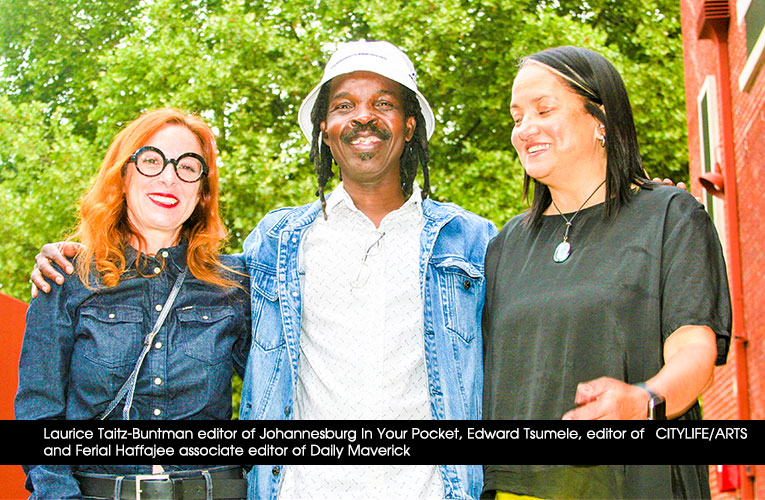
By Edward Tsumele, CITYLIFE/ARTS Editor
I should have known. And that is that, when you see an exhibition’s curatorial idea farmed with two iconic poems from two iconic poets of their time, then you are about to undertaken an intellectual tour.
However Alastair Findlay’s exhibition, which opened on Friday June 20, 2025 at Stokvel Gallery in Melville, and which enjoyed a short run as per gallery’s normal scheduling of short sleek exhibitions, ending on Sunday, June 22, 2025, is not the abstract type of intellectual journey where one is taken on hard-to grasp cerebral ideas.
This is because after immersing yourself in the beauty of flowers painted by the artist, that misleadingly make the viewer believe that Solstice is all about the beauty of life only, you are soon quickly jerked back into the current reality of our life.
Of course around Johannesburg there is indeed a good life for many who have taken advantage of the opportunities abundant in this world famous city, which at one time had the biggest deposits of gold in the world. The flowers are indeed a gift of nature that humanity has for centuries appropriated for itself to represent the ideal world of love and deep intimacy that they would like to see in a world that constantly denies us that opportunity. Painting these flowers represents in fact that ideal world we aspire to have within which love thrives in abundantly.
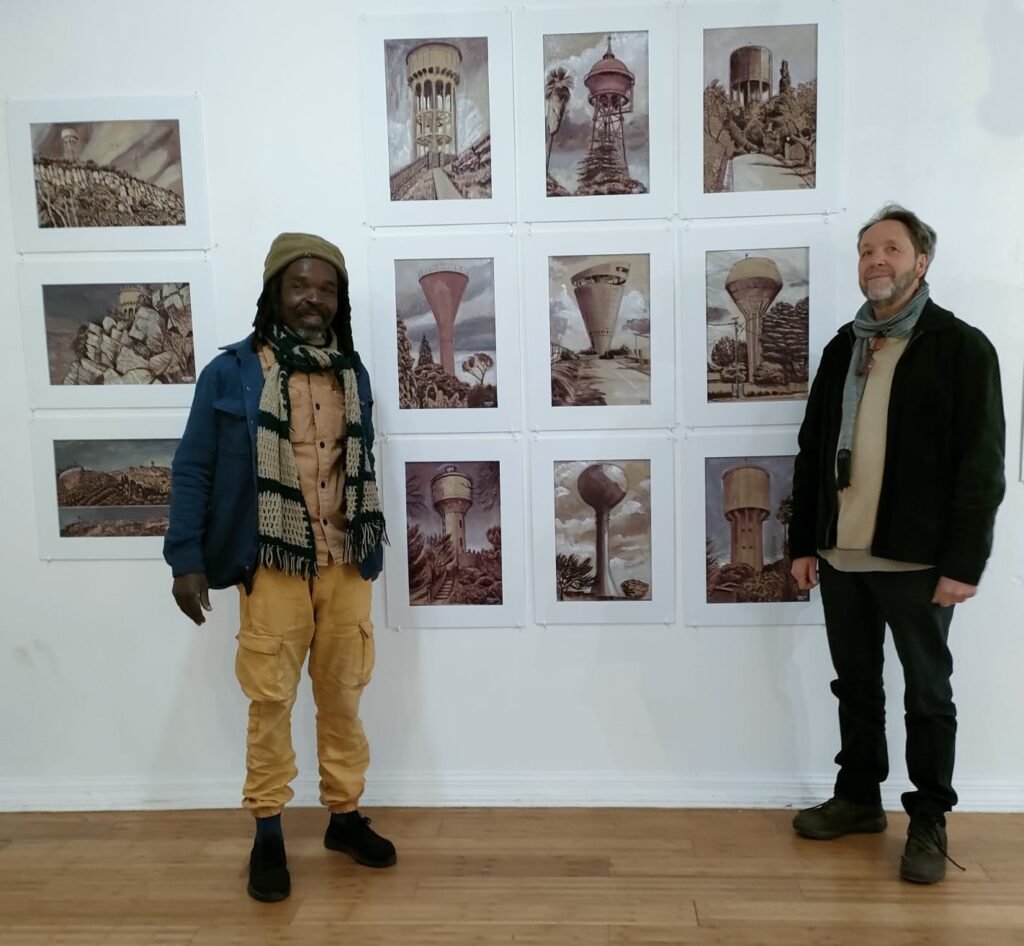
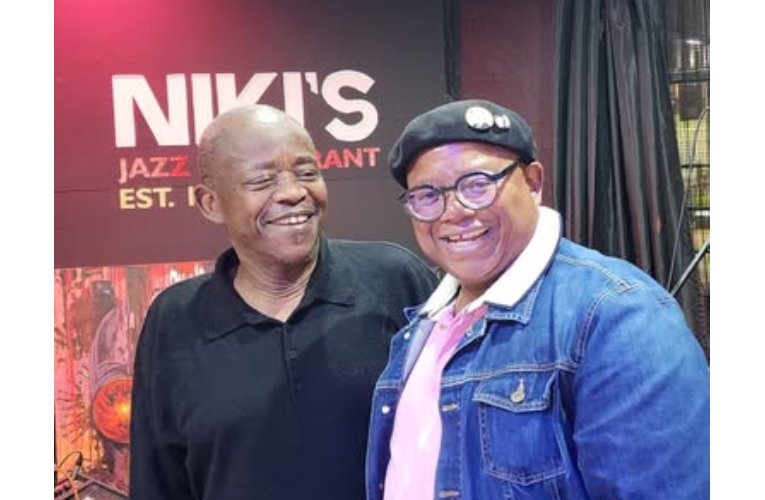
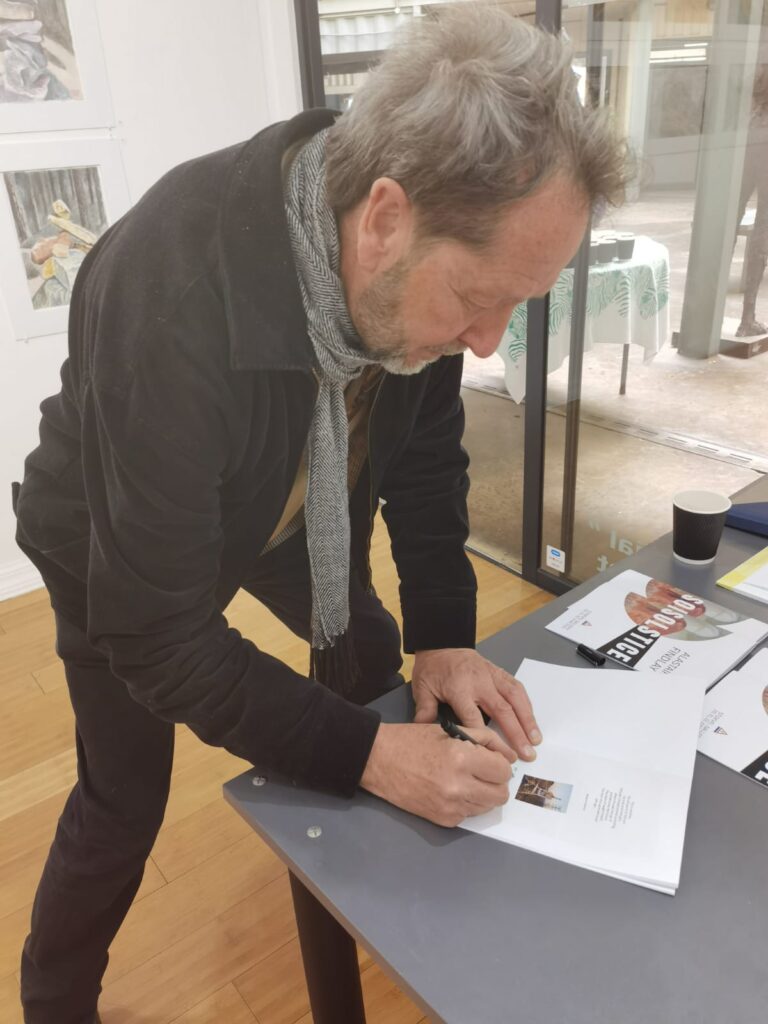
Edward Tsumele and Alastair Findlay. Credit Rae Wilmot
However after viewing the flowers, immersing yourself in reimagining what life would be without wars, hatred and angry politicians, another reality about this exhibition strikes when you least expect the blow.
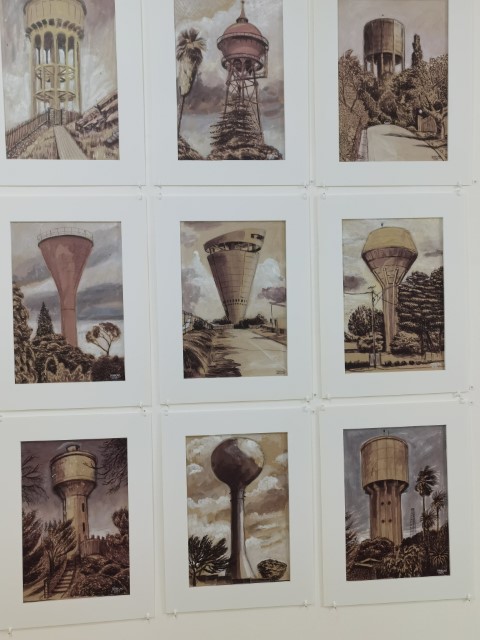
It does so in the form of well captured familiar man-made Johannesburg store houses of the essential commodity – the water that we drink, wash with and generally make our lives a fulfilled reality, sustainable existence.
But before we get there, let us start from the beginning, if that will help us to frame in our minds, the big idea that has assisted the artist in framing some aspect of the curatorial thrust of Solstice: An excerpt from a powerful poem of the same name by Margaret Atwood:
This is Solstice,
The Still point of the sun
Its cusp and midnight,
The year’s threshold and unlocking,
Where the past lets go of,
And becomes the future,
The place of caught breath,
The door of a vanished house
Left ajar…..
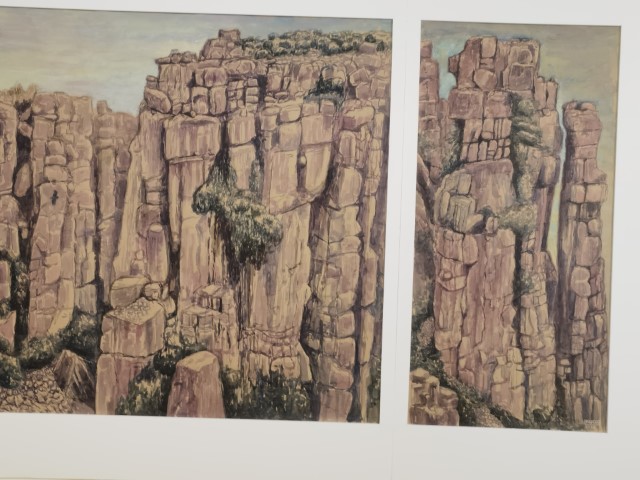
Then from here the exhibition takes you to the familiar ground: the water towers that sustain our lives and the majestic koppies’s that are part and parcel our cities’ surrounds. In Johanneburg, we are surrounded by koppies, really beautiful works of nature.
However there is another side, co-existing with this beautiful part of the city.
For example, through this exhibition, if you lived in some of the cities under investigation, like I did for example in the case of Johannesburg, my home, you will be taken on a deep sentimental trip if not a journey of fading nostalgia. Memories that capture and trigger the past that you may have long forgotten in the fleeting passing of time. A fading memory that is triggered to make you reconnect with the past that is not always painted in glory. For in that past lies a trail of broken promises and false starts. A potential that was never realised. But also in that past you find so much promises, promises fulfilled indeed. It is a mixed bag of fortunes and misfortunes really. Love, breakups, sadness, happiness and pain. All co-existing next to each other as if they are friends, and not adversaries inherently a contradiction of themselves.
This is the power of Findlay’s exhibition. It digs a past that we want to forget and bring it into the present. In fact making the past to co-exist with the present.
For example, if you take the water towers that populate this exhibition, the famous Yeoville Water Tower, the Northcliff Water Tower, The Linden Water Tower, Strijdom Park Water Tower, and South Hills Water Tower, familiar landmarks in Johannesburg, all sorts of emotions build up in you. Beautifully captured by the artist’s mind, eye, paint and brush, you however cannot help but think about the current problems of water that has been mismanaged by highly paid but grossly incomptetentlocal government bureaucrats and often corrupt politicians overseeing them, you cannot help but feel like throwing up. How can you not be when after seeing this exhibition, one is not sure, whether you will find the tap running at homefor you to cook and wash ourselves. There is no certainty these days about our lives, when it comes to the issue of the regular uninterrupted supply of both water and electricity. Sometimes even the removal of garbage.
This is despite the fact that these water towers are imposing structures not easy to ignore, visible from any angle in our suburbs, and yet some of them are dry instead of being filled with water to sustain our lives.
This however may not have been Findlay’s intention when he decided to paint these imposing city structures that carry a substance that our lives depends on daily, but for viewers struggling with water issues in a city that risks running dry one day, they cannot help but be reminded of their current predicament. I was.
However the exhibition will also take you back into appreciating our urban landscapes, and how their natural features remind us of the fact that Johannesburg, despite its problems, a lot of them man-made, is still a beautiful city in several aspects.
The artist has captured this beauty in a remarkable way, and for once, making you forget about its current problems of the erratic water and electricity supply, that has become a regular feature of our daily lives.
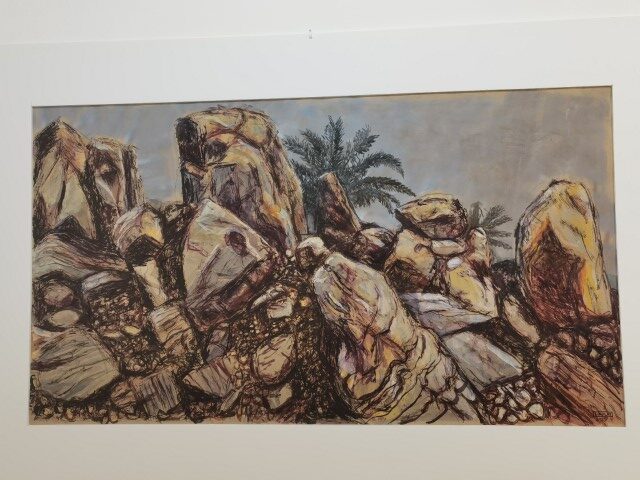
Besides of course the beautiful flowers, the artist’s rendition of the several koppies that surround our urban landscape around Johannesburg, makes one calm. You cannot help but admire these landscapes, natural features that are part and parcel of our various daily experiences as we drive around the city, and sometimes take an occasional incursion into the immediate surrounding koppies on weekends with friends, to escape for a moment the city grind.
Findlay with care, has captured the grandeur of the koppies of Johannesburg’s surrounds, managing to immerse the viewer’s thoughts into the idea that in as much as Johannesburg is generally regarded as a concrete jungle, parts of it in fact are a bush to which one could escape to if the city overwhelms you.
I am glad that although the artist’s rendition of the koppies involves documenting other koppies around the country, he has not forgotten Johannesburg’s koppies. Including the ever beautiful Melville Koppies. This landscape has become a sanctuary for many looking for both rest from the daily city grind, and those looking for healing from nature’s powers.
Solsticetherefore is an important body of work that connects the past with the present and aptly captures the contradiction of city life. Such as a life in Johannesburg, where opportunity intersects with challenges, such as the erratic water and electricity supply. Yet it is a place where dreams are made alongside experiences of nightmarish episodes.
“Ï like driving around and observe nature, particularly the koppies around our urban surrounds. I take photographs of the koppies and later sketch from them. But at other times, I reimagine koppies and paint them” the artist tells me as he takes me around the exhibition.
This draws my attention to the other poem which concludes the framing of this exhibition.
The poem is written by Charles Simic, which talks to the idea of a stone being a living thing instead of being an inanimate object. I found this poem to be appropriate in how the artist painted the koppies. They come out as a living thing that breathes and has life in them.
Go inside the stone
That would be my way
Let somebody else become a dove
Or gnash with a tiger’s tooth
I am happy to be a stone
From the outside the stone is a riddle
No one knows how to answer it
Yet within it must be cool and quiet
Even though a cow steps on it with full weight,
Even though a child throws it in a river,
The stone sinks, slow, unperturbed
To the river bottom
Where the fishes come to knock on it
And listen
I have seen sparks fly out
When two stones are rubbed
So perhaps it is not so dark inside after all,
Perhaps there is a moon shining
From where, as though behind a hill-
Just enough light to make out
The Strange writings, the star charts,
On the inner walls.
.Solstice ran at Stokvel Gallery, 27 Boxes, Melville, from 20-22 June, 2025.