


Opening night’s student crowd and Sibeko’s Olympic closing ceremony blow the whistle on mass consumption and decay
The exhibition RE: FUSE-ABILITY running at FADA Gallery till September, 6, 2025, gives the world a second chance.
By Jojokhala C. Mei

A walk down to the art gallery of the Faculty of Art, Design & Architecture on the Bunting Road campus of University of Johannesburg always takes me past the futuristic-looking Biokinetic and Aquatic Rehabilitation Centre, thus raising expectations that the ethically intriguing RE: FUSE-ABILITY exhibition on until 6th September has at least some links to the colourful undersea science staff and workings of conscience next door.
But Alas. I don’t identify academics from the rehabilitation centre at both the exhibition opening, and the walkabout a few days later. But the art exhibition is impressive enough to stand its own ground. not. The two departments work in silos.
You see, the group exhibition curated by Brenton Maart and Leora Farber, is billed as bringing ‘together a dynamic group of visionary artists from Africa and the Global South who repurpose the wreckage of extraction, empire and excess into urgent, electrifying statements of resistance and renewal.’
Not always ‘electrifying’ I’d contend. ‘Yet still explores urgent ecological, political and aesthetic questions through the transformation of waste and wreckage into sites of resistance and reworlding.’
What curator Maart calls ‘not just an exhibition; it’s a manifesto for art in the age of planetary crisis where waste is treated as a haunted, living material.”
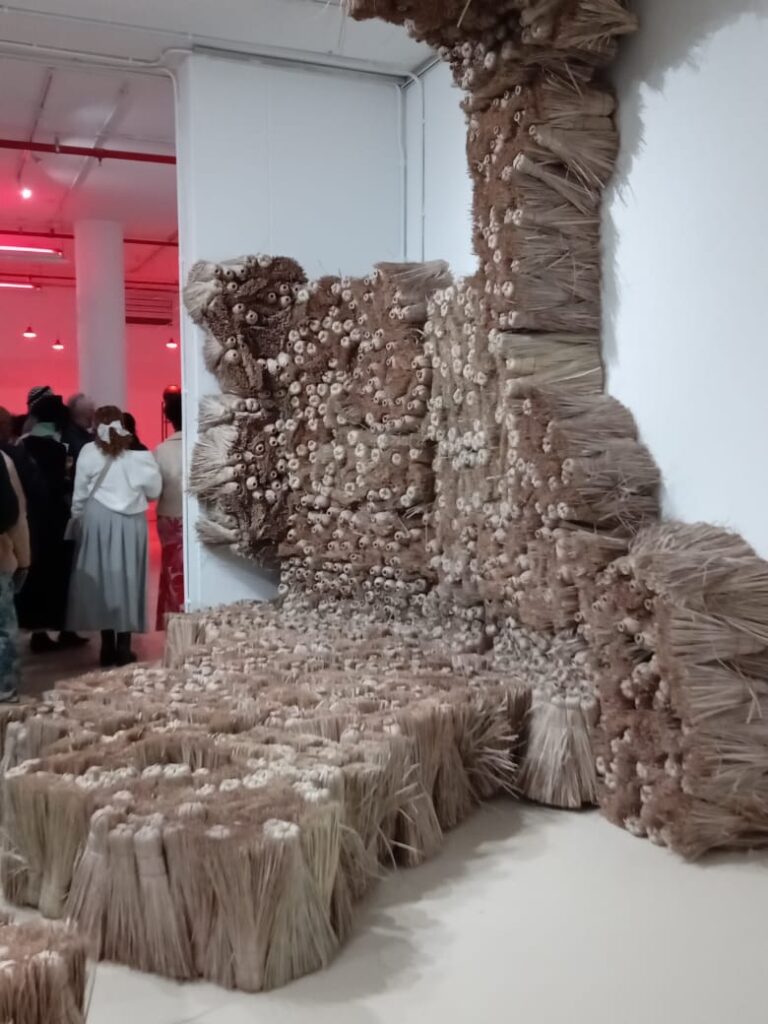
Like the first majestic installation by Usha Sseejarim called ’Grass, Roots, and Memor’ (2025) is a decoratively arranged floor-to-wall vista of grass brooms. Dubbed a living archive of ecological memory, domestic labour and the poetics of care.
It is more contemplative than electrifying and controversial, I’d say. You could counter, What’s the semantic bother?
Then glittering ‘The Stone Age of Biology’ exhibition by Australian-based Oron Catts, and Ionat Zurr look like framed prints in a high-end jewellery store, but only on returning a few days later to the less crowded walkabout that I learn that these are ‘Digital prints or Iridium silver Gloss … they are actually made of ‘ semi-living objects, and part synthetic and part organic … act as symbolic gestures heralding another profound shift in human consciousness.’
I wonder how controversial this art is if it takes so intense a description to not only capture the imagination but also stretch thoughts and conscience.
Nolan Oswald Dennis says his living installation feeds hiding earthworms pages of the rare English language and prized Zulu language translations of iconic North African revolutionary psychologist Franz Fanon’s magisterial book Wretched Of The Earth. His grandmother bequeathed him a copy of the book that now ‘’transforms … into living compost, with a bioactive earthworm system that literalises the text.’
A handful works by Zimbabwe-based artist, and former shoemaker, Tawanda, like the appropriately titled The Macabre have long raised eyes and the group exhibition theme to win past prestigious prizes. He could have pushed boundaries.
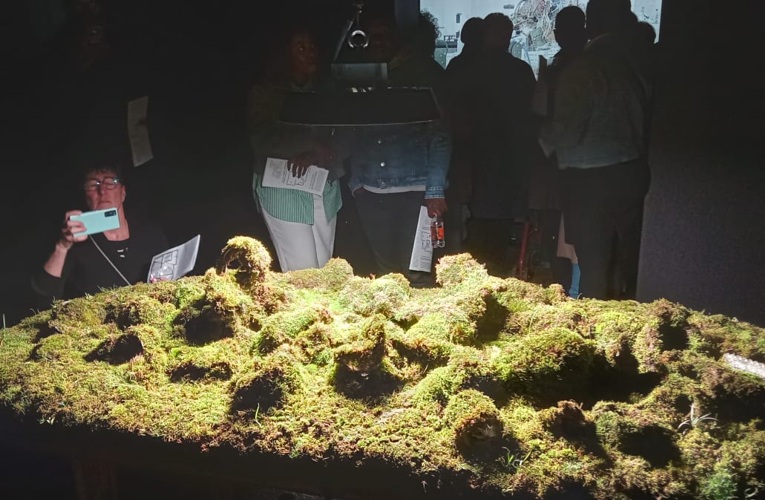
Downstairs in the dark bowels of the gallery a lit National Geographic-like mini-landscape of an overgrown ancient dead Aztec civilization buildings catches my eye for inspection. But the curatorial statement corrects again that the artistic matriarch academic curator ‘Leora Farber cultivates living moss over the remnants of a colonial dinner table, a living monument to biopolitical entanglement and vegetal agency.’
To rest my legs and brain I finally take a seat to watch three or four big screens playing disinterested old, blurry, and looped videotapes. Francois Knoetze’s cinematic installation Core Dump excavates the digital debris of techno-capitalism, exposing the violent afterlives of discarded technology across the Global South.’ Again, it took expert walkabout talk to explain things to me. As much as curatorial overload proved necessary, and intrusive.
So further walkabouts of the exhibition will be conducted on Saturday, 16 August 2025 at 11:0; and Wednesday 20 Aug (student walkabout; to be done by Keonah Nyembe)
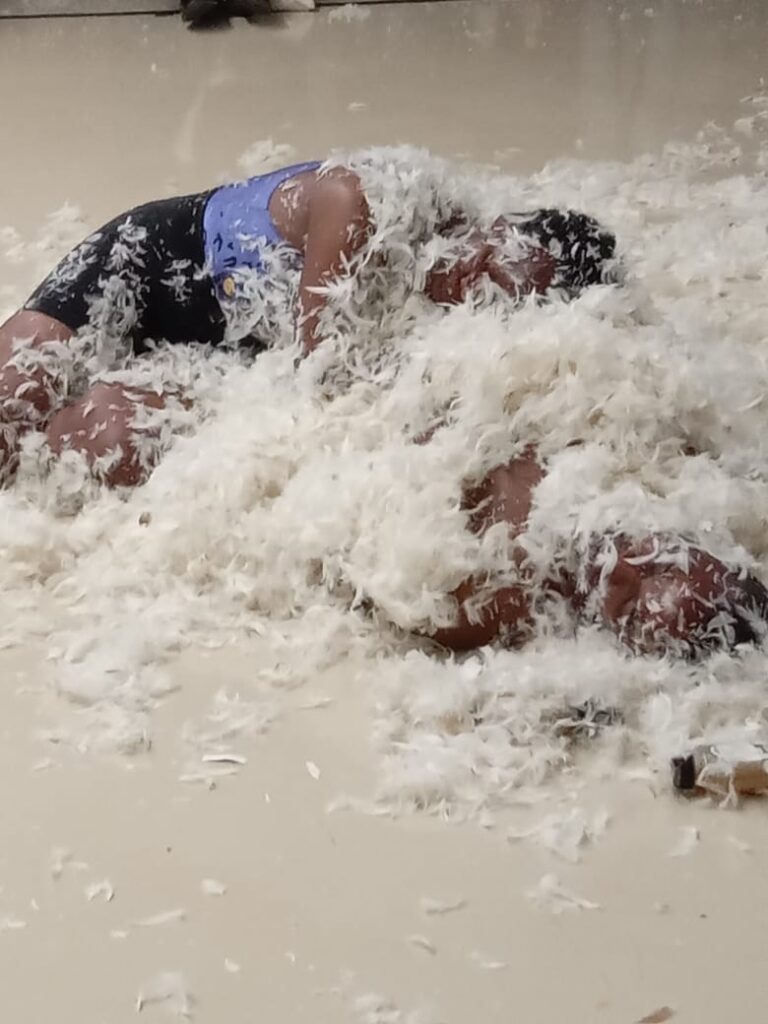
The installation by Masimba Hwati and Michael Gould, of the Zebra Collective is missing without any explanation. And Oupa Sibeko’s whistle-stop performance art is described by the curators as ‘ritual performances that transform pain into healing, and residue into renewal.’