





Women Embroiderers of Winterveld through these tapestries tell stories of pain, loss, suffering, and the hilarious during a pandemic
The exhibition 2020 Through the Eye of a Needle: Remembering the Covid-19 Pandemic in 2025 curated by Charlton is at Wits Art Museum. Entrance is free and no booking is required.
Museum hours: Tuesday – Saturday 10:00 – 16:00 Exhibition dates: 22 July – 13 September 2025.
By Edward Tsumele, CITYLIFE/ARTS Editor
About two months ago the Johannesburg City Library in the Johannesberg CBD, partially opened its doors to the public, after five years of locking the public and the book loving public out as renovations were said to be going on, rehabilitating this historic building, I curiously walked in on the day. I found the building almost empty, with the exception of seemingly bored staff who milled around. The people who had heeded the call for its opening had long gone, perhaps as soon as the Mayor Dada Morero had finished officiating and the plates were licked clean of whatever refreshments was provided on the day.
I walked in nevertheless. I actually preferred it that way. The place was so quiet. I moved from one room to the next, and my eye was first attracted to the African literature section in one of the rooms. I lingered there for sometime as I admired the literary efforts of Zakes Mda, Achmat Dangor and others, whose books immediately caught my eye.

After a while I moved on to the first floor where I found myself attracted to a cabinet that contained music, classical music CDs, that seemed lost and abandoned.
However, as I looked back through the door through which I came in, I noticed an art work on the walls, just close to the entrance. I wondered why I had not seen this colorful tapestry. I went straight there and gazed for quite a while. I read the inscription accompanying this tapestry. It said this was the work of a group of women in Winterveld, just outside Pretoria. The piece of fabric was beautifully embroidered, colourful and exuding dignity of its own. That got me wondering how did this piece of art end up there, abandoned for years to share its loneliness with the books and the audio material I had just seen, locked away beyond the reach of the public by city officials whose priority is clearly not to cultivate the spark of a reading resident.

I was sad but also curious to know that there was such a group of women creating such beautiful art in a place like Winterveld. A place where one would not expect such kind of artistry among the women folk of Winterveld. However, it is not because I did not think that art cannot possibly be created there. It is just that it is a place where the folk are struggling to exist. Food, clean water, sanitation and a struggle to maintain dignity in a harsh peri-urban environment such as that which defines the landscape of Winterveld, makes it hard, extremely hard in fact, for people to create. Let alone create such beautiful art works.
Just who are these women, and how come that I had not heard about them in the circles of art in the country? These were questions that occupied my mind as I eventually made my way out this huge building housing thousands of books, classical music, and yes of course some tapestry of the quality that really touched me.
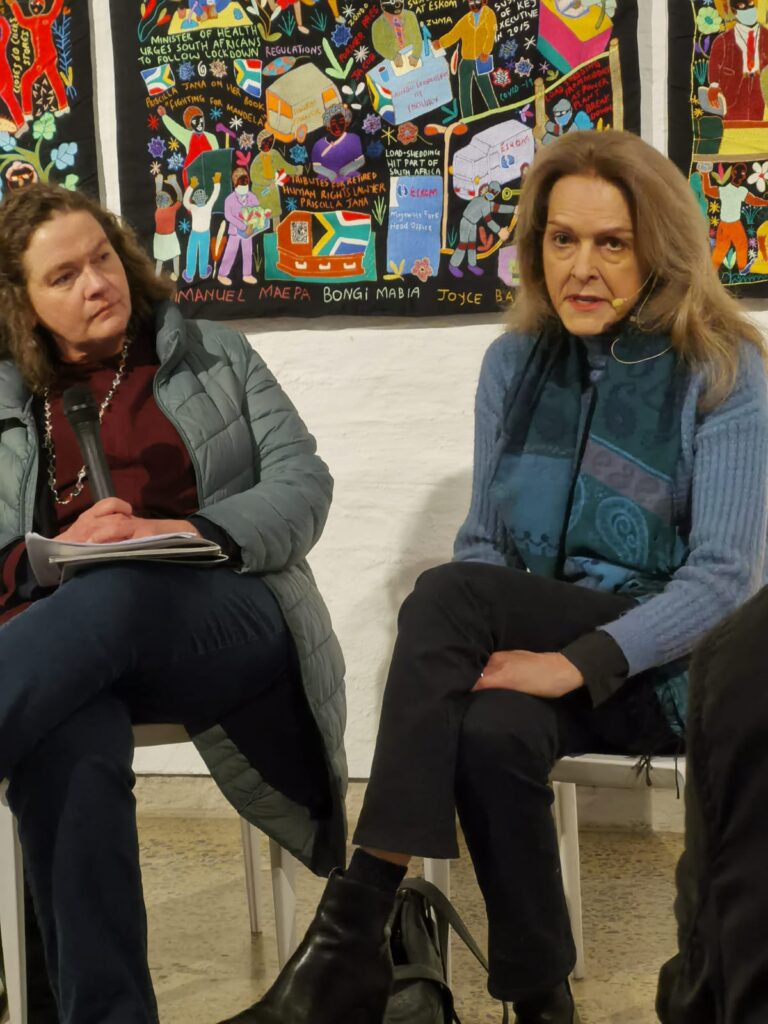
Well, I got the answer. Not immediately, but months later. That answer was delivered at Wits Art Museum, where I joined a number of people for a walkabout led by Wits Art Museum’s Julia Charlton and Professor Brenda Schmahmann, who in an informative discussion took us through the history of how the Winterveld embroiderers came into existence, now numbering over 100 designers and embroiderers.
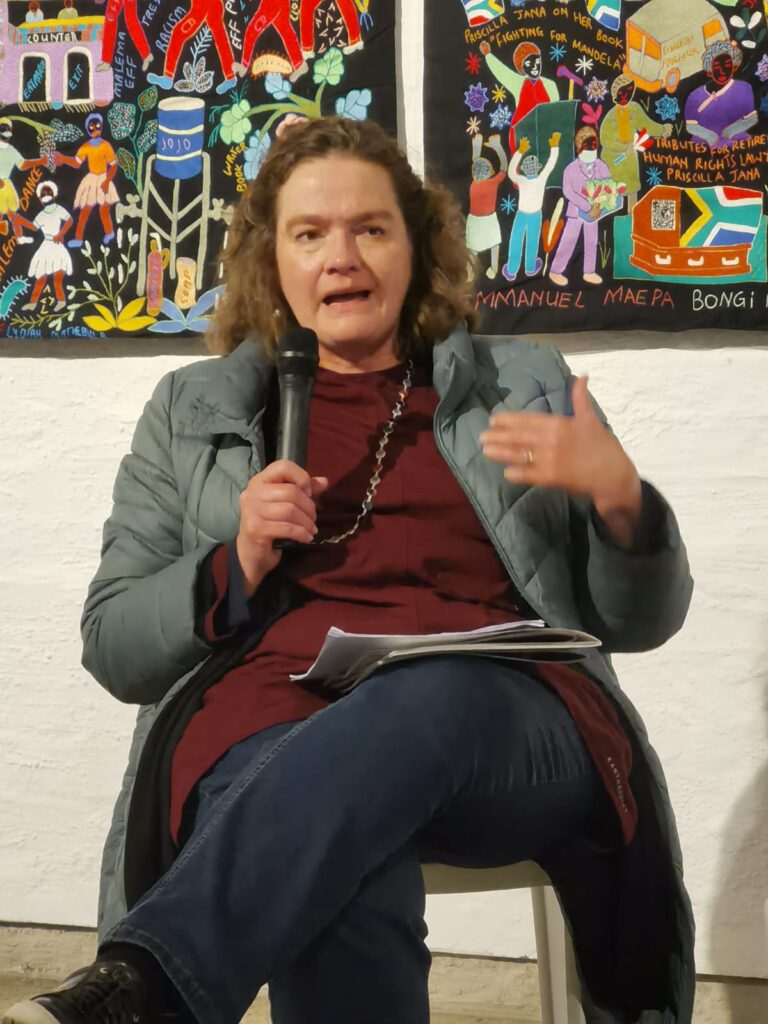
On that day at WAM, Saturday, 26 July 2025, at 12:00, I listened attentively as the two art luminaries through the engaging dialogue gave us deep insights about the newly installed exhibition 2020 Through the Eye of a Needle: Remembering the Covid-19 Pandemic in 2025 curated by Charlton.
Schmahmann — South African art historian and current South African Research Chair in South African Art and Visual Culture (SARChI) at the University of Johannesburg’s Faculty of Art, Design and Architecture (FADA) through that conversation with Charlton, Senior Curator at WAM, shared reflections and insights into the embroideries on exhibition, created by members of the Mapula Embroidery Project, a community art collective of women embroiderers based in the Winterveld and Hammanskraal.
We learned so much from the two learned and cultured ladies. All the questions that had been prompted by what I thought was a casual walk into a public library that was not even really open, but partially forced open due to public pressure by activists and civil society, were eventually answered.
Between admiring what we saw on the walls as the two art fundis spoke and stealthily snaping at the art work on the walls, we got to hear that in fact, this group of women artists had been in existence for years, having been a project of an organization called Sisters of Mercy. Working closely with universities such as UJ and on this latest project Wits Art Museum also, which commissioned some of the work on display (Others are from the UJ’s separate project with the same group) these women artists have created art that every year gets shipped to the US where their work is sold and the money put back into the organization. The women artists are commissioned to create the work and get paid, while the proceeds from the sale goes back into the organisation’s kit for its sustenance, were told.
In the group’s art making process, the role of professors such as Schmahmann and others is restricted to giving guidance, keeping such involvement to a minimum, such as giving them a theme, often marking a disaster, such as the Floods in Mozambique that destroyed lives and nature years back, and recently the global pandemic Covid-19.
This brings us to the essence of what 2020 Through the Eye of a Needle: Remembering the Covid-19 Pandemic in 2025 is all about.
“This year marks five years since the World Health Organisation declared Covid-19 to be a global pandemic. The spread of the disease had devastating consequences worldwide, with appalling loss of life, terrible emotional strain, extreme social disruption and economic devastation. The anniversary offers us the opportunity to reflect on that time by considering an interactive exhibition of embroidered textiles dealing with Covid-19 and its impact on the community,” Charlton says in her curatorial note accompanying the exhibition.
However, there is more to this exhibition than the statement above is willing to share. There are stories of pain, soul searching, loss, contemplation, and even hilarity. Yes, hilarious stories in the mist of telling a story of human pain, loss and suffering, believe you me.
For example, in one of the pieces, you will see a short man, well dressed in a formal sense. And besides him, there is a woman, also fashionably dressed. You start to wonder what has gone into the heads of these artists -are they depicting the Covid-19 story using the code of fashion or what? But that is until you see a jet in the picture, parked and ready to fly out of South Africa’s skies towards the north. Then, you will notice the name Shepherd Bushiri. No point to explain further.
And yes, you will also encounter sad stories of people mourning their loved ones lost through Covid-19. Here you need to be strong as it may trigger your own pain, coming from remembering a lost loved one during that terrible disease’s rampage. But even sadder you will also witness naked greed by those powerful who did not think twice about stealing funds meant to assist a nation in distress. I am sure you are getting the vibes, especially involving powerful and corrupt politicians ganging up to teal from the desperate during that period of uncertainty and existential doubts engulfing all of us.
And so, this exhibition is multi-layered in its symbolism and meaning. On one level it is a story of how the privileged in the Ivory Towers of knowledge, such as universities have climbed down and shared their knowledge with the less privileged in a socially meaningful way. At another level it is a story of entrepreneurship that you will not read in prestigious business publications, as these women have bee earning a living for years through this project. Feeding themselves and their families and educating their children through the proceeds of business.
And yet at another level, it is a story of art, art created on a piece of cloth, ordinary in all respects, but radically changed and its status suddenly elevated by carrying some of the poignant stories of pain that the southern African region has experienced over the years through natural disasters such as the Mozambican Floods and of course Covid-19, and its accompanying micro-narratives of greed and selfishness by the powerful, corrupt and uncaring in contemporary South Africa.
This is a highly recommended exhibition to visit.
Entrance is free and no booking is required.
Museum hours: Tuesday – Saturday 10:00 – 16:00
Exhibition dates: 22 July – 13 September 2025