




In Pursuit of Glimmer exhibition extends women’s struggle for freedom beyond that of 1956
Currently on at223 Jan Smuts Creative Hub, in Rosebank, this Women’s Month, the exhibition features the works of eight women artists, curated by Dudubloom More, and supported by Austrian Cultural Forum.
By Edward Tsumele, CITYLIFE/ARTS Editor

First it was the artist, the printmaker Lebogang Mabusela who took us through her art works and the imagination that went into it. At face value, the material used to create this conceptual art, looks simple: Two pouches hung on the wall. But this apparent simple use of material, two pouches made up of pieces of brown, dotted whitecloth, turned into pouches, hides a complex message that strikes straight into the heart of unpaid labour that women often undertake in homes, in which raise a family. Quietly, but committed, it is actually that unpaid care labour that builds families, raising children into productive adults. This is while the men in those families, are out there doing the paid labour, which tends to be recognised more. Not even to speak about the wide gape between women and men in the labour market.
It is correct to argue that both the man and the woman in such families, are contributing to raising their families in different ways. But problem is, when it comes to recognising the important role of women in men’s lives, in raising families, for inexplicable reason, society tends to forget that role. It is this issue of unpaid labour performed by women and the lack of recognition that Mabusela is raising through this installation.
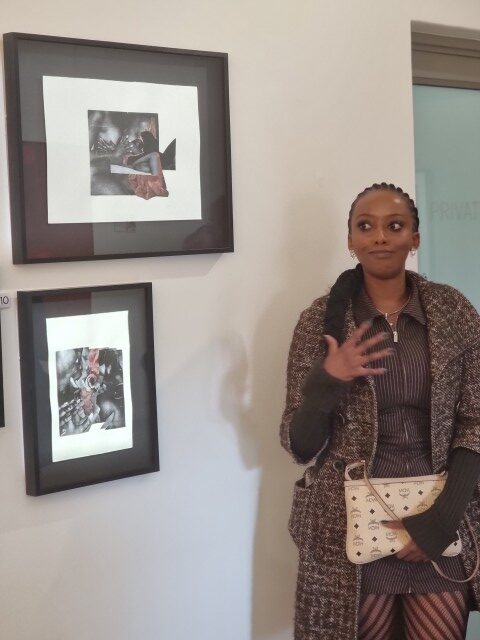
“The bigger piece, which looks like a skirt or a dress, represents the unpaid labour performed by women. In the smaller piece, there is a pad inside, which visitors can pull out and write a quote, after which they can hang it up here,” explained Mabusela to the audience that had gathered inside the gallery to view In Pursuit of a Glimmer.
In art circles, this Pretoria based artist, a graduate of fine art from Wits, and an alumnus of Newtown-based Bag Factory Artist Studios, is known as Monotype Babe. This is in reference to her printmaking practice in Johannesburg’s tight knit art ecosystem.
I first met her at Turbine Art Fair in Illovo, where she was manning a stand, having been introduced to her by veteran artist and Bag Factory Artist Studios founding member, Kagiso Pat Mautloa, who praised her for her resourcefulness, when she bought a small printmaking machine. That purchase changed her life, especially during Covid-19, as she was able to do printmaking for artists in her home studio in Pretoria. This, was during a difficult time for artists and other working professionals, due to the restrictions of mobility government put in place to control and manage the spread of the Covid-19 pandemic.
An interview followed with this publication thereafter, and I have since followed her career closely ever since.
Mabusela’s career is definitely on an upward trajectory, having been in 2024, afforded an opportunity for an artist residency in Canada, among other opportunities that have since come her way.
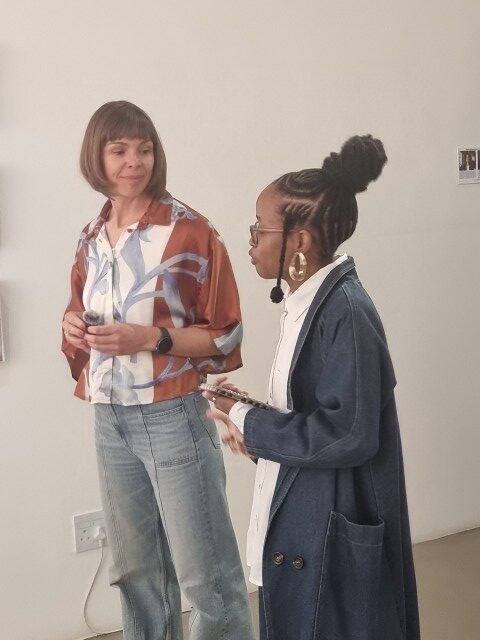
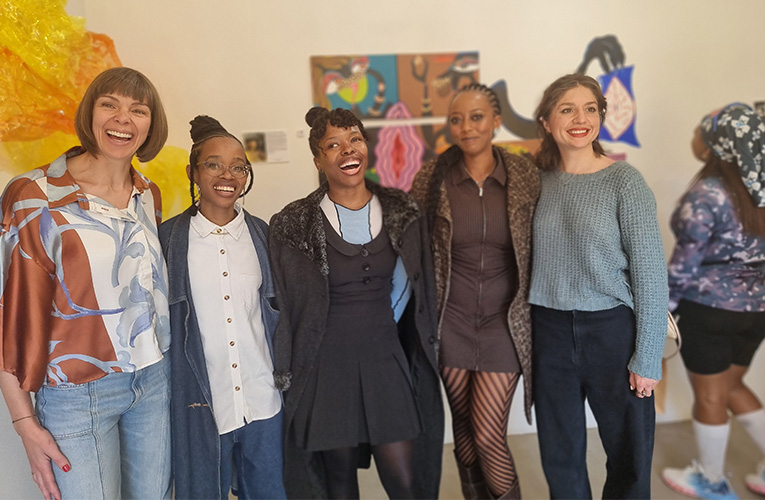
On Saturday, August 8, 2026, at 223 Jan Smuts Creative Hub, Monotype Babe, and other women participating artists, were introduced to gallery guests by Dudubloom More, this time wearing the hat of both curator and artists, of whom, I also met a few years ago to interview her for an article published in CITYLIFE/ARTS. This is after she won the prestigious Welz Cassirer Award for emerging visual minds.
She too, I have closely followed her career. Her own work has found favours with collectors, both in South Africa and overseas. For example, her work was snatched up at 1:54 Art Fair in London in recent years, and locally, the Soweto born artist, is fast consolidating her foothold on the local art scene, through both solo and group exhibitions, and increasingly as a curator. A graduate of Artist Proof Studio in Johannesburg, Dudubloom More’s art and art practice, have been embraced by the art market in a significant way, signalling to a sustainable art practice going forward.
At 223 Jan Smuts Creative Hub, she also curated another women only exhibition last year, with The Pursuit of Glimmer,supported by the Austrian Cultural Forum, being the second iteration of that series, which centres women artists during August, Women’s Month.
At the opening of the exhibition, Dudubloom More, framedIn Pursuit of a Glimmer,as an exhibition that extends the meaning and relevance of the day in 1956, which gave the genesis to August 9, a Public Holiday in South Africa, to mark that day and celebrate women’s role in the fight against Apartheid.
That day in 1956, is when women marched to the Union Buildingsin Pretoria, the seat of Power, as a protest action against the Pass Laws of the time, that defined where black people could live and what time of day they could be in certain spaces in South Africa.
This exhibition, therefore, according to the curator’s framing, is a way of rethinking how to move forward from that period in a post-Apartheid South Africa, when women folklore still face several challenges. Such as Gender Based Violence and marginality in various social settings. Different eras, different problems for women folk in South Africa.
Dudubloom More’s curatorial note accompanying this exhibition, captures well her thinking around this.
“Yet celebration alone cannot transform the conditions that continue to shape women’s lives. Happy Women’s Day. In Pursuit of a Glimmer builds on the reflections of last year’s exhibition by asking what meaningful change requires. If the previous exhibition sat with the celebration and emotional tensions surrounding Women’s Month, this iteration looks beneath the celebration, examining the realities that continue to inform women’s lived experiences.
By de-layering the celebration itself, the exhibition explores the social, cultural, and institutional conditions that continue to shape women’s lives. Through diverse practices, the artists engage with inherited norms, silence, resilience, care, memory, and the everyday experiences through which these conditions are both challenged and sustained. Across these varied responses, a recurring sense of autonomy emerges, revealing the many ways women assert agency within, against, and beyond these realities,” she writes.
Essentially, what this exhibition does manage to achieve, is to centre women as having the agency, when it comes to how they should relate and understand their bodies.
For example, The Pursuit of Glimmer, invites a viewer to think along these eightcontemporary artists, astheir works, explore resilience, care, memory, identity, autonomy, and hope, inviting audiences to reflect on women’s lived experiences and possibilities for transformation.
Jessica Adams in collaboration with Amy Keevy, Lebogang Mabusela, Rina Noto, Mummy Khumalo, Nwabisa Ntlokwana, Thato Tlatsi and Yolanda Mazwana, in addition to Dudubloom More, are the participating artists, whom the curator invited to create works that reimagine a historically important epoch in South Africa’s tough journey from Apartheid to freedom in 1994.
These artists here, are not inviting a gaze into their most intimate reflection of the self, but a respectful sharing of their vulnerability. They give a permission to a viewer to get into their space of being. This is a privilege often easily given to the public by artists, as that permission comes with the risk of being vulnerable.
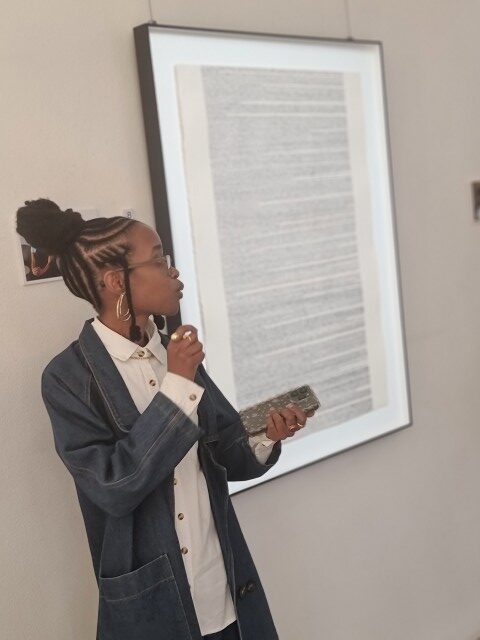
For example, Dudubloom More’s single art piece, existing in black text on board that she created over seven months of self-reflection as she journaled about life, is a glimpse of her inner thinking about self.
“Sometime when a viewer looks close to read the text, I become uncomfortable as what I have written there, is part of a journal of reflection that I wrote daily for seven months,” she shared.
Thato’s body of work, comprising abstract paintings, deal with the female body, and what it undergoes and feels, at certain times in the human journey.
“My work basically deals with expectations when it comes to women. We are expected to be soft and gentle. But the reality is, the body undergoes a lot of experiences,” she said.
This suggests, a level of unfairness such expectations come with.
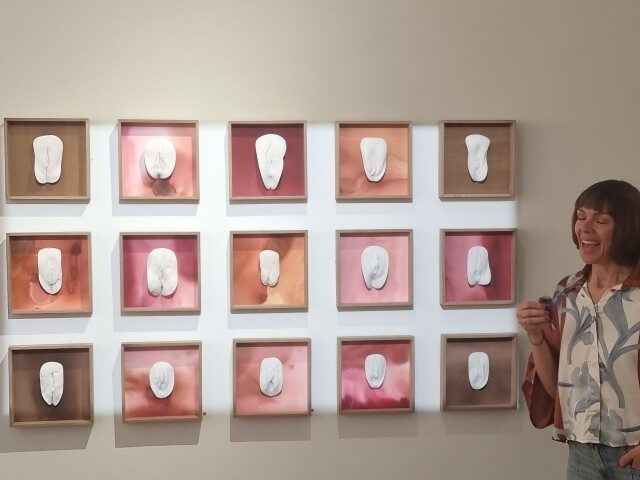
However, it is especially the body of work created by Jessica Adams in collaboration with Amy Keevy, that prompted me personally, to think hard about the female body and its role in creation, something that society often takes for granted.
Her body of work, miniature paintings of female genitals, the vagina, is a powerful statement to make people think about the role that women play in procreation, particularly the vagina, which is the most important exit of humanity out into the world. In fact, all humans trace their first foray into the world through that exit.
“Often when we think of the vagina, it is something that is never looked at. I mean, we never ordinarily look at the vagina, unless of course, you intentionally decide to do so. This is in sharp contrast to male genitalia, for example, the penis, which is out there for one to look at,” Jessica explained.
It is in fact striking in that this part of the body, through which all humanity get to witness the world for the first time, as they exit the womb, is never often looked at by the very same people carrying this vital tool of human delivery, simply because it is positioned in a way that does not lend itself to self-inspection and sighting on the body by the very person whose body carries it.
Therefore,The Pursuit of Glimmer, exhibition, indeed looks beyond 1956, as women think afresh about their positionality in post-Apartheid South Africa, with different challenges from those faced by the women of 1956.
Everyone needs to see this women centred exhibition, before it goes down, and it would be helpful to time one’s visit whenever there is another walkabout, as that will assist in navigating this body of work on exhibit.
.In Pursuit of a Glimmer is currently on at In Pursuit of a Glimmer, Rosebank, Johannesburg.
One thought on “In Pursuit of Glimmer exhibition extends women’s struggle for freedom beyond that of 1956”