





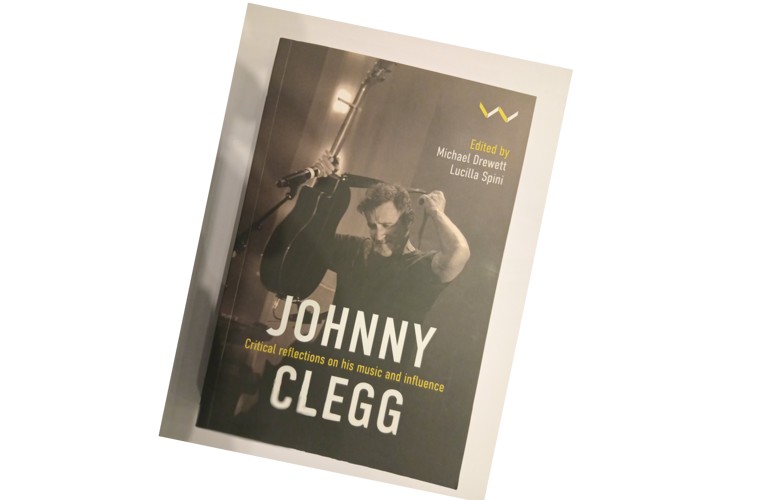
Music legend the late Johnny Clegg remembered through critical reflection of his music and influence
Reviewer: By Giyani Baloi
Title: Johnny Clegg: Critical reflection of his music and influence
Edited by: Michael Drewett Lucilla Spini
Publisher: Wits University Press
It’s a book written by several people who lived, worked, or were touched by the iconic South Africa’s musical legend Johnny Clegg’s illustrious career. Le Zoulou Blanc in French, meaning White Zulu as he was popularly known. He was born in England in 1952 to an English father and a Jews mother.
His mother moved to the then Southern Rhodesia, which is now Zambia and Zimbabwe. She then moved to South Africa in 1964 when Johnny Clegg was 11 years old. Muriel Brando Johnny Clegg’s mother was a cabaret jazz singer herself. Which obviously means that Johnny Clegg was introduced to music at an early age in his life
He met Charlie Mzila in Johannesburg, who taught him the Zulu guitar. Their friendship grew, and Johnny Clegg used to frequent Jeppe Hostel, a dwelling place where most Zulu migrant workers used to stay in Johannesburg. That’s where he fell in love with the Zulu music, dance, and culture when it was unpopular for a white person to be seem mingling with black people in South Africa then. It was also against the separatist apartheid laws.
He met with Sipho Mchunu and others and formed Juluka a musical band. He used to visit Sipho Mchunu’s village in KwaZulu-Natal and immersed himself with everything about the Zulu culture. He was also studying anthropology at Wits University at the time. He later graduated with an honours degree in anthropology. He lectured at Wits University as well as the University of KwaZulu-Natal before quitting to concentrate on his music.
Sipho Mchunu his band member and close friend later decided to retire and go back to the village in KwaZulu-Natal when his father passed on. Johnny Clegg continued to play as a solo artist. They later joined together again and formed another band, Savuka. They toured the world against the separatist apartheid laws and produced some of the best songs of all time, like Scatterlings of Africa, Asimbonanga, and more.
The struggle for democracy in South Africa was fought by many people from different fronts and places, although the victory seems to have been appropriated by a few today.
Besides Johnny Clegg his academic degree, he was also awarded honorary degrees by Wits University, University of KwaZulu-Natal, Dartmouth College in the USA, and City University of New York.
He was also honoured by the French government with a Chevalier de L’ Ordre des Arts des Lettres (Knight of French Arts and letters. The Order of Ikhamanga, Sliver (OIS) the highest honour that can be bestowed on a South African.
Well, some may argue that he appropriated the Zulu culture for his personal musical gain. I think that that is a simplistic look at things. Culture and identity is what you live. We are just humans that can adapt to any environment we live in, and I think Johnny Clegg lived the Zulu culture through and through and expressed it on his music. I remember during my photography studies at the Market Photo Workshop in Johannesburg. My trainer said to me, “Maybe you need to go and sleep over one night with your subjects.” The subjects in fact were homeless people. That experience of sharing a ‘bed’ with the homeless in order to create images about their lives and experiences (published) was a transformative for me, and those images are some of my images that I treasure long after graduating from the market Photo Worskshop.
“So that you can view things their way,” he added. I went to sleep over with them in a bushveld in Houghton, Johannesburg. The otherness bridge was destroyed, and the work was amazing.
Johnny Clegg was quoted as having said, in one of the interviews, “The living must remember the dead.” I think Wits University Press and the contributors to the book indeed remembered him.