



Mystery surrounding identityof Drum writer, Dugmore Boetie remains unresolved, clam authors of new book The Original Apartheid Hustler
This scholarly work was undertaken to piece together a narrative aimed at reconstructing the identity of one of the most elusive figures in South African literary history.
By Edward Tsumele, Winner of NHC Heritage Journalism Award for 2026
Pictures: By Molelekeng Mothusi/JIAS
Little is not known by the South African public, and yet, he was one of the larger than life characters who traversed the streets of Sophiatown of the 1950s, where lines were constantly blurred between illegality and legality. Tsotsi and pastor, the straight and crooked constantly, crossed paths. Issues of morals were a question of choice instead of a universal truth. The struggle survive, especially in the ranks blacks in Johannesburg of the time was a common feature of life.
It is in this environment that colourful characters and personalities emerged in the community carrying various identities. Shebeen queens. Gangsters. Models. Pastors. Writers. Journalists. Community leaders. Conmen. Businesspeople. Prostitutes. Jazz musicians. Poets. Hustlers.
One Dugmore Boetie was several of those identities. He was a writer, a journalist, conman, jazz musician, political activist and even a one-time exile.
This is a picture of a man caught up in an environment where any of those identities could be loosely easily assumed, depending on the circumstances of the moment, which dictated what one could become in real time. Shifting from one identity to another was a matter of survival for Dugmore Boetie, whose identity to date still eludes researchers and historians.
However two researchers, Professor Benjamin Lawrence and local academic Vusi Kumalo have pieced information together, gleaned from various archives, including primary sources that have been published and recorded in official documents, newspapers, journals, books and libraries, comparing such information with oral testimonies gleaned from extensive interviews with friends and family members. This scholarly work was undertaken to piece together a narrative aimed at reconstructing the identity of one of the most elusive figures in South African literary history.
What is known about Dugmore Boetie is that he lived in Sophiatown in the 1950s and till 1966 when he passed on. He wrote for Drum Magazine, alongside well-known names such as Lewis Nkosi, Casey Motsisi, Can Themba, Bloke Modisane and E’skia Mphahlele, among that generation of writers who blazed a trail in black journalism of the time. But Dugmore Boetie did more than just writing to survive. He also unsuccessfully tried to go to London. He however managed to illegally live the country for Tanganyika (Tanzania) where he met influential figures of the struggle such as Julius Nyerere before secretly sneaking back into the country. This is after he wrote a poem that would put him in trouble with the apartheid government.
Like most of the characters that emerged as journalists and short story writers during the Drum era of the 50s and 60s, Dugmore Boetie’s praxis was multi-disciplinary. For example, he could easily write a short story as he could do the same writing a journalistic piece. He could play a jazz note with the likes of Kippie Moeketsi, as easily as he could switch from being a Coloured, to a Zulu or a Xhosa.
But he was more than that. Fiction and reality in his world, particularly in his head, seemed to be the same thing. Lines between fiction and non-fiction were often collapsed in his writing style. Not even an attempt to write an auto biography, commissioned by then Classic Editor Barney Simon was spared.
For example, when Barney Simon was impressed by his literary skills in one of his short stories, he commissioned him to write an autobiography. Indeed, Boetie did. But the outcome was something else. Instead of an autobiography, Simon got a manuscript that clearly did not differentiate between reality and fiction. Instead, as if they were cousins, both were melded together to create a fantastical piece of writing that defied categorisation. That left Barney Simon confused.
However, the very same late internationally reputed theatre director, who co-founded the Market Theatre with Mannie Manim, is implicated in the book for allegedly partially appropriating Dugmore’Boetie’s work, originally titled Shosholoza by the writer and subsequently published overseas with Barney Simon as co-author and therefore incorrectly making him entitled to 50 percent of the royalties from the book, according to the two authors
The book that has never been available in South Africa, but has been republished several times in both the UK and the US with the title Familiarity Is the Kingdom of the Lost, was prescribed reading at some institutions overseas as it gives insight into the precarious lives of black people during apartheid.
Familiarity Is the Kingdom of the Lost first published in 1969, is essentially a fictionalised autobiography by Dugmore Boetie (Douglas Mahonga Buti) that blends picaresque storytelling with the realities of apartheid-era South Africa.
The novel follows Duggie, a dispossessed black street kid turned con man, navigating Johannesburg’s Sophiatown and beyond. Through a series of witty, often outrageous scams, Duggie exploits the absurdities of apartheid’s pass laws, bureaucratic oppression, and racial hierarchies. The narrative is both a satire and a survival story, showing how the protagonist uses humour, cunning, and his artificial leg to outwit authority and endure hardship.
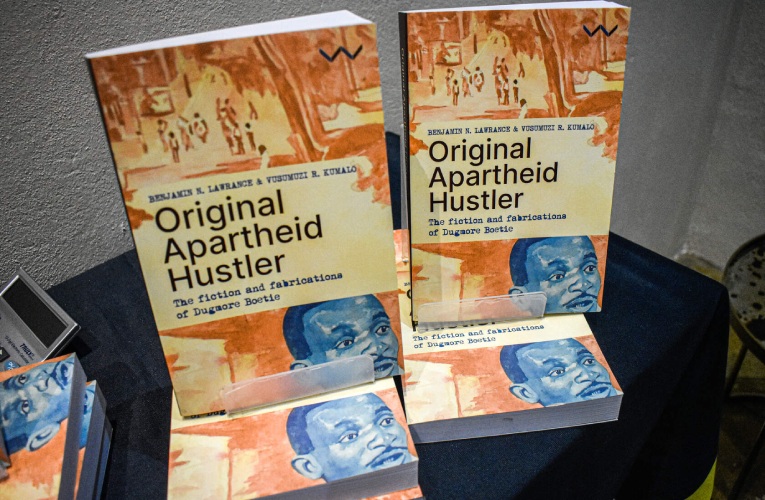
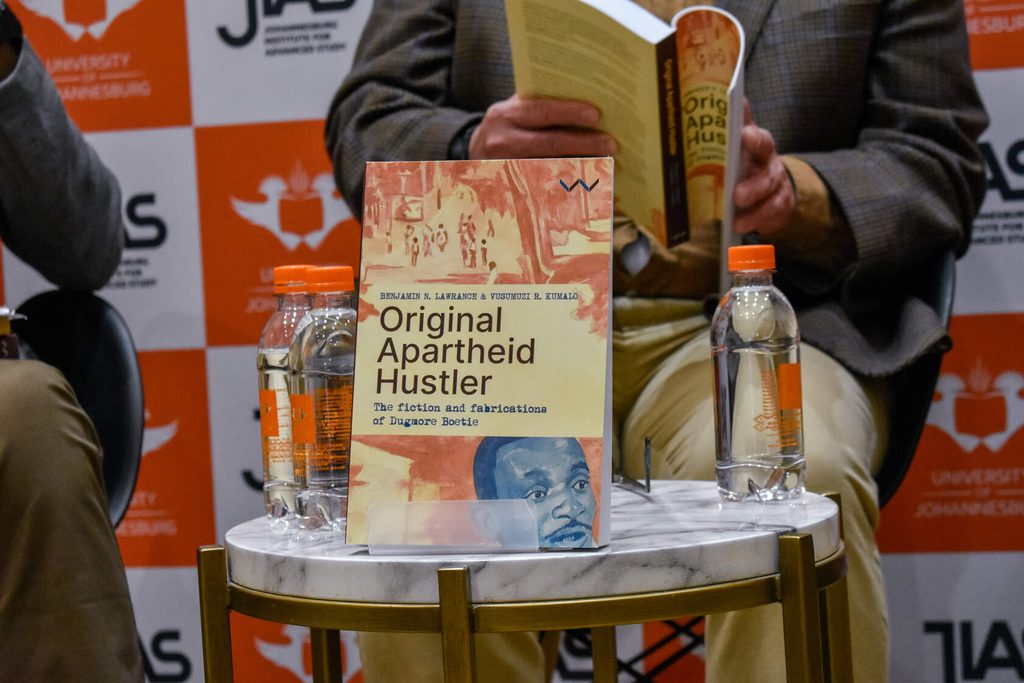
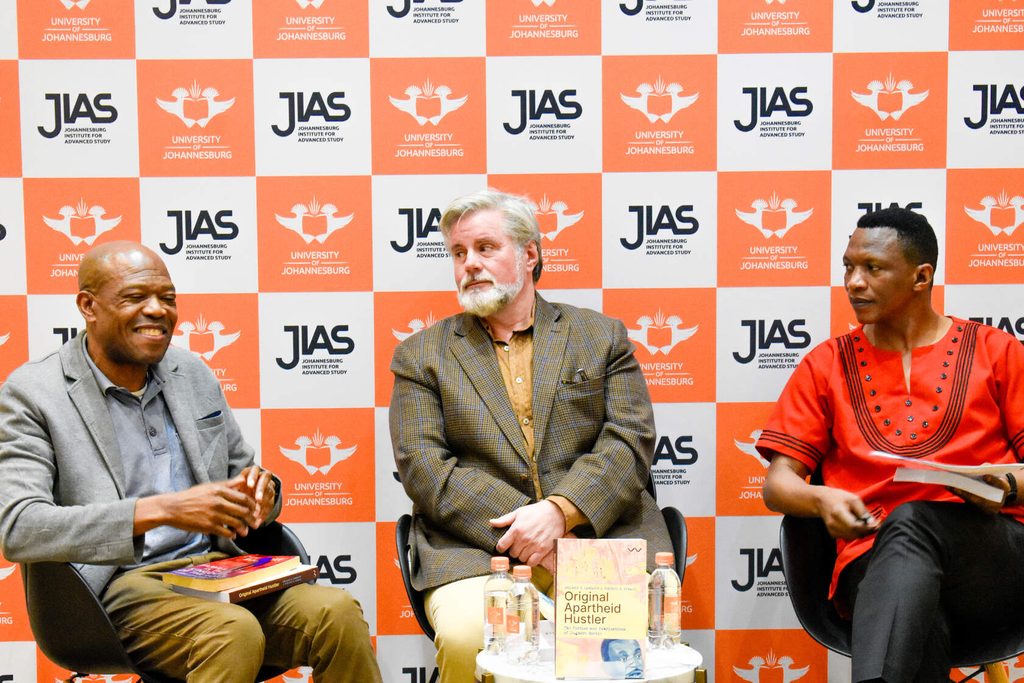
All these seemingly contradictory identities of who Dugmore Boetie was, emerged at the launch of the book, Original Apartheid Hustler: The fiction and fabrications
of Dugmore Boetie, a critical biography of Dugmore Boetie, co-written by the two academics Dr Vusi Kumalo and Professor Benjamin Lawrence, published by Wits Press in collaboration with University of Johannesburg African Biographies Project of UJ Vice Chancellor and Principal Letlhokwa George Mpedi.
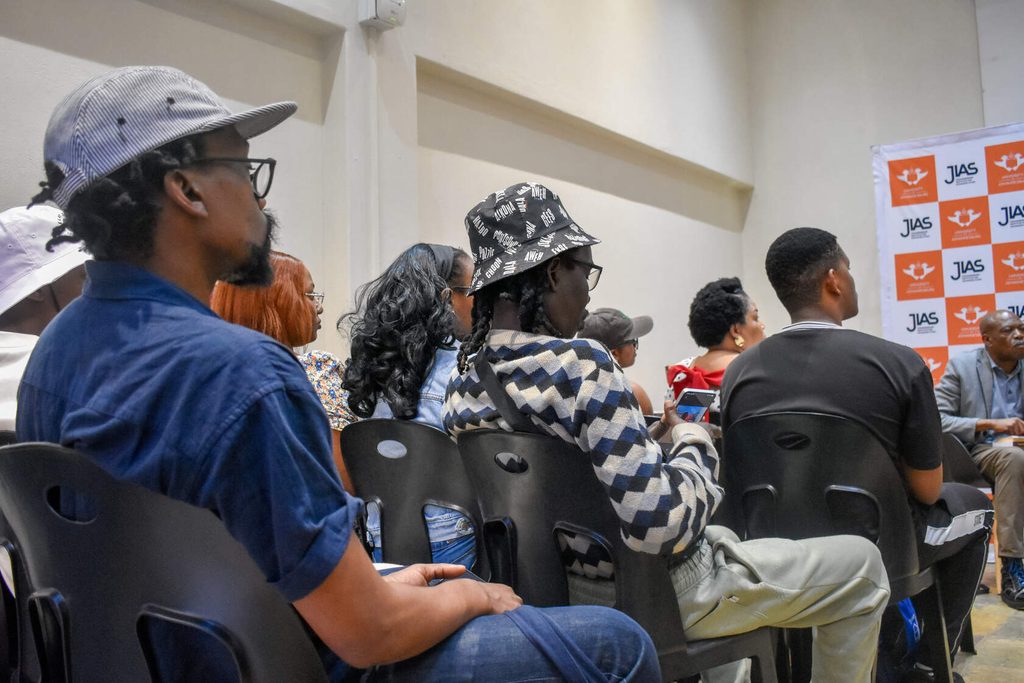
And according to Prof. Siphiwo Mahala, acting director of the Johannesburg Institute for Advanced Study, where the launch took place on Monday, 12 October 2026: “The project is aimed at producing biographies of prominent people, as well as some marginalised individuals, and Dugnore Boetie falls into that category.”
“We regard this book as some kind of restoration of the family legacy of Dugmore Boetie. In our research, we have used archival material, as well as speaking to about 50 members of the family, including travelling as far as Queenstown and Hershel where Dugmore Boetie’s mother, a Coloured woman is thought of having come from.
As historians, we are not kind to Barney Simon for having published this book overseas passing it as partially having been written by him and Dugmore Boetiue, whereas documentary evidence we have discovered at Amazwi South African Museum of Literature in Makhanda, in including drafts that were handwritten by Dugmore Boetie, indicate that he is the solo author,” said Lawrence.
He however was quick to say that they also admit that Barney Simon financially looked after Dugmore Boetie, but that does not justify taking 50 percent of the royalties from the book, he said.
Kumalo said that he and Lawrence first me in 2017 to start researching the life and times of Dugmore Boetie.
“This is after Benjamin Lawrence came across a letter in Rhodes House at Oxford, where he was doing research. He was then introduced to me by a common friend. Then me having been born in Soweto, when I saw the address on that letter that pointed to Rockville, a township that in fact, is not far from my home, I went there and found a family member of Dugmore Boetie’s, who confirmed that indeed that the name I had mentioned is their relative. She even showed me a picture of him hung in their dining room, a decent, pristine four bedroom house,” he said.
However because of the contradiction in Boetie’s identity, in which the make-believe world of fiction collided with reality of his life in a country with a racially segregated history, the two authors admitted that at the end of their research, it was difficult to fully reconstruct Dugmore Boetie’s identity as it kept on shifting.
“This was because he wanted to survive in a country with an oppressive history. This man was arrested several times and jailed. He was kidnapped to work as a slave on farms in Mpumalanga. And so, the lies that he told about who he was, was a way of surviving in such an environment. He told lies in order to survive the harsh reality of his environment as a black man in a society governed by racial hierarchies,” Lawrence explained.
He gave an example of how he lied about his disability by claiming that he had lost his leg through a heroic act –that is while fighting the Nazis in the Second World War in North Africa, when the reality was that his leg was amputated when he was around 8 years old, after he got an infection while playing soccer with his friends.
“And therefore, we decided to title this book Original Apartheid Hustler as we realised that he was not a liar-liar, but did whatever he did, in order to survive the harsh reality of apartheid,” said Kumalo.
Kumalo went on to explain that it was common practice for example, for some black people to claim that they were Coloured during the apartheid years.
“This happened especially among those who were light-skinned as by being Coloured, they enjoyed certain privileges that were not extended to black people due to the racial hierarchies created by the apartheid system,” Kumalo said.
What Original Apartheid Hustler is, is, is a biographical study, an analysis of Boetie’s writings, and a decolonial meditation on apartheid-era exploitation and erasure. Based on archival research and interviews with Boetie’s family and friends today, the authors provide insight into Boetie’s background, his struggle to find his place as an artist and writer, and his collaborations with prominent intellectuals, including Ruth First, Nat Nakasa, Nadine Gordimer, and Barney Simon. Simon, pivotal in globalising Boetie’s work, controversially controlled his copyright, influencing his posthumous narrative.
This book unravels webs of fact, fantasy, and myth, exposing the highly racialised socio-cultural, political, legal, and intellectual violence Boetie and his legacy suffered during and after apartheid. It reveals Boetie’s resilient self-fashioning, his multiple fabricated identities, and the concealment of his disability and political activities.
Original Apartheid Hustler is a profound contribution to debates about authorship, privilege, legacy, and race, from apartheid to the present day.