

Solo exhibition by Henrietta Scholtz, Planetary Cognitive Ecologies: Gondwana, poses question of what survives when the world ends
The exhibition offers multiple audience entry points namely; science, art, philosophy and theory, visual, and technological.
By Traver Mudzonga

“I love science as a tool for art making” quipped Henrietta during the Planetary Cognitive Ecologies: Gondwana opening speech. No cap to that; as you walk into the exhibition space you are indeed greeted by love of science as a medium for her artworks.
Planetary Cognitive Ecologies: Gondwana by Henrietta Scholtz opened on October 3, 2026, at the Wits Origins Centre. The body of work was initiated by Scholtz and presented in fulfilment of her 2026 UJ Arts & Culture Artist-in-Residence, which made it possible. The exhibition poses the question, “what survives when the world ends, and what can still be known about it?”.
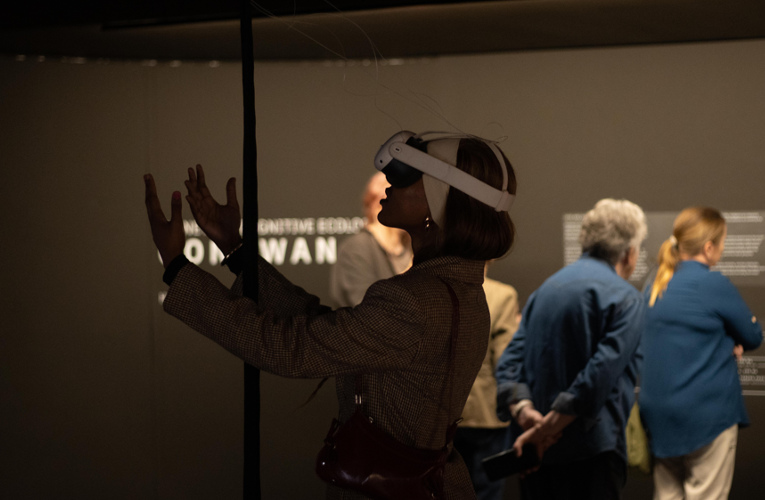
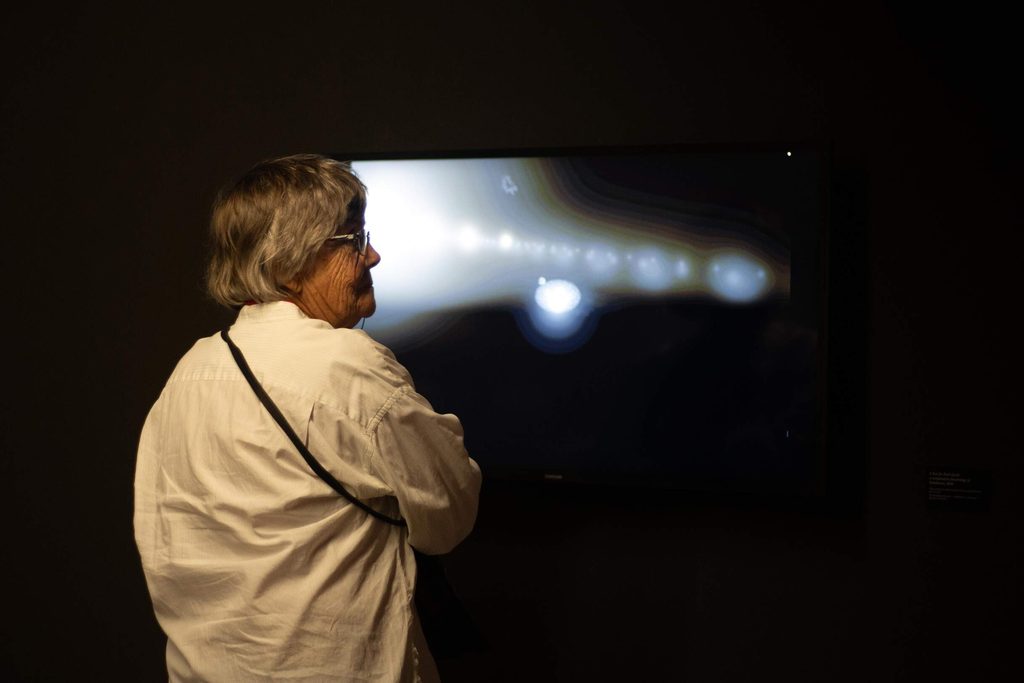
The multilayered exhibition takes the traditional planetarium to an experiential virtual reality through an installation that allows visitors interact with the ancestral protein artwork derived from computational and scientific research. Through this body of work, Henrietta invites the audience to embrace how while times of uncertainty and great upheaval challenge the ability to remain steadfast in hope, they present opportunities for endless possibilities.
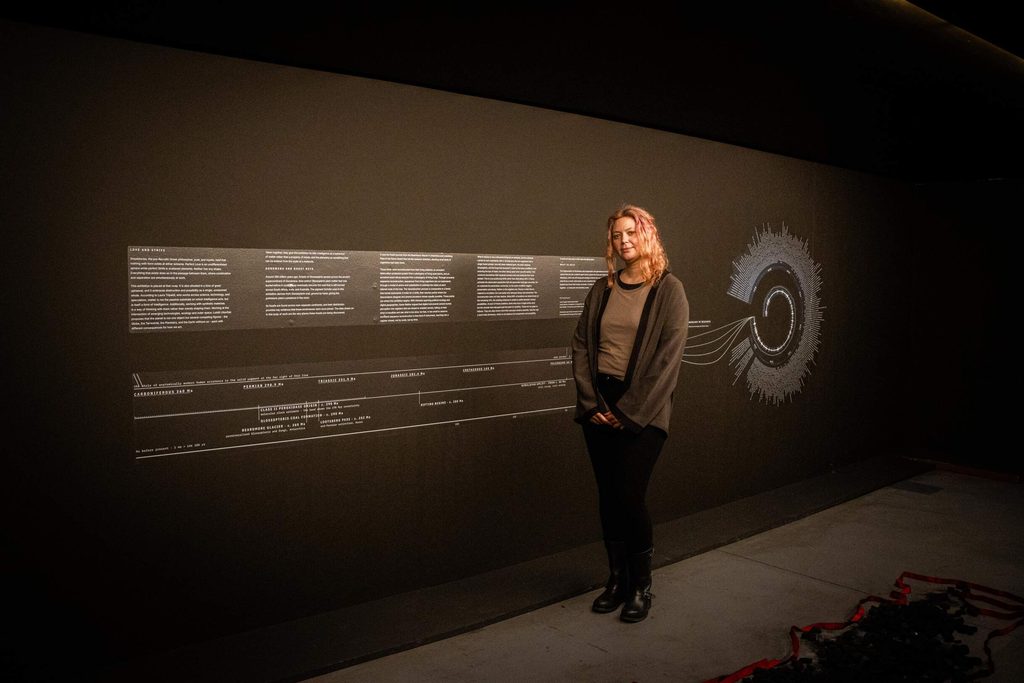
The white vinyl on black wall combination artwork creates a section of the body of work bound to draw you to read, view and imagine a world past, present and future. Love and Strife: the wall-text section is about Empedocles. He held that “nothing with form exists at either extreme, since perfect Love is an undifferentiated sphere and perfect Strife is scattered elements, and that everything that exists does so in the passage between them.
The exhibition is placed at that cusp, and holds destruction and possibility together”. The white vinyl creates text-and-talk moments which will have evolution, geology, science, philosophy and general knowledge enthusiasts leaning in towards each white vinyl marking on the black exhibition wall. Here, Henrietta brought text, a historical time-lapse and a data-driven diagram artwork titled Archaeology of Research. A combination of the three white vinyl sections gave me a sense the vastness of time and drew me towards the exhibition’s research question. While the temptation is to attempt a summation of the wall-text, this is where I invite you to visit this multilayered offering. Explore how the exhibition makes representation for how “Ancestral sequence reconstruction is that kind of instrument, reaching into a register closed, not by scale, but by time”.
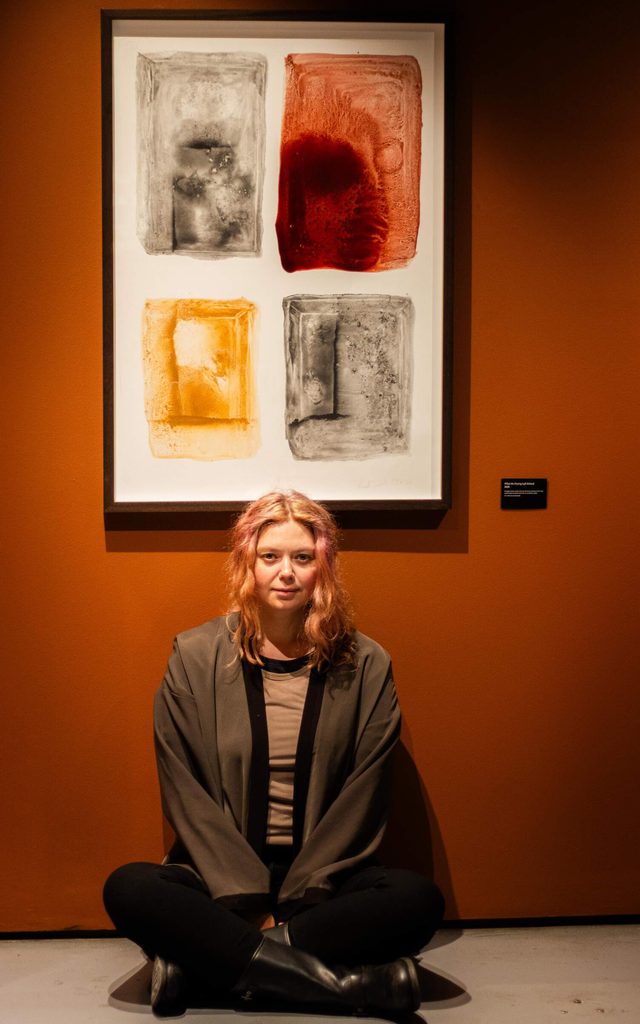
The scientific and bio-based medium are further expressed through how South African Permian coal in both part of a floor-layout installation and as hand-ground pigment in What the Drying Left Behind painting series. Henrietta’s work is situated at the cusp of existence and passage. For instance, the South African coal mines occupy a momentous aspect of the national psychosocial and as Hugh Masekela’s Stimela song reminds us, of the broader African continent. Here, coal becomes part of Henrietta’s bio-based, nature-based foraged materials, which includes minerals.
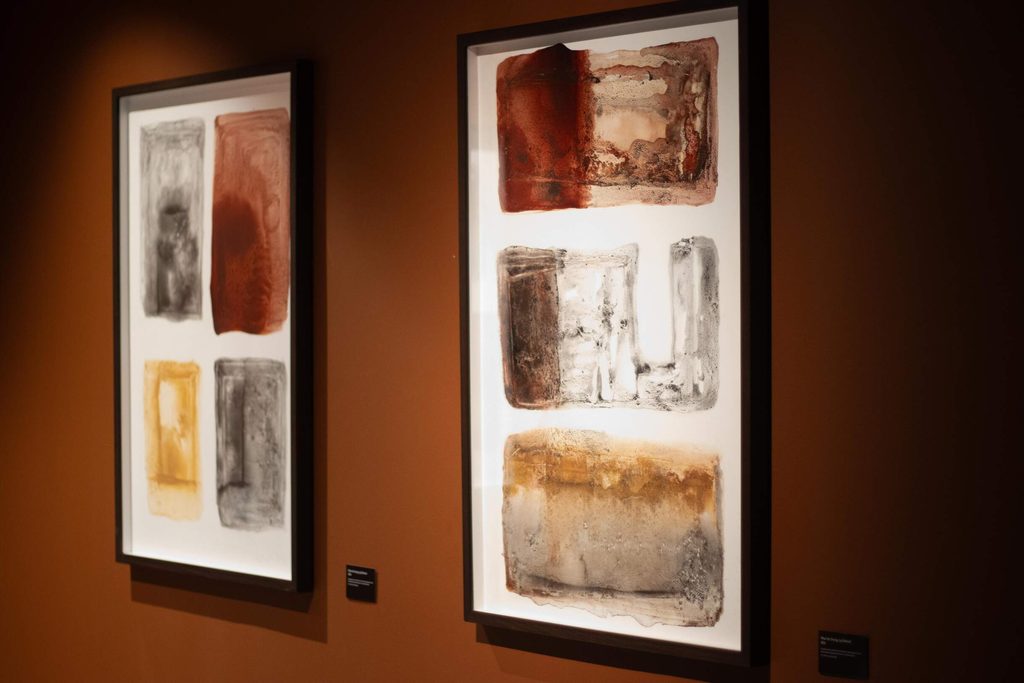
The same coal which contributes to the national economy and an essential part of our weekend braai (barbeque) with loved ones. Humanity can be quick to pass a verdict on what is immaterial, waste and or dead. Gondwana had me asking about the seeds we cast away counting them dead and buried yet in the hands of an artist, an alchemist, well-watered gardens await the curious in the future? Visit the exhibition with a curious and open mind. “A seed can wait years in that state and still be alive.” Henrietta Scholtz
Planetary Cognitive Ecologies: Gondwana may seem like an invitation for escapism yet it draws audiences into readers and participants. I asked Henrietta to reflect on a few questions on this body of work and the UJ Arts & Culture Artist-in-Residence, below are the reflections:
Who is the exhibition for?
Henrietta: Just as the work is layered, I don’t have an ideal audience member. Anyone who is interested, or who finds a way into the work, is an ideal audience member. Someone might come through an interest in technology, philosophy, science or history, or as a student. For me, the audience is the curious individual: someone interested in the larger questions about life, or in being translocated to a different space through an experience, not necessarily through science directly. In this case, that experience uses art and science.
Most exciting moments during the process of creating the body of work.
Henrietta: Being curious is exciting for me, and every step is exciting. I was excited about learning new things in the making of this. Excitement acts as a guide: if I’m not excited about something, I generally won’t be as interested. A lot of it I had never engaged with before, and it was very hard and very challenging, but that is exciting too, because constantly learning, growing and understanding myself is exciting to me.
Traver: Share part of the challenges.
Henrietta: The hardest thing was having set myself really difficult challenges and persevering, even when things were frustrating. Working within limits of time and resources, some paths led nowhere and I had to backtrack. That is part of the research process.
Traver: What is your overall experience of the UJ Arts & Culture Artist-in-Residence?
Henrietta: I felt truly grateful and honoured to be part of the UJ Arts & Culture Artist-in-Residence. It made me feel connected to something larger, and respected in my ideas. My overall experience can be summed up in three words: guidance, support and trust.
Traver: How did the UJ Arts & Culture Artist-in-Residence impact your practice and/or ways of thinking about your work?
Henrietta: The UJ Arts & Culture Artist-in-Residence programme gave what I had been developing a home and a platform, and it allowed me to manifest concepts, ideas and artworks that I hadn’t known I was capable of. I don’t think it changed my ways of thinking, because they were already there. What it did was let me take them seriously, and give everything I had been working towards the space to synthesise in an academic and contemporary art context. It also showed me more of what is possible with institutional support.
Traver: What does “loving science as a tool for art-making” mean to you?
Henrietta: For me, it means being curious about different areas, and then finding out how those areas, methodologies, structures or tools can be used as an art-making medium. I don’t feel bound to using only science. But when scientific methodologies align with my interests, they are very much a human connection point.
The Planetary Cognitive Ecologies: Gondwana exhibition offers multiple audience entry points namely; science, art, philosophy and theory, visual, and technological. Hearing a much older attendee whisper to her company, within my ear-shot, that “I can’t believe that this is my first time on this University campus because of art” before they all giggled made me think about access. Here is a body of work on show at the Wits University Origins Centre that was initiated by the artist and made possible by her 2026 UJ Arts & Culture Artist-in-Residence, in association with the UJ Art Gallery. It was added to the programme of the Fak’ugesi African Digital Innovation Festival.
The exhibition runs until the 14th of November and entry is ticketed at the Origins Centre rates: R95 for adults, R75 for seniors, and R50 for university students with a valid student card, children under 12 with an adult, and learners. The exhibition is included with a main museum ticket. Discounted entry for the general public will also be offered during walkabouts, which will be communicated via the UJ and Origins Centre social media channels. Please bring a valid ID to gain access to the Wits University main campus where the Origins Centre is located. Come and explore how the body of work contributes to our collective public imaginaries. Henrietta Scholtz’s approach to creating this body of work takes a thread from Tim Ingold’s tools and gestures on writing and making, Laura Tripaldi’s material intelligence and Karen Bakker’s work on instruments and perception.
As mentioned earlier, Planetary Cognitive Ecologies: Gondwana poses the following question;“what survives when a world ends, and what can still be known about it?”. The exhibition invites us to think with it, the materials, the ontology, the multimedia artworks as units and a collection, and the possibilities in our current South African public imageries. The South African Permian coal presents a layer of irony and our lived realities with load shedding, rolling blackouts for our international readers. Then there is the bio-based pigment with foraged ochre and avocado seed ink.
Yep, the actual avocado seed we often throw away with the peels. Ochre plays a prominent role in many cultures across South Africa as can be noted during our annual 24th of September Heritage Day celebrations. For the curious mind, this where you look up ochre’s significance in some South African cultures, materially and symbolically. The question the exhibition poses leads us to multiple answers.
I find myself grappling with three answers centred around the ancestry of our world before humanity was conceived, present global foreign policy shifts resulting in upheavals requiring us to remember that we only have one South Africa and one African continent, and place-making as part of curating public imaginaries.
The three answers, which I elect not to offer here, also speak to my social constructs as someone who has grown to call Jo’burg home for past eleven years only. The world as we perceive it is about our passage and we might not be as fortunate as reconstructed ancestral protein or the South African Permian coal in the hands of an artist millions of years to come; make today count, it is all we have and tomorrow is never promised.
Yes, one may have responses framed in the language of the Sustainable Development Goals. The Planetary Cognitive Ecologies: Gondwana exhibition is a must see, read and experience. The conversations, enjoyment and giggles, I intentionally avoid using laughter here as I reflect on fellow guests waiting their turn at the VR section, during the opening cannot be fully captured with words here.
This reflection is not a summation of what to see. I leave room for each reader to visit the exhibition and have a personal experience. Lookout for Henrietta Scholtz and commission artworks too. “The fragmentation of Gondwana was catastrophic and generative at once.” Henrietta Scholtz.