



State Capture whistleblower bares all in her new book
Review: By Rolland Simpi Motaung

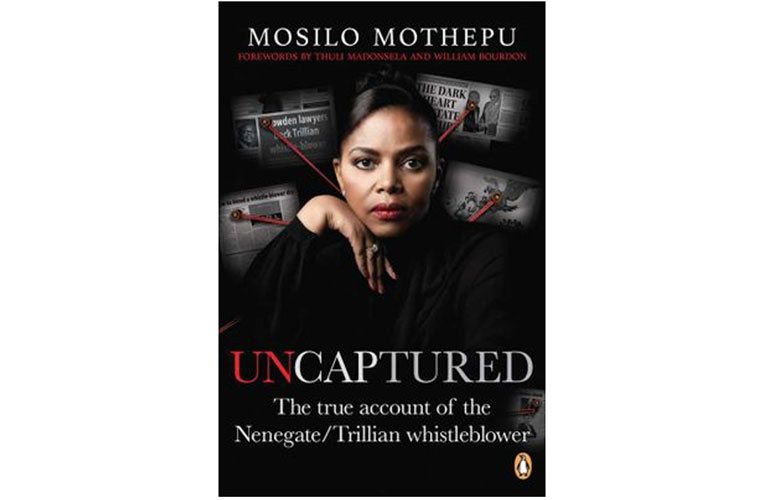
Title: Uncaptured- The True Account of the Nenegate/Trillian Whistleblower
Publisher: Penguin Books (2021)
As we await the outcome of the State Capture inquiry chaired by Judge Raymond Zondo, we can make attempts to piece together the colossal program to loot the public wallet. In this latest offering Uncaptured, Mosilo Mothepu courageously offers her personal account of how she got entangled in the Gupta-Zuma saga, and how she refused to be part of a devious initiative to bring a country’s economy to its knees. This book comes on the back of a few whistleblowers who have been bravely coming out to tell their stories on the impact of the state capture. One of them is Cynthia Stimpel who in Hijackers on Board (2021) recounts her experiences of how she blew the whistle on corruption in who gets to be awarded tender deals to restructure South African Airways (SAA) around 2016.
In For My Country (2021) former government spokesperson Themba Maseko also tells of the dubious request by Ajay Gupta to divert the government’s entire advertising budget to the Gupta’s media company. Another book that captures various voices of whistleblowers is the brilliantly written The Whistleblowers (2020) by well-respected journalist Mandy Wiener. These previous publications may be argued as smaller pieces of the puzzle compared to this latest offering. This book gives a bigger piece to this state capture puzzle through firsthand accounts exposing the main catalysts of the state-looting machinery.
SOEs as cash cows
This gripping read indicates that Trillion Capital had all the major parastatals as clients, namely Transnet, SAA, SA Express, Denel and Eskom. “Many of them had been allocated huge budgets in particular SAA, Transnet and Eskom- to undertake large infrastructure development projects” writes the author. This means that there were billions of Rands in play, which made the SOEs perfect cash cows for the Guptas and their associates. Some of the Gupta-linked associates at Regiments and Trillion included Mohammed Mo Borat, Anoj Singh and Eric Wood. Apart from the other well-publicized Gupta brothers Ajay, Atul and Rajesh, Salim Essa was considered the fourth brother and was the major shareholder at Trillion Capital. “He was the lieutenant of the empire and the brains behind much of the Gupta’s state capture operation” says the author. During her time at Regiments and Trillion the author stated how she met various players in this state capture machine “I met the who’s who of the architects and enablers of state capture, including Koko Matshela, Brian Molefe, Siyabonga Gama and Garry Pita.” All of whom were clients and the head of the SOEs.
The author’s role in state capture
Exceptionally passionate about her work Mothepu was hired as an associate director at Regiments Capital from 2007 where she resigned in 2010. After a calculated splitting from Regiments Capital, Trillion Capital Partners was formed in 2016. Both these companies offered consultancy services to various municipalities, government departments and SOEs. Being positioned as a young black woman in 2016, the author was appointed CEO of the Trillion Financial Advisory, a subsidiary of Gupta-linked Trillian Capital Partners. Being a right-hand woman to Eric Wood, one of the executives at Trillion Capital unbeknown to her at the time, was that she was getting a front seat to the state capture operations. To ensure the grooming was solidified Wood requested for loyalty from Mothepu in exchange for “rewards.” The author indicates that “at the time I had no idea that loyalty would mean being complicit in impropriety and corruption and keeping his dark secrets about state capture.” The author was privy to internal government decisions about ministers before it was announced in public. For instance, in Eric’s office in October 2015, the author mentioned that out of the blue Eric told her that then President Jacob Zuma was about to fire then Finance Minister Nhlanhla Nene. She further states that “Eric went to add that the new minister would approve new projects, such as the nuclear deal and hybrid capital to be issued by Eskom and Transnet.
”All these abrupt and disastrous reshufflings we saw unfolding in December 2015 were dubbed #Nenegate by the media. This event therefore showed the undue influence that the state capture actors had on the Presidency and other senior public officials.
Whistleblowing: The turning point
After reading an article in March 2016 about the Gupta web within the parastatals, the author thought “They left out Trillion. Mo and Eric should be in this graphic.”
For the first time the author was able to connect the dots then realized that she too, was part of that machinery. “I went cold,” she writes. After this crude realization, the author began a series of whistleblowing initiatives that changed the course of her life. This included written statements to the then Public Protector Thuli Madonsela, giving testimony at the Zondo Commission and even meeting the Federal Bureau of Investigations (FBI) agents.
With her life in danger, she sought assistance from the Platform to Protect Whistleblowers in Africa (known by its French acronym PPLAAF), an organization that fights for whistleblowers in Africa and around the world. The founder William Bourdon even described Mothepu as “the South African Edward Snowden” who was one of their clients including another world-renowned whistleblower Julian Assange.
Pressures of being a whistleblower and finding healing
The backlash from her former employers included smear campaigns, lawsuits, and harassment. Unemployed, dealing with depression, anxiety and facing bankruptcy to a point where she had to sell her house, one can feel her pain emanating from the pages.
“As I write this in 2020, I can honestly say that I haven’t had a good night’s sleep unassisted by medication, since January 2016” she writes. In finding healing, through a series of therapy sessions the author was able to deal with some of the emotional and psychological repercussions of being a whistleblower. She mentions that on her first session she broke down;
“It all came tumbling out, everything that had happened: the betrayals, the fear, and the loneliness, the loss of work and identity and purpose.”
She further writes: “I would sleep all day and drink, haunted by the feelings of hopelessness.” Though she lost friends and colleagues during these times, she still had some support from her mother and friends such as Bianca Goodson, also a former executive at Trillion turned whistleblower.
Apart from praying together, Mothepu and Bianca shared battle scars over bottles of wine. Being a high fashion enthusiast as well, the author also spent time travelling the world to countries like Paris and Spain with her partner Vusi Mavimbela.
Regarding government support the author is not pleased. Although she did get a direct phone call from President Cyril Ramaphosa, she is still dissatisfied about the lack of support for whistleblowers by the government.
“We are completely abandoned and the new dawn you speak of cannot happen without you taking care of us. I have to be the voice to those people” she firmly asserts to the president during the call. Regarding how some public sector entities perpetuate state capture by seeking external parties instead of using internal capabilities available, she charges that “the unnecessary use of consultants and exorbitant fees that they charge at the expense of the taxpayer is one of the financial and economic impacts of state capture and corruption.”
Conclusion
Mothepu is still dealing with chronic depression and anxiety and still suffers from insomnia. Despite that, however, she is still rooted in prayer, justice, and ethical standards. Apart from telling her side on the state’s capture and drawing attention to the challenges of whistleblowers, the arduous author mentions that this book is about empowerment. She boldly states “I want to empower and encourage anyone who is going through what feels like an insurmountable challenge, whether it’s an illness or a divorce or a death or something else entirely. Know that the human spirit is resilient.”
As we sit in darkness due to load shedding and our economic hopes are drowning in potholes due to the ripple effects of the state capture program, we trust that the efforts of all the whistleblowers will not be in vain. Criminal charges, expeditions and imprisonment should be instituted particularly after the Zondo Commission concludes its inquiry.
To emphasize her conviction to her ethical efforts, in one interview the strong-willed Masilo Mothepu stated “You guys go back to work on Monday. You get an award, you get paid, and you get a pat on the back. Nobody recognizes or funds us for the aftermath and it’s ugly. It’s nonsense. We are heroes. We are not whistleblowers”
.Rolland Simpi Motaung is a Johannesburg based writer and entrepreneur.