
Structures exhibition at Joburg Art Foundation ventilates the built environment and its relationship with human beings
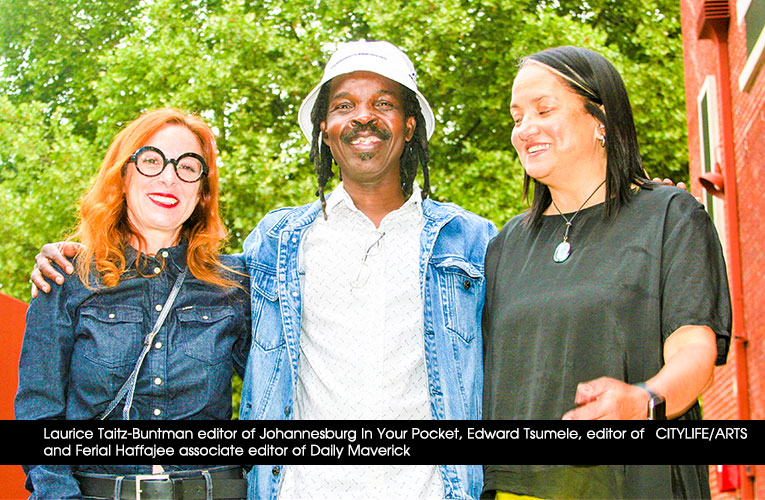
By Edward Tsumele, CITYLIFE/ARTS Editor
One thing that will greet you as your arrive at the Joburg Contemporary Art Foundation (JCAF) is a giant structure made of wood and steel, resembling a building under construction such as a scene at a construction site, in fact very common in most parts of Johannesburg right now.
This is the work of multi-disciplinary artist Stephen Hobbs, who is mostly known for his fondness of architecture. He is not an architect, but his work is based on architecture, as he creates sculptural works that investigate the intersection of architectures, spaces and human beings.
This structure is one of them, and in fact is an introduction to the current exhibition titled Structures which opened last month and is running till September at this Forest Town, Johannesburg, privately owned museum, which is increasingly playing an important role in art education in the country.
In fact museums such as JCAF in South Africa have replaced public museums in leading the way when it comes to art education simply because public museums have over the years increasingly lost their status and capacity as centres of public art education due to a number of factors, such as continuous budget cuts by authorities and in some cases wastefulness of resources by incompetent and corrupt bureaucrats leaving private museums to pick up the pieces and fill in the gaps.
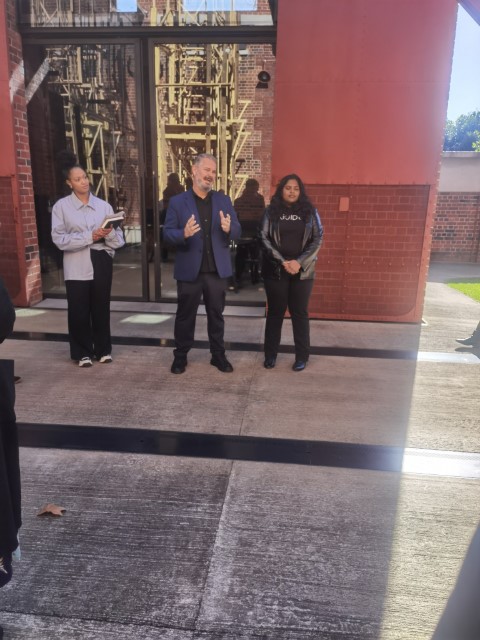
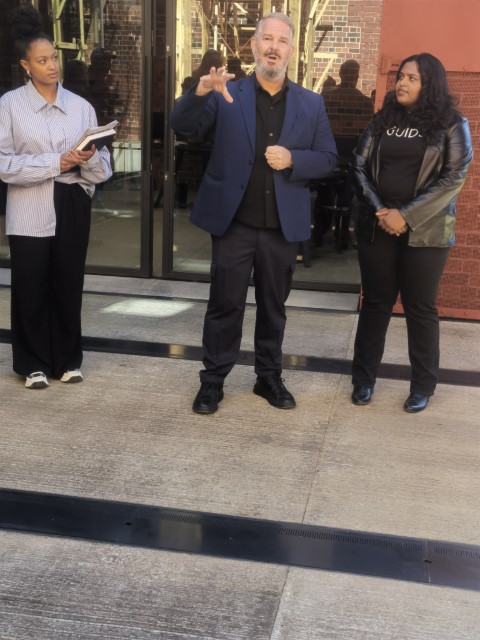
I was part of the media that was invited to the exclusive opening of this exhibition in May, and I witnessed the importance of such spaces as JCAF when it comes to public art education as those present (locals) who created sections of this multi-faceted exhibition took turns to explain the process and the thinking behind their specific work. All the participants present came out as knowledgeable and gave helpful insights to the media about the work they created. I somehow felt that it would be a master exhibition, perhaps the best that this institution has put up so far since its founding in 2019, before its programming was disrupted by the global pandemic Covid-19, if the international contributors were also there to explain their specific parts of this interesting exhibition.
This in no way is to suggest that Structures is not adequate with regards to its current curatorial impetus. The fact is it is a powerful exhibition that one must visit and view before it comes down in November. The fact is it is quite insightful in at least its ventilation of the built environment and its relationship with human beings.
“I am no architect, but I have always worked with architecture in my art practice. The fact of the matter is that everywhere you go in post- colonial Africa, you will always come across half-finished structures, such as buildings, some of which have been like that for several years. In South Africa, just like on the rest of the continent, you will see half-completed structures in urban areas,” Hobbs explained the motivation behind the structure.
The Structures exhibition is in fact the second in a trilogy of exhibitions exploring the museum’s theme titled Worldmaking, three-year programme explored through a trilogy of exhibitions and an accompanying series of talks and publications that consider the kind of world we want to inhabit and leave behind.
Last year, JCAF presented Ecospheres (2024), a reflection on the natural world. This year, Structures (2025) focuses on the built environment, and next year’s Futures (2026) will explore the techno-future.
Structures brings together artists and architects from the South who engage with questions of space, place and race.
“A structure can be understood in both material and immaterial terms. It might represent a body of knowledge, a social framework, or an infrastructural system treated as a single entity, held together by a plan, a pattern or a guiding logic.
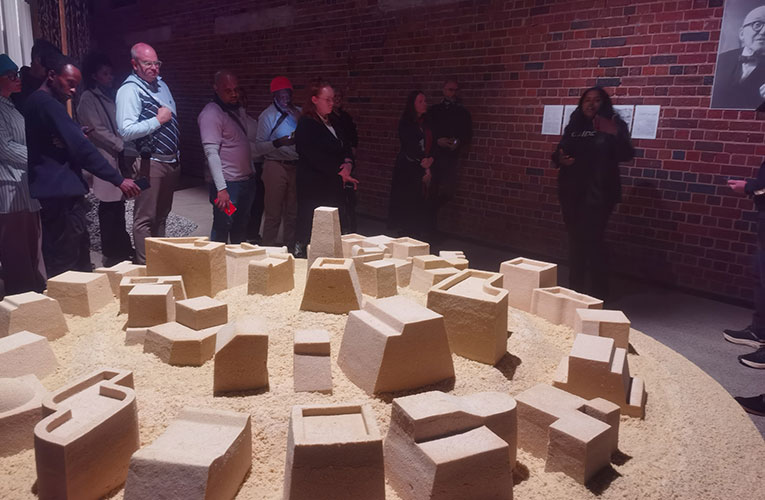
For this exhibition, JCAF brings home the immersive South African Pavilion from the 2024 VeniceBiennale (originally commissioned by the Department of Sport, Arts and Culture), installs a city made of couscous, presents an interactive installation by a women-led architectural collective, displays delicate photographs capturing light in Tunisia, and reconstructs a Brazilian installation from the 1970s that visitors can walk on, over and through.
While the featured artworks are charged with political concerns, they also explore the poetics of the relationship between materials and meaning. From the walls of a panel beater’s workshop that gesture toward spaces of manual labour, to the social meaning of Constitution Hill and the Union Buildings in South Africa today, and the “desire lines” carved by people in Cape Town that contest apartheid spatial planning, the exhibition reflects on what is embedded in physical structures—and how people themselves can become a form of infrastructure2
.This is expressed throughout the exhibition in different ways: monuments that convey political ideologies, the Bahurutshe and Bakoni peoples’ evolving relationship to land following displacement, couscous as a prompt for conversations around Algeria’s cultural heritage, and stories of migration that intersect with acts of place-making,” says the Museum in its curatorial statement.
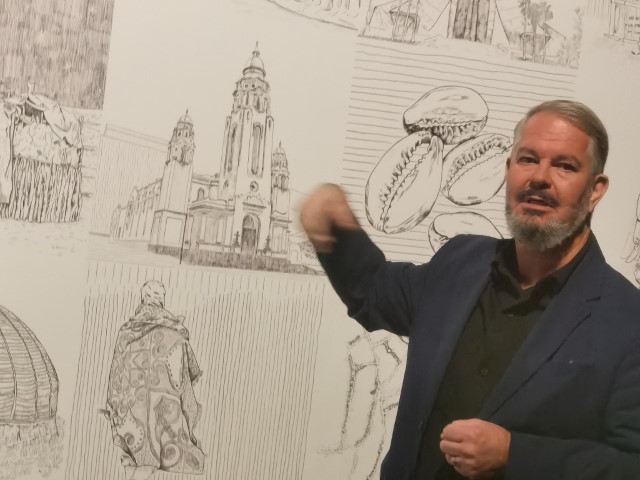
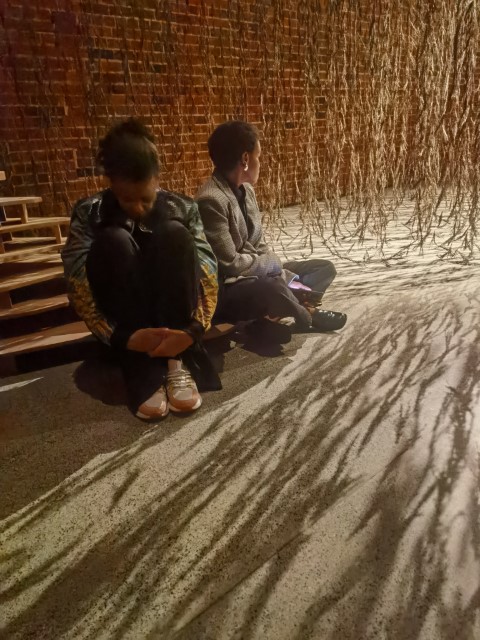
I particularly liked the part that was in fact the South African Venice Biennale installation especially as co-creator of it, Molemo Moiloa of the collective, MADEYOULOOK (comprising Molemo Moiloa and Nare Mokgotho) articulated the two powerful stories underpinning the thinking behind the exhibition.
Commissioned by the Department of Sport Arts and Culture, Republic of South Africa for the 2024 South African Pavilion at the Venice Biennale, curated by Portia Malatjie and managed by Makgati Molebatsi, Moiloa articulated well the two stories captured by this installation. The historical narrative of how two communities in North West (Bahurutshe) and Bakoni (Mpumalanga) and their close relationship with their land.
Another section that caught my eye is one created by a progressive group of women creators that go by the name of Matri-Archi(tecture) (South Africa/Switzerland), which was founded in 2017by a South African born but Swiss based architectural researcher Matri-Archi(tecture) was founded in 2017 by Khensani Jurczok-de Klerk. This one looks at the architecture of the Union Buildings in Pretoria and Constitution Hill in Braamfontein, two places that contain past and complex histories as well as current histories in post-apartheid South Africa. The two buildings are quite historic, but their histories and what they represented in the past and their role and purposes now are quite contradictory. Please do not leave before visiting this section of the exhibition if you intend to go visit Structures.
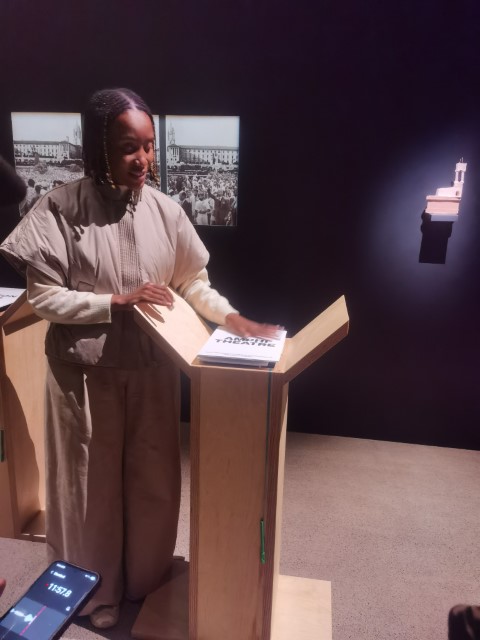
“At the heart of these concerns lies a central question: How have indigenous forms of artistry, tradition and knowledge contributed to architecture and everyday life in the Global South—more especially in a South African context?” asks JCAF’s Executive Director and curator of the exhibition, Clive Kellner.
Featured artists:
Igshaan Adams (South Africa)
Kader Attia (Algeria/ France)
Kamyar Bineshtarigh (Iran/South Africa)
Jellel Gasteli (Tunisia/France)
David Goldblatt (South Africa)
Kiluanji Kia Henda (Angola)
MADEYOULOOK (South Africa) *
Matri-Archi(tecture) (South Africa/Switzerland)
Hélio Oiticica (Brazil)
Hajra Waheed (India)
Special projects:
Wolff Architects (South Africa)
Rebecca Potterton (South Africa)
Stephen Hobbs (South Africa)
* The sound installation, Dinokana (2024) by the collective, MADEYOULOOK (Molemo Moiloa and Nare Mokgotho),
Exhibition Details
Exhibition dates: 31 May – 15 November 2025
Bookings can be made on the JCAF website from 19 May 2025
Exhibition viewing is by appointment only
Entrance to JCAF is free to the public
Visit www.jcaf.org.za for further information
Instagram @foundation_jcaf