



Thandiswa Mazwai delivers a frenzied set at the National Arts Festival
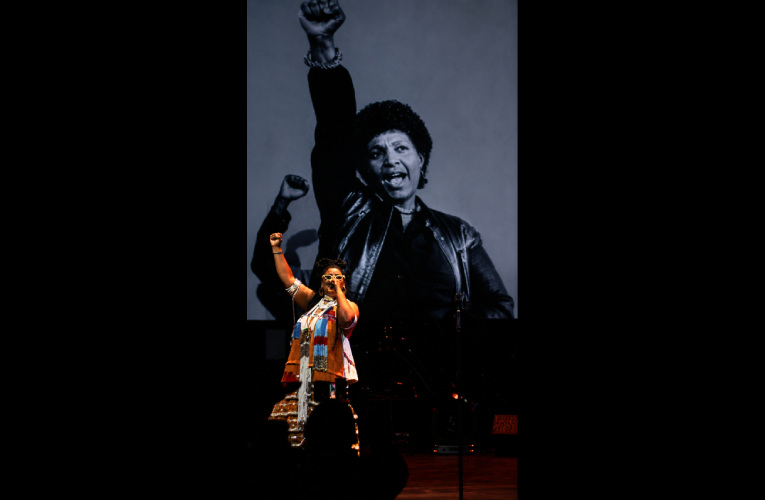
She also induced the audience into a chant of “take me back to my mama’s village” and created a photographic moment when she donned shades while singing Zabalaza’s Ni Zalwa Ngobani with a fist clenched in the black power salute while a huge image of Winnie Madikizela-Mandela in a similar pose loomed large in the background.

By Jacob Mawela at the National Arts Festival
Popular singer Thandiswa Mazwai delivered an octane-charged once-off festival closing night performance at the Guy Butler Auditorium inside the 1820 Settlers Monument building during the penultimate day of this year’s National Arts Festival at Makhanda.
Following closely after 2026 Standard Bank Young Artist award recipient for Jazz Gabi Motuba’s 120 minute curated programme at Rhodes University’s Great Hall, just down the road – the duo of Gauteng-based songstresses, quickly turned the chilly weather of the Eastern Cape town into a non-factor as washed-and-dressed attendees, collectively generated the requisite heat for memorable events.
Hyped as one of South Africa’s most significant voices of the post-apartheid era, like Motuba, Mazwai’s appearance, was a once-off shindig which had attendees inside the sold-out venue up on their feet and dancing throughout the 60 minute curated programme.
An erstwhile member of Bongo Maffin who has since carved a solo career, which has moved her across Xhosa tradition, mbaqanga, reggae, et cetera – Mazwai performed in Makhanda with her band consisting of Lungile Maduna (drums), Sanele Phakathi (keys), Sunnyboy Mthimunye (guitar) and Tendai Shoko (bass guitar), to deliver a body of work which was deeply rooted and restlessly alive.
Mentioning that she has been coming to the festival since the early 90s while a student, Mazwai drew rapturous applause from an audience which included the freshly-appointed CEO of the National Arts Festival, Palesa Kadi, Miss Grand India and a delegation from Zambia.
A veteran who has participated in pan-African collaborations and Diaspora connections, which have witnessed her performing on stellar stages ranging from Carnegie Hall, Apollo Theatre to Cannes Film Festival, Mazwai’s presentation included familiar old-school hits from past albums.
She also induced the audience into a chant of “take me back to my mama’s village” and created a photographic moment when she donned shades while singing Zabalaza’s Ni Zalwa Ngobani with a fist clenched in the black power salute while a huge image of Winnie Madikizela-Mandela in a similar pose loomed large in the background.
Working the stage from end to end, donned in Chuck Taylor sneakers, Mazwai delivered an energetic and frenzied set, which had old-timers screaming in approval. It was befitting response for a still young artist who appears to have stayed the course in a notoriously temporary industry in which contemporaries have yet to master, balancing making gainful living from.
Moreover, Mazwai’s resume is festooned with commendable milestones: with her first solo project 2004’s Zabalaza reaching double platinum status and garnering her awards, such as a Kora and four SAMAs; the sophomoric 2009 release Ibokwe realizing critical acclaim; 2016’s Belede reaching gold status; her fourth release, 2024’s Sankofa which combines archival Xhosa field recordings and includes songs which were produced by the likes of Meshell Ndegeocello and Nduduzo Makhathini.
A bio of the artist made available on the NAF website mentions Sankofa as meaning ‘to go back and fetch what has been left behind’ – which related to Mazwai, as she pointed out that her relation with Makhanda also extended to 2010, when she visited the International Library of African Music at Rhodes University.
There, she got access to an archive of field and research of Xhosa music which contained musical expressions such as umrhubhe and uhadi. Thus, her appearance at the NAF was apt in the context of giving back to a place (the Rhodes African music library) which was instrumental in her development as the matured musician she’s evolved into.