



Visual artist Lerato Motaung’s exhibition Whispers at Constitution Hill carefully sketches the artist’s personal journey of memory and loss
Not only does this exhibition trigger individual emotions that at the end become a collective wave of emotions among those viewing the exhibition, The Whispers instigates individual imagination about their own fading fragments of memory.
By Edward Tsumele, CITYLIFE/ARTS Editor
The first time I was exposed to Lerato Motaung’s art practice it was last year at a former factory warehouse in Bertrams, east of Johannesburg, that is owned by well-known South African abstract artist Nicholas Hlobo, whose home and studio is also in the vicinity. It is a former Synagogue that he bought and repurposed into a home and studio.
Hlobo, who is said to be one of a collective of a group of artists, working with and supporting the emerging conceptual practice of Motaung, as fellow corroborators, and in some cases, contributing in kind, such as their time and ideas in shaping his exhibitions, were once gain at the Constitution Hill Women’s jail on Saturday April 5, 2025. They congregated to witness the second iteration of this latest series of conceptual exhibitions by Motaung, who also paints and mounts installations.
The first iteration last year, was an impressive body of work, not only because of the power of the idea, but the use of unusual material to create a powerful narrative about memory, rather fragments of memory about his life. At last year’s exhibition, which got a lot of people talking, including fellow artists, he used simple material -beer bottles that were collected around Johannesburg over time and then broken into little fragments that formed a curious hip of a small hill at the centre of the exhibition. Above this hip hung tires suspended on the ceiling by ropes. That was it. But this simple installation told a complex story of the artist’s navigation of life. Including healing from personal loss, such as the loss of his grandmother that he was close to.
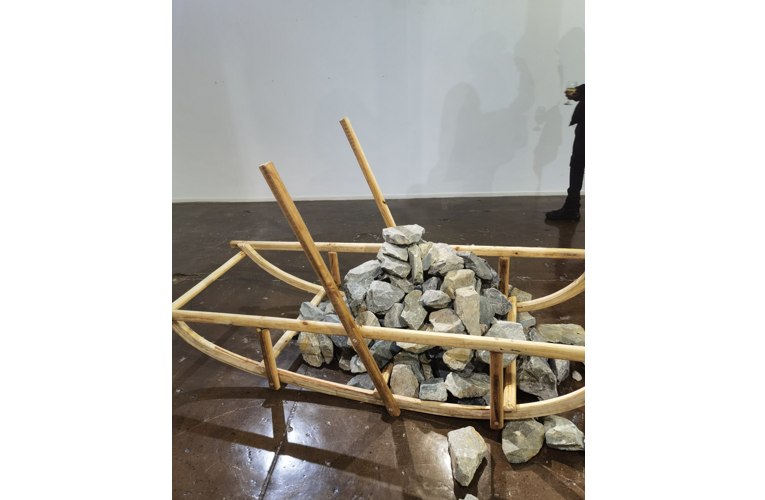
The Whispers exhibition, that is currently on at Constitution Hill, is an elevated variation of last year’s exhibition. And just like last year’s exhibition, The Whispers carefully sketches Motaung’s personal journey, and again using simple materials -wood that has been turned into a structure, an undefined furniture like, on which stones of different sizes are piled up meticulously, seeming to balance precariously on each other, and on other structures the stones seem to be flowing out of the structure onto the floor.
Again, this exhibition is an attempt by the artist to articulate his life’s journey, particularly the fragments of his memory that seems to be fading, essential salient moments being slowly erased from his memory as he grows into adulthood.
Again, through The Whispers, just as he did last year with his first iteration of this series, Motaung manages not only to share his life’s journey, but he evokes in a viewer their own fading memories of their salient moments in their own journey. And just like the pain of loss that is embedded in The Whispers, a viewer is also triggered into remembering their own loss. Such as the loss of their loved ones. This is what makes this exhibition powerful, and that is that Motaung’s loss that he is articulating in this exhibition, using a powerful language within the abstract art realm, becomes a collective and yet individual shared experience. Not only does this exhibition trigger individual emotions that at the end become a collective wave of emotions among those viewing the exhibition, The Whispers instigates individual imagination about their own fading fragments of memory.
This series definitely distinguishes Motaung as one of a new crop of conceptual artists whose art practice is bound to attract curiosity and even admiration from the global art world, particularly those invested in abstract art.
And what is also notable in this artist’s journey of creating this series, is his keenness to collaborate with other artists, even those from other art disciplines to shape what then becomes an installation for public viewing. The result is pleasing.
“I have worked with a number of artists as collaborators, who came with different ideas on how best to put together this exhibition as a process of creation. Some of them are musicians. They all came with different suggestions working of course around my grand idea. Sometimes we differed and sometimes we agreed, but at the end, all these ideas shaped what you see in this exhibition,” he explained.