

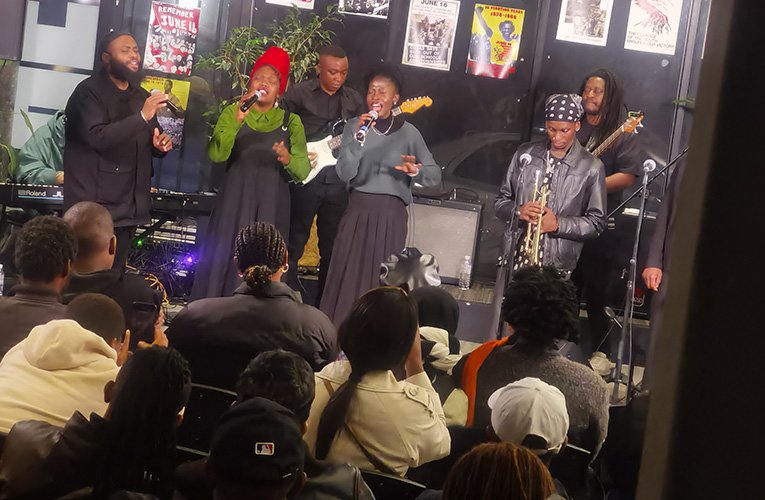
1976: A Political Revival at The Forge was a site for meaningful intellectual engagement, poetry and Afrocentric music performances
By Edward Tsumele, CITYLIFE/ARTS Editor

By Edward Tsumele, CITYLIFE/ARTS Editor
When the CITYLIFE/ARTS team arrived at 1976: A Political Revival event, we noticed that one thing struck us as unusual. There was no parking space on Reserve Street in Braamfontein on Saturday, June 27, 2026. Cars filled up whatever parking space was there, spilling over onto the neighbouring streets. Inside, The Forge, was packed. Some people stood outside chatting, while waiting for an opportunity to move in whenever some people already inside, got out for fresh air, in the process, creating space for those waiting outside to move in.
We found a captive audience, comprising mostly of the woke youth of Johannesburg, and of course, adults especially those coming from academic and art background. Not even Basha Uhuru Festival, the annual popular Constitution Hill festival, taking place a mere 500 metres away, distracted this audience. They had decided a long time ago, that this was the event they were going to attend.
After all, it was an event for those intellectually inclined, and it appeared as if, there were lots of those in attendance. The music offering, the poets chosen, and the speakers that had been booked for the day, were all carefully curated to give the audience a glimpse of where South Africa is today. Freedom itself, rather, the outcome of the liberation struggle, was under scrutiny from the poets, the musicians and the speakers. The audience seemed to agree that the country was at crossroads, 32 years later after democracy was attained in 1994. A democracy gained through a hard fought struggle, where some paid the ultimate price, others incarcerated for long periods in jail, while others remain scarred for life till today, both physically and psychologically.
But here we are, the very same democracy that came as a result of those sacrifices, was under scrutiny in this Youth Month of June, commemorating the June 16, 1976 Student Uprising.

What with the gap between the rich and the power, continuing to grow even wider, instead of closing, uncertainty about the possibility of an inclusive society proving to be continuously elusive. This event that got those with big minds, an opportunity to share their thoughts and ideas with a captive audience, happened against the backdrop of a collective anxiety caused by a number of issues that define contemporary life in South Africa right now.
What with the issue of racial harmony constantly threatening to rapture as race relations in South Africa stand on precarious grounds, 32 years after democracy. What with the protests that have been going on around the country against the presence of Africans from other countries on the continent in South Africa, both legal and illegal, leading to mass evacuation of Africans worried about the uncertainty of the June 30 deadline declared by those whose actions tend to frame South Africa as a country unfriendly to Africans from other countries. Legally or illegally here.
The occasion appeared to be a perfect platform for those gifted in words and music, to give light to the complexity and nuances of life in South Africa right now. This event, therefore, was more than just a poetry and music event taking place at The Forge on an ordinary Saturday. For those participating, both audience and performers, appeared to share one mission, a diagnosis of a country under strain, 32 years after democracy. A country unsure of its place and its uncertainty about leading the continent. Ironically, this is a factor, which at one stage after democracy, it was almost a foregone conclusion. This is given South Africa’s huge economy, strong institutions and massive infrastructure. But right now, nothing seems to be certain anymore. The country’s relationship with the rest of the continent, given the current protests, sometimes violent and fatal, led by movements, such as March and March and Operation Dudula among others, make that possibility seem like a far-fetched idea. These movements complain that Africans are competing with ordinary South Africans for jobs, business opportunities and access to social services, such as health facilities and education.
And therefore, against this background of uneasiness, uncertainty and prevailing doubts about the promise of liberation delivering ordinary South Africans from poverty, unemployment and race based inequality,: 1976: A Political Revival, was more of a conversation than a musical and poetry performance event. It felt like an event providing an intellectual sanctuary to a restless, an uncertain young intellectual class, caught up in a moment of uneasiness and uncertainty in a country fighting hard to emerge out of real challenges. Such as lack of economic growth, poverty, and massive unemployment among the ranks of the youth. All these frustratiuons sometimes express themselves through the phenomenon of xenophobic sentiments directed at Africans. This is clearly as a result of the difficulties ordinary South Africa face daily.
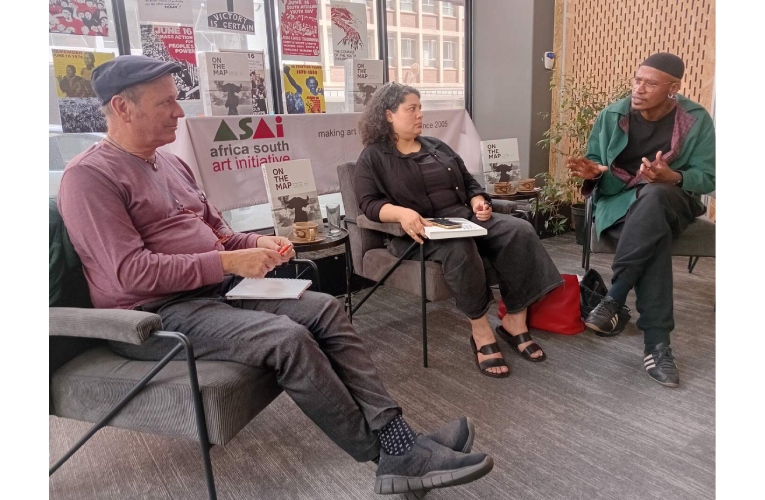
When the CITYLIFE/ARTS team arrived, we found The Forge’s co-director Yvonne Phyllis in the middle of introducing Dr Buthane wa Bofelo, a scholar and poet, who quickly got to setting the tone of his poetry reading and performance through referencing the scholarly work of Franz Fanon.


He positioned the selection of his poetry for the day in the same frame as Franz Fanon’s critique of Negritude, when African American thinkers of the time, such as jazz and blues musicians, responded to the weight of segregated America through creating improvised, rhythmic jazz and blues music, that cast them as victims, instead of as an oppressed people with agency to proactively get rid of that burden of oppression.
He went on to list some modes of struggle employed by South Africans during Apartheid and after Apartheid had fallen, and the responses that it triggered from those who felt the oppression.
For example, Bofelo said, South Africans started with a struggle mode called Petition, a plea to government to ease life on those oppressed. When that did not work, they escalated the struggle to Protest, and the corresponding music was jazz, which was a more resolute response than the Petition response.
When that did not work too, they further escalated the struggle in a form of the Resistance that he, said triggered a Biko type of response.
What was especially notable in this framing of his poetry that he presented, is that he located FeesMustFall movement, when black students, mainly at historically white universities, including Wits, Rhodes and University of Cape Town, protested against unaffordable university fees that their parents could not afford, including those classified as middle class, in 2015/2016.
“The musical response to that was hip hop and indigenous music,” he said.
Bofelo then went on to present six poems, some in Sesotho, and others in English that he said were aligned with a specific mode of resistance.
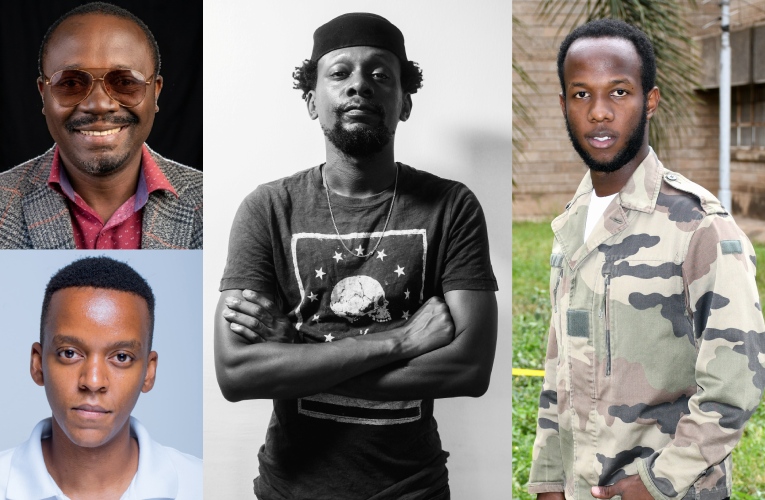
Indeed one of the groups that emerged at Wits the FeesMustFall movement as participating students at Wits at the time, who extended their ‘rebellious’ music beyond lecture halls into the streets, is Afrocentric group iPhupho L’ka Biko. What started as a “rebellious” music group in academic halls, is today, a solid musical ensemble that has a huge following across race and age in South Africa. The group has filled up clubs, and has performed at major musical events, such as Cape Town International Jazz Festival, and Joy of Jazz festival, among others.
Framing what they do as informed, Pan African music, guided by the spirit of Black love and Black Consciousness, their music tends to connect easily with all races and age groups, particularly appealing to woke youth. Such as the ones who gathered at The Forge on Saturday, June 27, 2026. The audience showed the group some love, even as they performed new songs, instead of the old popular songs that are now very much etched on the minds of especially middle class youth with a Black Consciousness sensibilities.
The group was warmly received, and so was Imvemnyama, whose powerful performance of a mosaic of jazz, indigenous sound, blended with innovative story-telling, was also received with some love from the appreciative audience.
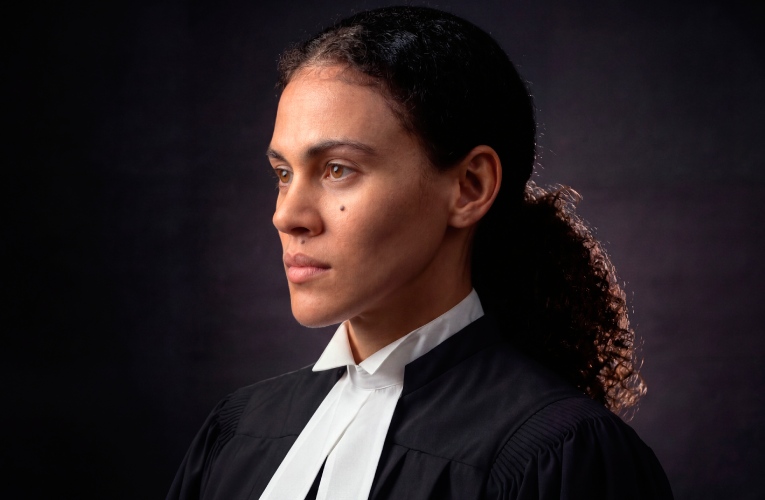
This admitted Attorney, songwriter and performer, has this year, released his debut EP, titled Emnyamandawo.
Others who participated in this event include poet, Nonkululeko ‘MaMntambo’ Mntambo, who held her own as a performer and political thinker, whose work as a writer, researcher and society practitioner, sits at the intersection of politics, memory, faith and social life.
Nomzamo Zondo, especially right now, when issues of activism, particularly when it comes to interventions to protect the vulnerable of Johannesburg, has a full engagement diary, as Executive Director of Socio Economic Rights Institute (Seri). However, before she dashed out to chair a virtual meeting that evening, she had time to address the gathering on the need to reclaim people’s spaces. Such as Constitution Hill, which she maintained, due to bureaucracy, remains inaccessible to individuals and organisations that are fighting to transform the lives of those on the margin of society, to bring them closer the centre.
So, the 1976: A Political Revival, became a platform for meaningful intellectual engagement, social conscious poetry and Afrocentric music performances.