



Academic Mark Swilling in his new newly released book argues that apartheid ended because of what unfolded one day in Langa
Yet there is another event, less known publicly, but its aftermath in the 1980s, had a huge impact on the course of the struggle for freedom. You may not have known much about this event, however it had so much impact on the trajectory of the fight for freedom, that the author of the book In 1985: The Langa Massacre and the Ending of White Rule in South Africa,Mark Swilling,attributes what happened there as one of the reasons why white rule ended in South Africa.
By Edward Tsumele, Winner of NHC Heritage Journalism Award for 2026
When wars are fought there are certain moments that are quite poignant in a conflict, and have a huge impact on the direction of the conflict. Some even change the course of history.
For example in the context of the struggle against apartheid, there are several such moments that characterised the South African conflict-freedom fighters on one hand that fought for freedom and to unchain black South African from the chain of apartheid oppression and racial segregation, and on the other those that fought to maintain the status quo, mainly the apartheid government and its bureaucracy that it established to implement apartheid.
These poignant moments often change the course of the struggle, and even redefine the character and trajectory of the struggle going forward.
For example, when Sharpville happened in 196o, it was a huge even whose implications went beyond the borders of South Africa as it showed the brutality of the apartheid machinery to the rest of the world. Not only because 69 people lost their lives and several others were left injured, but that it exposed the brutality of the apartheid repressive system for the rest of the world to see.
Today, June 16, 1976, is not remembered as just yet another date on the South African calendar. It is a year that saw young people stand up to the apartheid regime and take it head on, protesting in big numbers in Soweto in what has become to be known as Student Protest, as a way of defying the attempt by the government to introduce Afrikaans in black schools as a language of instruction. The student resisted forcefully, pushing back the attempt, and in fact, demonstrated the youth’s agency when in it came to their capacity to fight for freedom in South Africa.
Today that day is a public holiday, declared so, to commemorate the heroic act and the agency of young people to fight injustice and for their own freedom, and that of society at large.
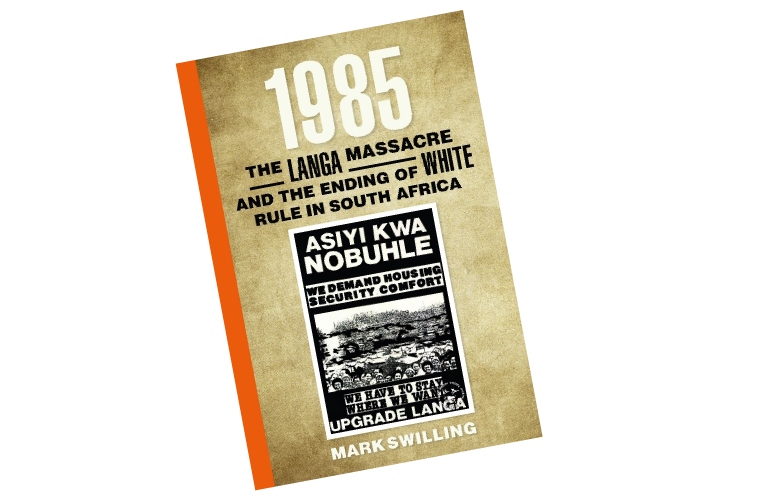
Yet there is another event, less known publicly, but its aftermath in the 1980s, had a huge impact on the course of the struggle for freedom. You may not have known much about this event, however it had so much impact on the trajectory of the fight for freedom, that the author of the book In 1985: The Langa Massacre and the Ending of White Rule in South Africa, Mark Swilling,attributes what happened there as one of the reasons why white rule ended in South Africa.
In this well researched book, Swilling revisits the event that unfolded on that day, and analyses the implications of the events in relation to the wider struggle for freedom. The massacre had consequences for the government of apartheid. It lost momentum in its resistance to the march fro freedom.
What happened?
On 21 March 1985, police opened fire on a funeral procession in Langa township outside Uitenhage in the Eastern Cape, killing peaceful protesters and sending shockwaves through South Africa and around the world.
Forty years later, acclaimed academic and author Mark Swilling revisits this pivotal moment in South African history in 1985: The Langa Massacre and the Ending of White Rule in South Africa.
The book tells the story of the massacre, the events that led to it and what followed – both in Uitenhage and across the country – while examining why 1985 became such a decisive year in the struggle against apartheid.
While the Sharpeville massacre of 1960 was followed by the banning of liberation movements, the imprisonment of resistance leaders and the strengthening of the apartheid state, the political consequences of Langa unfolded very differently.
By 1985, South Africa was governed by an increasingly militarised and authoritarian apartheid regime facing growing resistance from communities across the country. Democratic movements representing the aspirations of the black majority were finding new ways to organise mass resistance while simultaneously developing democratic alternatives at local and national level.
The Langa massacre became a defining moment in this changing balance of power, argues the author.
Four years later, Nelson Mandela was released from prison. Five years after that, South Africans participated in the country’s first non-racial democratic elections.
In short, 1985 examines how this transformation became possible.
At the heart of the book is the massacre itself: the killing of peaceful protesters on the dusty streets of Langa township on Sharpeville Day, 21 March 1985.
Swilling reconstructs what happened before, during and after the shootings, placing the tragedy within the wider political upheavals of the 1980s and the growing mass democratic movement that was making apartheid increasingly difficult to sustain.
But 1985 is more than an account of a historical event.
At a time when authoritarian populist regimes are gaining ground in different parts of the world, democratic movements are once again confronting difficult questions about how to resist increasingly violent, exclusionary and authoritarian forms of government.
South Africa’s experience during the 1980s provides an important historical case study.
How does a democratic movement confront a powerful authoritarian state? How can mass resistance be organised without descending into prolonged civil war? Can resistance and negotiation take place simultaneously? And how can democratic alternatives be built while an undemocratic system is still in power?
South Africa’s transition ultimately resulted in the negotiated dismantling of the apartheid state and the establishment of a constitutional democracy.
Understanding the events of 1985 – and particularly what happened at Langa – is therefore essential not only to understanding South Africa’s past, but also to contemporary debates about democracy, political resistance and authoritarianism.
In 1985: The Langa Massacre and the Ending of White Rule in South Africa, Mark Swilling brings this critical period back into focus and argues for the importance of understanding the people, organisations, decisions and events that helped change the course of South African history.
And therefore this book is not only a historical account of the tragedy that took place in the context of the struggle, but how that event changed the course of history in the struggle for freedom. Yes, events such as the Sharpville massacre and the Soweto Student Protest, and certainly other tragedies that befell the country in the struggle for freedom, had a bearing in the direction of the struggle for South Africa’s freedom, but this less known event too played a significant role.
The author has put forward strong arguments to demonstrate how that single event had such a huge impact in the march to freedom.
It is therefore recommended that you get for yourself a copy of In 1985: The Langa Massacre and the Ending of White Rule in South Africa. It will leave you better informed about the various factors that led ultimately to freedom in 1994. It was a collection of events, which when looked individually, may not make much sense, but in totality they do. This is one of them.
.Massacre and the Ending of White Rule in South Africa is published by UJ Press.