




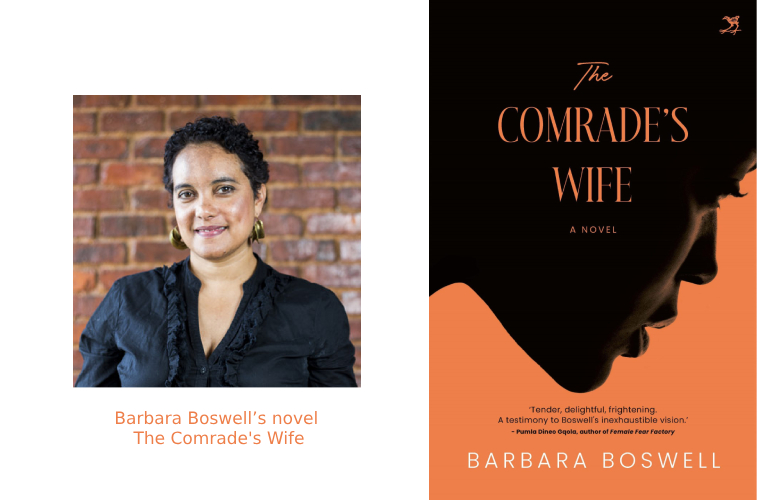
Barbara Boswell’s novel The Comrade’s Wife is a subtle critique of former liberation fighters turned rogue in post-apartheid South Africa
By Edward Tsumele, CITYLIFE/ARTS Editor

There is something about this novel that makes it a great read. In fact, some with valued arguments will conclude that is a mirror of contemporary South African society in the context of the new political elite’s behaviour, which-prioritises greed over public service and personal individual instant gratification over transformation for the benefit of society. And again, they will be right.
The Comrade’s Wife is not a book about how wonderful the country is – which by the way is true even though there are problems that continue to make us believe that we are not sometimes.
I mean we have a wonderful constitution, a resilient population, a thriving creative environment that continues to churn out wonderful people that go out there to generously gift the world with what they God-given create. Think about Trevor Noah. Think about Black Coffee. Think about Tyler. Think about Charlize Theron. Think about Elon Musk, the richest person on earth currently. Think about Lebo M and what he gifted The Lion King with. So, no doubt this is a great nation among other great nations of the world.
Therefore, Barbara Boswell’s The Comrade’s Wife is not about all these great things made possible by the great minds of great people born in this country. Rather the novel is about the other side of this society, the side that unfortunately consistently manifests itself in an ugly fashion in post-apartheid South Africa -greed and corruption by the powerful and wealthy. The Comrade’s Wife is critique of the politics of power and the stomach, and ethical degeneration affecting a segment of a population that at one time did a great thing for this country. This a generation that bravely took up arms at great personal risk and fought the evil of apartheid that they eventually won so that everyone, black or white would enjoy the beauty of this country and take on opportunities for self-advancement. These were opportunities that were previously under apartheid denied to the majority based on one’s skin colour. The black people of South Africa were prevented by the system from fully participating in the country’s economy and take on educational opportunities for example, among other obstacles they faced.
And so, reading The Comrade’s Wife, though it is a book about one man who uses the power in a wrong way. In his case the power that comes with lots of money and political positionality and betrays those close to him as well as the values that once underpinned his quest for fighting for justice. The protagonist who belongs to a ruling party that is faction infested after winning the first democratically held elections in the country has gone rogue. In every aspect imaginable, he has lost his moral compass and is therefore no longer the freedom fighter that he once was, fighting a good war of liberation and freedom.
In the new South Africa with a comfortable seat in parliament after a successful life in law practice, Neill has sadly lost his way. For example, the married and wealthy comrade has a string of women, he is given to lying to his wife repeatedly and his cheating is legendary. That is of course until he is caught and everything that he had tried to hide coming out into the open, eventually. And come out they always do, don’t secretes do.
The Comrade’s Wife is a novel that that cleverly uses the genre of fiction to clinically dissect the current problems involving former comrades who are now in position of power in government. Talk about corruption, cheating, and abuse of power by the new elite of the post-apartheid south Africa.
Does it sound familiar? Former comrades and struggle heroes who are now holding the levers of both political power and financial muscle, and how they use such resources in a crude and morally detestable way is something that unfortunately is increasingly normalised.
All these issues are creatively ventilated and weaved into The Comrade’s Wife through the two protagonist Neill the philandering politician, an MP who aims to grab the position of Speaker of Parliament once his faction wins at his party’s upcoming conference, on one hand, and on the other Anita, a honest and hard- working, love-struck professor of history. Devastated by the failure of her first marriage due to the fact hat she could nor conceive, Anita, the professor of sociology at the university of Cape Town fell for Neill’s charming demeanour, whom she met through the dating App Tinder. Yes, these days people search for love on this App, including the educated and high flying.
What makes this a sad revelation, but good fiction though, is that the two protagonists, both so called Coloured in the South African context of narrow racial identity definition, one born in the poverty stricken Mitchell’s Plain in Cape Town, and the other from an equally poor Coloured family in Bloemfontein, is the fact that both Anika and Neill’s stories of struggle against poverty are the essence of what rising above your environment to achieve something in life is all about. Neill fought poverty, got educated against all odds, fought in the struggle for freedom, and in the new South Africa became a successful lawyer with his own practice before turning into a politician with a seat in Parliament.
On other side Anita fought poverty in Mitchell’s Plain to become well educated and eventually getting a doctorate in sociology along the way and getting appointed an Associate Professor at the university of Cape Town. But then unbelievably she gets played by this smoothing talking, and clearly charming politician, himself also a divorcee. But problem is unbeknown to Anita she shares the man with a string of other women that Neill, using his political and of course financial muscle keeps for sex whenever he wishes to do so. This is despite the fact that he is married to Anika.
in essence The Comrade’s Wife follows a turbulent marriage between a rising politician and an academic told through Anita’s lens and eyes.
In a way, this book is not only about the entangled lives of two people, caught in a toxic web of deceit and betrayal, but broadly The Comrade’s Wife, is a subtle critique of the new rich. The new political elites who have access to wealth using their political currencies and connectedness rather than business acumen to amass wealth and how such wealth has taken them on a wrong path.
Therefore, in order for you to fully grasp the importance of this book in the current climate of massive corruption by the political elite, forget that this novel is about two lovers-at least one of the protagonists believes that they were in love – and rather think about The Comrade’s Wife as a hard-hitting commentary about the rot that has descended within the class of former freedom fighters-turned wealthy and powerful men in post-apartheid-South Africa.
Therefore, this novel is an apt critique of a class of people who have abandoned the notion of the egalitarianism that drove them to fight for freedom. This is because now they get carried away from using their power to effect meaningful transformation in society and complete what in the first instance was the reason they took up arms and fought the enemy for social transformation. Instead, greed has crept in as they use their political office to amass wealth and use such wealth not to transform society for the better but for instant personal gratification.
I like the fact that instead of writing a nonfiction book that shouts that the former liberators have gone rogue, and lost their values that made them to take up arms and fight for the liberation of South Africa in the first place, Boswell has taken a fiction route. However reading The Comrade’s Wife, one immediately notices in contemporary South African politics who these characters are. It is io identify some of their horrible behaviour and indiscretions with that of Comrade Neill.
The book in fact will make you even identify who these characters are in your immediate environment if you take your time and observe well. This is because though the writer is very subtle in her writing style, the book leaves you with no doubt about who the comrades are and the ruling party they belong to. This could only work well in fiction as this genre gives the writer more leeway than nonfiction to critically engage with contemporary society without the burden of the need to provide evidence to back up her claims. That is in fact the beauty of fiction.
However, this does not mean that the evidence to see who is corrupt and who is wealthy and who is abusing such wealth for nefarious reason instead of transforming society for the better is absent in contemporary South Africa. In fact, through the shenanigans of the protagonists it becomes clear who are these comrade charlatans.
My only beef though with the novel is that I cannot understand why Anita all along has been lied to right in g-her face – the signs have been there to see through all this, but she does NOT pick it up. How possible is that possible. It is not as if Anita is just an ordinary girl from next door who is being taken advantage of by a powerful politician. This is the whole professor of sociology at one of the leading universities in the country that we are talking about, and who should have analytical skills to see through the lies of her husband. For example, the philandering scoundrel has the nerve to pull out of the honeymoon to Victoria Falls on the last minuet claiming that he needed to attend to urgent affairs of The Movement that had just arisen. Instead, the newly married wife spends a horrible honeymoon on her own in the beautiful Victoria Falls.
Not only that, on their one-year anniversary trip to a luxury coastal resort in the Western Cape, Neill again does his shenanigans -leaving Anita on her own, and again his excuse is that he was to attend to an urgent matter of The Movement. But that is when the great discovery reveals itself to a now suspicious Anita, leading to a series of events that takes this story to another level. This is where my criticism is based on. I think the writer here stretched it a bit too much as these were not the only two lies he told her in their short-lived marriage, and she ignored the clear signs of a trouble union. Isn’t it they say that once beaten twice shy?
Anyway, again they say love can blind you and therefore I guess it can blind even the whole professor of sociology.
The Comrade’s Wife is indeed a good book that is a powerful critique of the contemporary rot in our society, in which the personal becomes political and the political becomes personal.