

Evita opens The Queer festival to rapturous reception at the Market Theatre
Pieter Dirk-Us, is a master political satirist, and his once performance on the Joni Kani Theatre at the Market Theatre on Wednesday, October 21, 2026, will remain something that those who attended will talk about for a long time.The Queer Festival runs from October 21 to October 25, 2026 at the Market Theatre in Newtown.
By Edward Tsumele, Winner of NHC Heritage Journalism Award for 2026
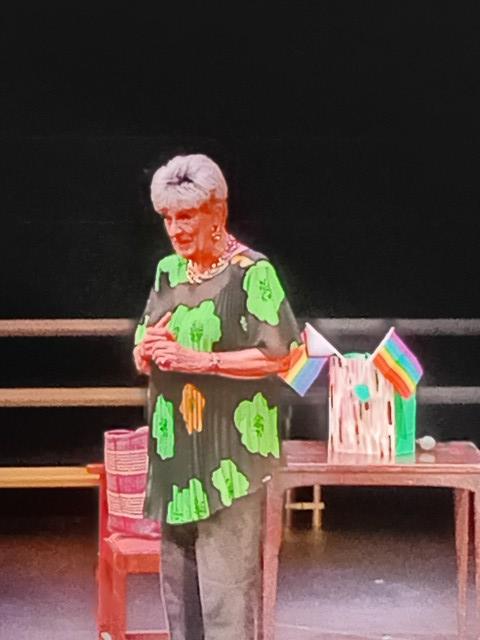
For more than one hour, she told stories of South Africa, right from the time of PW Botha, in the 1980s, marked by elevated tension between the Apartheid government and generally citizens fighting for freedom, to South Africa’s delicate, but significant shift of gear towards the direction of unity and freedom.
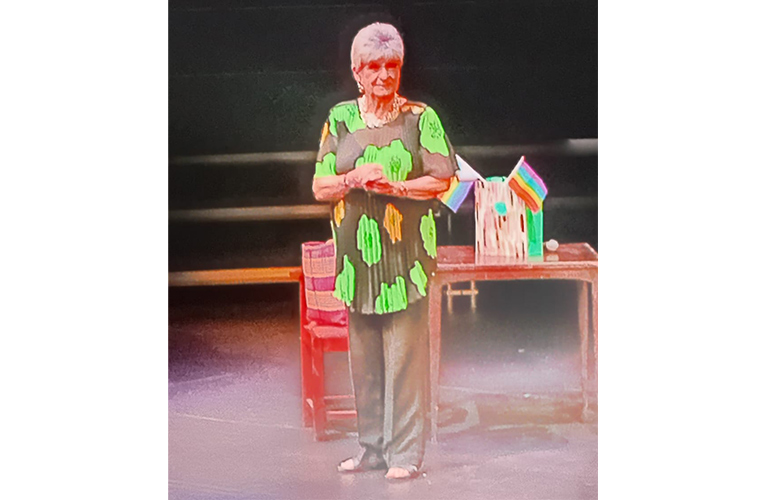
Pieter-Dirk Us, is a master political satirist, and his once off performance on the Joni Kani Theatre at the Market Theatre on Wednesday, October 21, 2026, will remain something that those who attended the performance, will talk about for a long time. The charismatic Tannie Evita, who is celebrated in corridors of power for her culinary skills, feeding the hungry presidents right from those who served during apartheid and those in the new South Africa. Peter-Dirk Uys, has immortalised this character, his alter ego, to the extent that in the public imagination, she actually exists and she is fond of spilling the beans about what the presidents are up. And we love that. That night, it was no different.
It is also important to note that Evita Bezuidenhout was in fact, home coming to a space that showed bravery in 1981, when they gave Pieter-Dirk Us a platform to vent and actually create this character that continues to give the powerful and out of order among the leaders sleepless nights. Through hard hitting political satire. It all started on a stage at the Market when the producers gave her a platform and she successfully went on for decadesto critique the then political status quo. It was not easy to be given such access by those controlling spaces of performance at the time, because of the political pressure and risks that were embedded in the South African body polity.
It is important to remember the context of the time, in order to understand fully the risks involved in such an endeavour and artistic choice. There was no constitution, now regarded as one of the best in the world that would restrict the backlash from a government pushed against an unyielding wall. There was no constitutional guarantees of freedom of expression.
Most importantly, there was no way of knowing how the government would push back against offering a platform to satirist of Dirk-Uys’ satirical precision in making the actions of the powerful and invincible look ridiculous and absurd on stage. But the Market did anyway, in a space that became in later years, Gramodoelas, a restaurant of delightful dishes.
But on Wednesday, there was another reason why this performance was unique and in a way, a first in the country. Even in democratic South Africa, where several freedoms are guaranteed by the constitution, assumptions were really challenged in many ways.
Pieter- Dirk Uys’s performance, was in fact, the opening of the first ever Queer Festival to be held in the space, and actually in South Africa. And so, the audience that came in huge numbers to fill this huge space to the rafters, were not necessarily your usual theatre audience. A huge number in fact. That was clear on the night.
These were South Africans who had come of course to watch on stage, one of the most popular and iconic political satirists in the country, perform his satire that has survived public scrutiny for years and passed with flying colours when it comes to appealing to both white and black audiences. Ironically, including even politicians, the very subject of his satire, that often ridicules their decisions, actions and personality.
This performance was therefore, not the Pieter-Dirk Uys, usual performance. It took place in the context of the theatre yet again, going beyond what is often on offer when it comes to festivals in the country, by introducing a festival that tells unique stories of queer life in contemporary South Africa.
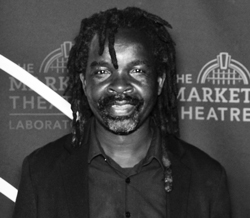
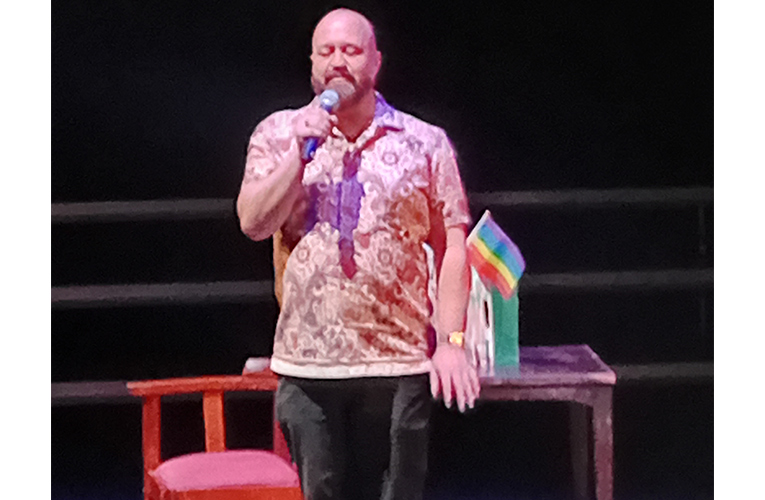
“There was no better person to open the Queer Festival, than Pieter-Dirk-Uys, because it is exactly in this space, at Gramodoelas, where Evita Bezuidenhoutemerged in 1981,”said Greg Homann, the Artistic Director of the Market Theatre in his opening remarks, delivered to officially open the Queer Festival and welcome Evita on stage.
What followed for over one hour, was sheer brilliance on the part of Evita. Each word was closely scrutinised by the audience. Each step was closely watched. Each satirical line meticulously analysed, to perhaps assess if the Evita Bezuidenhout they had watched for years, was showing any sign of fading or still rocked the stage with her penetratingly mind stirring satire.
However it became clear from the word go that fade she did not. Even at the mature age of 91. She actually was in her element. Not yielding, hard hitting and not holding back on demanding accountability from those in power since the 1980s up to the 2000s. She clearly has a rich archive from which to assemble her arsenal with which to target the truant and powerful in society, particularly the political tribe.
Evita certainly did magic on stage that night, more than 0ne hour non-stop. The performance was so brilliant, the response from the audience was rapturous in appreciation. After every line of hard hitting satire, there was an equal force of response from the audience. Clapping, applauding, and sometimes, shouting words of encouragement.
And as per typical Tannie Evita, politicians were the fodder for her satire. They were the unwilling props she needed to deliver blow after blow of hard hitting satire that cut to the bone of the banality of South African politics, as it keeps on reproducing itself, whether in the post-Apartheid South Africa or in the racially segregated past. The actions of those in power once they are in there, appear to be a carbon copy of the previous in several respects. It is a question of different ears, different characters, but the character of body polity, stubbornly remains the same. Following the tried and tested route of the previous leaders’ actions, attitude to serving the ordinary man and ordinary woman who look up to them for leadership and service.
During the performance, Tannie Evita’s satire traced the political gymnastics of a country trying to wiggle itself out of self-inflicted pain associated with apartheid rule complications during PW Botha’s presidency, the demise of his rule and the ascendance of FW De Clerk as President. He surprised all and sundry when he went on shortly after taking the levers of state power, and released the then imprisoned Nelson Mandela in 1990. Unbanned the ANC, South African Communist Party and other liberation movements, paving the way for what unfolded in 1994. That is when the country transformed from a segregated world pariah into a democracy, with a new Constitution and Mandela ascending to be the President of a free country. A miracle had happened, the world praised and the late Acrhbishop Desmond Tutu coined what had happened a Rainbow Nation wheile the rest of us were happy to call the shape and form of what had emerged after the election in 1994, a New South Africa, for lack of a better description.
Once she climbed the stage on Wednesday, Evita then lounged into the leadership styles and idiosyncrasiesof the subsequent presidents that followed Mandela’s presidency. Usually, she was not always kind to them as she individually looked at their personalities, including what she described as intellectuallyinclined Thabo Mbeki, characterised the presidency of Jacob as presenting society with elements of uncertainties and awkwardness, but at the same time punctuated by humour. For example his love of dancing instead of making speeches only to drive his political points home.
But then, Evita stopped there. But I am sure many in the audience would have loved to hear what the master satirist had to say about the current president, Cyril Ramaphosa. After all, it is not as if there is not enough material for the legend of satire to weave together a picture that would tell us more about the personality, character and idiosyncrasies of President Cyril Ramaphosa.
Not with what started as a rumour of a huge stash of foreign currency stuffed in some couches for safe reportedly for safe-keeping, but the caused a problem for the president when thieves stole the money from his Phala Phala farm. The existence of the stashed moolah and the thievery thereof, having been confirmed by none other than the Buffalo Soldier himself.
Be it as it may, Evita did not go there. However, what a beautiful show that was Evita@91 at The Market. But sorry, you cannot see it again. It is gone.
However, there is a lot see at The Queer Festival this weekend. But again, you need book tickets early, as some of the shows are fast selling out, with especially one of the shows Bum Stuff: A Cheeky Cabaret,having sold out by Wednesday as confirmed by Homann.
There indeed seems to be an audience for a festival of this kind in Johannesburg. The Other Foundation has partnered with the Market Theatre to bring to audiences the Queer Festival this year.
“We hope that they will continue to partner with us for the second iteration of The Queer festival next year. If there are some in the audience who going forward would like to partner with us, please do so,” encouraged Homann.
What to watch at The Queer Festival
In addition to Evita’s seminal comeback, Chantal Stanfield’s Shockwaveis billed as something that will electrify the programme with its sharp and compelling drama. Directed by David Dennis, this brand-new play is set concurrent with P.W Botha’s State of Emergency that gripped the country in the 1980s and intensified resistance against the apartheid regime. The spectre of a new ‘Gay plague’ looms large while homosexuality is illegal and stigmatised. As it unfolds, the script lures audiences into the life of “Larry”, who is forced to confront questions of sexuality, faith and belonging in a world trapped by increasing fear and deepening prejudice.
Grounded in the lived experience of being a trans man, The Breasts of Tiresias is a provocative new work that draws deeply on the life of Angelo de Klerk, who co-wrote the play with former Market Theatre Artistic Director Malcolm Purkey. Rooted in truth and identity, the production offers an intimate and compelling exploration of gender and transformation against the backdrop of heritage and social conformity.
Making his highly anticipated return to The Market Theatre as director during its 50th birth year, Purkey brings his considerable theatrical experience to The Breasts of Tiresias. The production stars Gerard Bester and Sandi Dlangalala, with music created by Carlo Mombelli and additional material by Renos Spanoudes.
Bum Stuff: A Cheeky Cabaret billed as a “smart, funny and surprisingly thoughtful new South African cabaret” commissioned by The Market Theatre that explores one of society’s last great taboos through music, comedy and storytelling. It centres around anal sex, exploring shame, pleasure, communication and the stories we inherit about our bodies. This production, written and directed by Bruce J Little, is strictly intended for adult audiences (18+).
Thamsanqa Tshabalala, the first dance-based recipient of the 2026 Barney Simon Residency Project which is homed at The Market Theatre Laboratory annually, is excited to return with a once-off performance in the Barney Simon Theatre with their dance-based work, Girls of the Golden West.
“The performance is an act of self-revelation and refusal, reclaiming the Black queer body as an expressive, political force that rewrites visibility on its own terms rather than submitting to dominant narratives,” reads text that has been sent out to the media promoting this production.
Vuyelwa Maluleke’s The Blue Album, which showcased at The Market Theatre Kippies Fringe and the National Arts Festival Fringe, champions unique township queer perspectives. With this piece, Maluleke fuses poetry, monologue, movement and choral voice to “”stage an intimate portrait of queer life and love in townships.” For its run at Kippies Fringe last year, The Blue Album scooped the Outstanding Performance Award, and at the National Arts Festival this year it received the Silver Ovation Award.
Highlighting music as a central form of expression and identity, the Queer Festival features a concert titled Queer Joyperformed by the Johannesburg Queer Chorus, who will be singing a repertoire that acknowledges Jo’burg’s queer community. Closing the festival will be a soon-to-be-revealed local artist whose work is prominent in the queer community, “adding to the radical joyfulness of our space throughout the festival.”
Alongside the broader offering of music, dance and drama is a curated series by Jason Wheeler and Maralin van Reenen of fresh, provocative LGBTQ+ writings from emerging and established voices, entitled No Filter: A Showcase of Queer Writing.
The full programme of the Queer Fest at The Market is available on the Theatre’s website, with bookings open for some events that have not yet sold out for the weekend.
.The Queer Festival runs from October 21 to October 25, 2026 at the Market Theatre in Newtown.