


The Scotts’ lifelong passion for collecting art enthrals photographers from Of Soul and Joy Photographic Collective of Thokoza
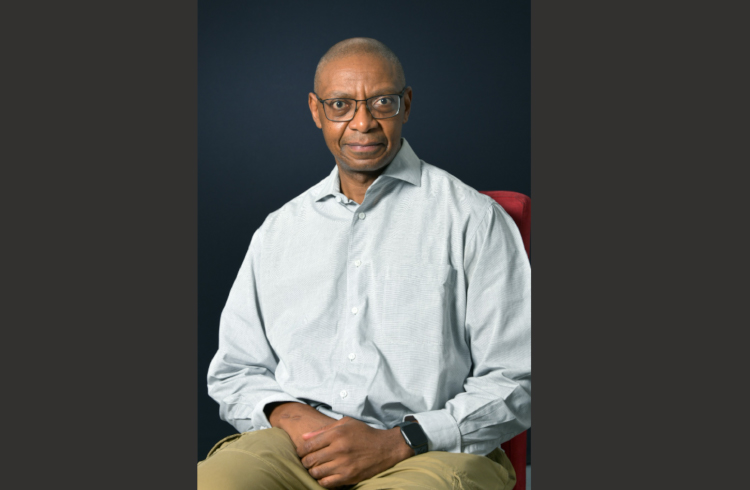
Meet Dr Fred Scott and his wife Susan Scott, passionate about South African art, the couple are well-known figures in Johannesburg’s close knit art circles, be it at art fairs, exhibition openings or art auction sales events. They hosted a group of photographers this week, to talk about art practice, collecting art and more.
By Edward Tsumele, Winner of NHC Heritage Journalism Award for 2026
South Africa since the advent of democracy, professional and business opportunities have certainly opened up to a wider demography, having been freed from the restrictive environment imposed by apartheid race based legislation of pre-1994.
The segregationist laws negatively affected particularly the upward mobility of black people in the country. However, the opening up of opportunities, previously restricted to a fewer demography, has resulted in the growth of particularly the black middle class, and this has resulted in consumption going up.
Luxury goods, such as design bags, design suits, expensive watches such as Rolex watches and luxury cars have over the past over 30 years of democracy, the dominant feature of consumerist behaviour in this demography.
Those with disposable income, have splurged out on these luxury goods, but not always living within their means, granted. Nevertheless, spending is spending, whether using available cash or taking out a loan.
However, when it comes to investing in art, or simply being a patron to art, the middle class, the new money people, have not invested that much. Therefore, the circle of those who collect art, remains marginal among the ranks of the new money people. The culture of collecting art, alongside luxury goods, has curiously been a missing factor in consumer behaviour of this class.
This has gotten those who market art, livid, looking for answers as to why that is the case. But as matters stand, marketers of art, are sitting with a marketing phenomenon they cannot put their finger on.
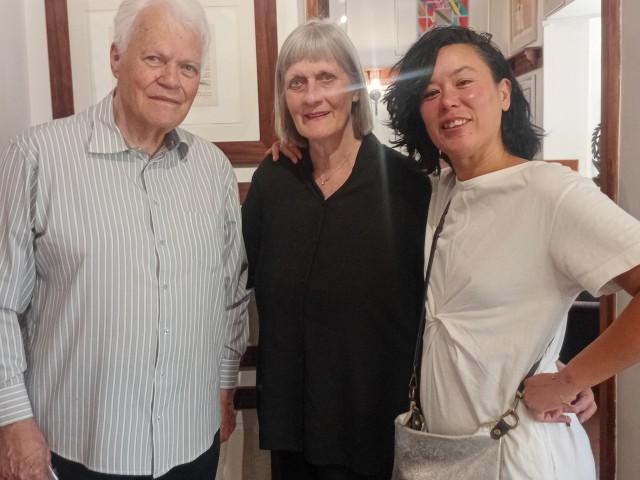
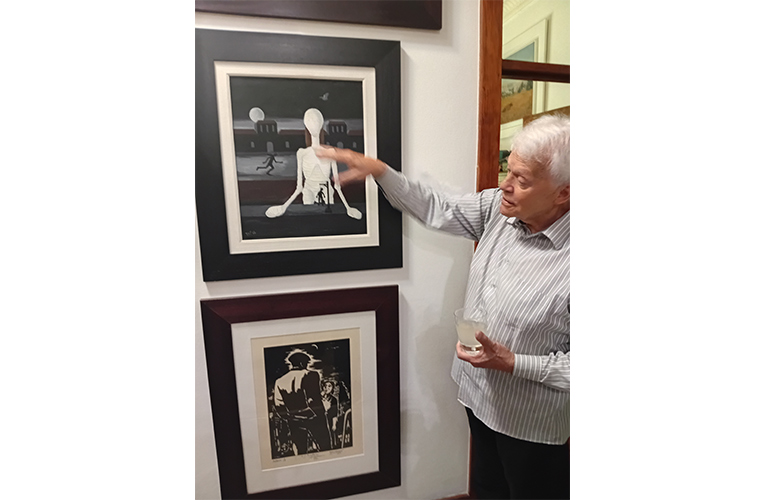
However, I was invited to a house of a passionate art collector, white and a retired chemistry academic, who alongside teaching chemistry at University of Johannesburg, on his free time, researched and collected contemporary artists from South Africa and elsewhere for years. His collection of art objects is impressive.
The discussion that unfolded between him and his guests, a group of photographers, made me think hard about why it proves difficult for art marketers to convince the black middles class with disposable income to invest in art for their own enjoyment, as well as an investment option, alongside their penchant for buying luxurious goods for instant gratification.
The reason most probably lies with the absence of a collecting culture within black communities, given the disruption to living a normal life due to a number of factors that historically, stood on their way of enjoying life fully, just like their fellow citizens of a different demography.
There may have been too many things to worry about –poverty, the struggle for liberation, and of course limited education opportunities under a restrictive environment. Clearly buying bread to feed one’s family was more of a priority than buying a Gerard Sekoto, George Pemba, Ernest Mancoba or Gladys Mgudlandlu, hence the imbalance in collecting habits between the black middle class and their white counterparts in contemporary South Africa.
But that was in the past, but why is it that the new money people in democratic South Africa’s tastes in their consumer behaviour does not include the habit of collecting cultural products as part of preserving their heritage?
Perhaps, the question of why this is so can only be fully understood if, it is investigated through an inter-generational lens. It is as complex as it is steeped in history and politics.
In other words, it is a cross –generational thing. It a collecting culture thing. It is a thing traced to and embedded in history. It is a thing embedded in the country’s politics. It is a thing that expresses itself in the consumer behaviour of the new money people, where accumulation of luxurious material things have priority over the possibility of enjoying looking at Mary Sibande’s Sophia taking the centre space of one’s living room, or a Blessing Ngobeni on the walls of one’s sitting room.
Fred and Susan’s passion for collecting art
Meet Dr Fred Scott and his wife Susan Scott, passionate about South African art, the couple are well-known figures in Johannesburg’s close knit art circles, be it at art fairs, exhibition openings or art auction sales events. They hosted a group of photographers this week, to talk about art, collecting art and more.
However studying how and why one Johannesburg based retired academic managed to build his huge art collection over the years, maybe where the answer lies.
“This art collection you see here, goes back as far as 80s years. The culture of collecting did not start with me. I found it existing in my family. My father collected art as far back as 1938/39.I Inherited some of this collection from my forebears, as well as the culture of collecting art itself,” said Dr Fred Scott.
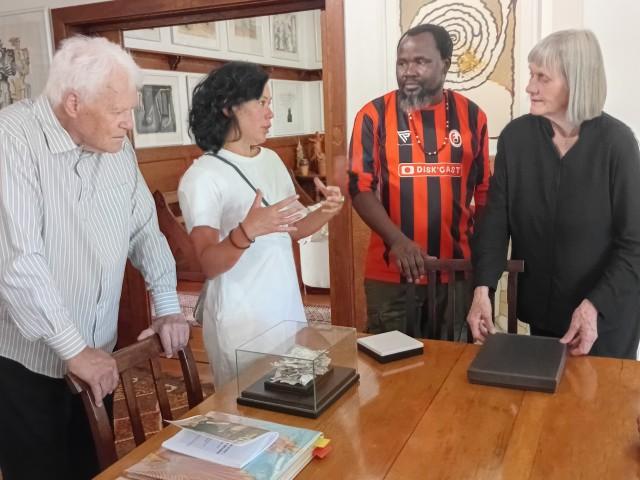
He and his wife Susan, hosted a group of photographers from mainly Thokoza township on the East Rand, members of a photographic collective called Of Soul and Joy, in their Rossmore, Johannesburg home on Wednesday, October 21, 2026.
Of Soul and Joy, since its inception, has successfully transformed the lives of many a photographer in that township, by training them in photographic skills, as well as affording them an opportunity to exhibit their work both locally and internationally.
Of Soul and Joy is essentially, a social and artistic mentoring programme created in 2012 by Rubis Mécénat to enable young people aged 13 to 30, from the township of Thokoza and surrounding areas of Johannesburg, to benefit from a framework and training in the field of photography. This tailor-made support system allows them to cultivate artistic expression and access new professional paths, so that they can in turn have a positive impact on their communities.
In fact, that project ranks as one, if not the most successful photographic intervention in years in South Africa. Its impact is felt in gallery walls and prestigious photographic festivals around the world today. Some of its alumni continue to win awards both locally and internationally, affirming the project as a success in the photographic sphere.
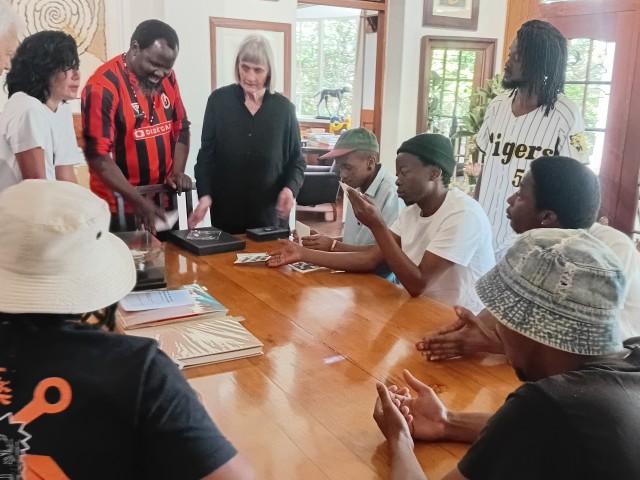
And so this tour, organised by Of Soul Joy’s Emilie Demon, was aimed at introducing these mainly young photographers to possibilities beyond their own photographic art practices. Indeed the photographers were curious and asked the collector important questions in relation to how he built up his collection over the years, but also generally about how an artists can achieve longevity in a sector known to be tough to stay on long. Of Soul and Joy project manager, himself a seasoned photographer, Jabulani Dhlamini, was also part of the tour.
The rest of the photographers who were part of the tour of the collection are Sibusiso Bheka, Lundhi Mnguma, Simphiwe Molefe, Zwelibanzi Zwane, and Vuyo Mabheka, who showed a lot of interest in the Scotts’ collection.
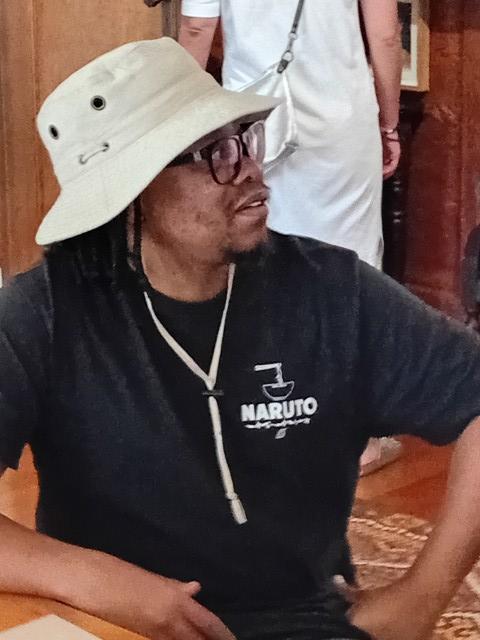
These sixphotographers that visited the Scotts, were taken on a tour of the husband and wife’s extensive collection of art works from around the world that the couple has collected over the years, building on what was left behind by Fred’s parents.
Their home, in fact, to call it a home in the conventional sense of a home, will be an understatement. Rather, it is a museum of art, right in the heart of a Johannesburg suburb. The collection is extensive in scope, just as it is, with regards to the styles and media used to create some of the pieces constituting this collection.
The collection mainly tells South African stories, as well as stories from the other parts of the world. The collection sits next to an extensive collection of mainly art books, collected from around the world.
“My father was born on a farm in the Free State. After his brothers paid for his education, he left after Matric for Holland to study medicine. It so happened that as a student he rented a room at a house owned by an artist. He was introduced to art that way as they became friends, and he started building his own collection as a result, alongside practising medicine after he graduated. He was so passionate and knowledgeable about art that he went on to write about art in publications, alongside collecting art,” Fred explained to the enthralled photographers.
In fact, this whole collection, is a study in how to build a collection in South Africa.
‘“When you collect art, it is important that you do not only collect narrowly. Such as collecting a particular medium. I know that some peopleadvise people that they should build their collection based on say, art of a particular kind or medium. Rather, the right approach according to me, is to collect as widely as possible,”Fred explained to the photographers.
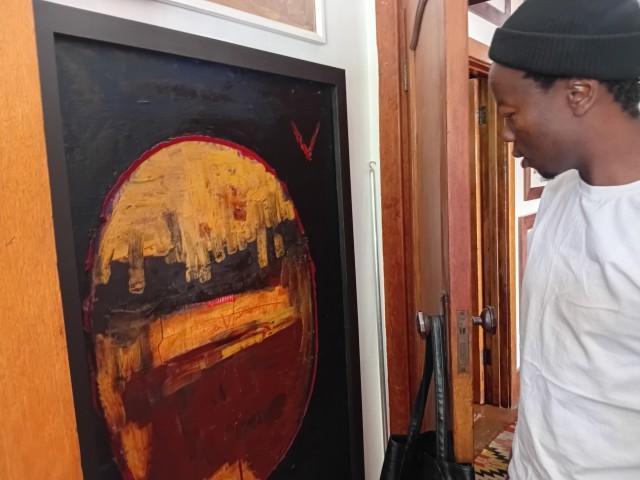
Indeed when it comes to collecting art, his choice of artists to collect is simply wide. His collection is quite extensive, as you will find a Samson Mnisi on his wall sitting next to art created by Flemish artists, along other South African contemporary works.
From sculptural works, paintings, drawings, textile, photographs, classic African art, such as a beautiful pair of voodoo sculptures tucked on the corner of the dining room of the Scotts.
“These pieces are actually from DRC Congo. They are actually fragile and should be in glasses,” pointed out Susan.
Fred told his guests that since he retired from lecturing in chemistry at University of Johannesburg, he dedicates his time to looking after his collection, as well as researching South African art and artists. The Scotts also loan their collection to institutions for exhibitions, with a major forthcoming exhibition organised by a major bank having just days ago approached them to loan them a Samson Mnisi piece for an exhibition that will open in November.
The late artist was given a break into his professional practice by the Scott when he organised a solo exhibition at University of Johannesburg at the very beginning of his career. From that point, his career ballooned, exhibiting as far as the US.
“It is such a great feeling to wake up and look at art works. Everyday I learn something new about an art work that in fact has been on the walls for quite a long time. Something I had not noticed suddenly reveals itself in an art work. That is the beauty of art,” Fred explained.