



How far does Breakfast with Mugabe Go?
By Jojokhala C. Mei
What a curious mix masala it is to witness how far South African dramatist Calvin Ratladi celebrates pocketing this year’s Standard Bank Young Artist Award by stretching the already larger-than-life personality and condition of Zimbabwe’s first President, Robert Gabriel Mugabe, when Mugabe reportedly suffered depression at the turn of the century.
On winning the award and rehearsing the old play Ratladi threw excited eye-jibes and elbow jabs into my ribs during a previous citylifearts interview, whispering that the old BREAKFAST WITH MUGABE will be updated to explore and explode the spirituality of the man with legendary contradictions and obstinacy. How great a promise.
Eloquently anti-White Mugabe was also a publicly devotee Roman Catholic who even proudly went to bury a Catholic Pope in Rome. It is also publicly mourned that Mugabe’s free Zimbabwe betrayed their freedom struggle, better known as the Chimurenga, which I studied under the inimitable Marian Lacey for my other, Politics, major in Makhanda. Is this the anger of the spirit haunting Mugabe in the play?
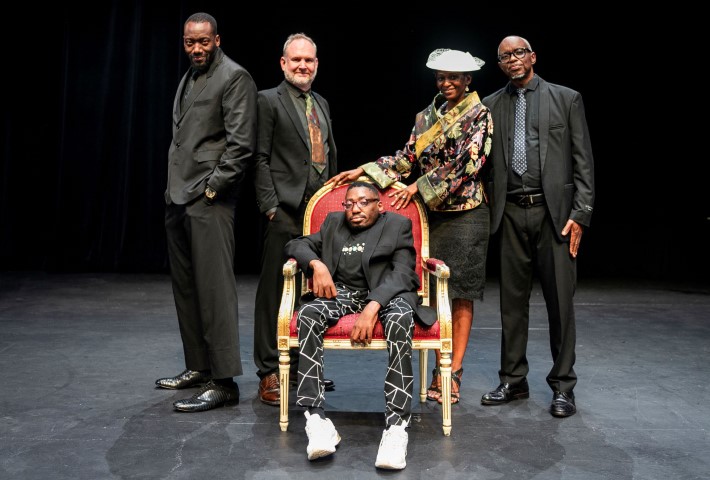
Accomplished stage and screen actor Themba Ndaba wrestles the president’s mannerisms and speech with uncanny similarity. Together with fiery South African screen and stage actress of perfect timing, Gontse Ntshegang as his wife Grace, they triumphantly deliver Breakfast With Mugabe currently on The Market Theatre stage in Johannesburg. To deal with the depressing and allegedly betrayed spirit the play has Mugabe unexpectedly consult a White psychiatrist, here called Dr Peric, and played by Craig Jackson. Zimbabwean actor Farai Chigudu growls and explodes the stock character of Mugabe’s bodyguard, Gabriel.
At least two decades ago when Mugabe was still alive and ruling, the play by established British playwright Fraser Grace made its world stage premier in Mugabe’s proclaimed enemy of Britain, under the direction of the Sir Anthony Sher we know.
More reason to wonder how far Calvin Ratladi goes off the beaten historical track with his trademark comedy, and nuanced macabre direction. True to his commitment the play starts with a humming ‘religious’ devotion procession around the set which is evocatively lit by Lighting Designer Hutchison. But the stage design follows on its long tradition of bland colours, when the Zimbabwean State House was famously as bright and colourful as the couple dressed up for rallies.
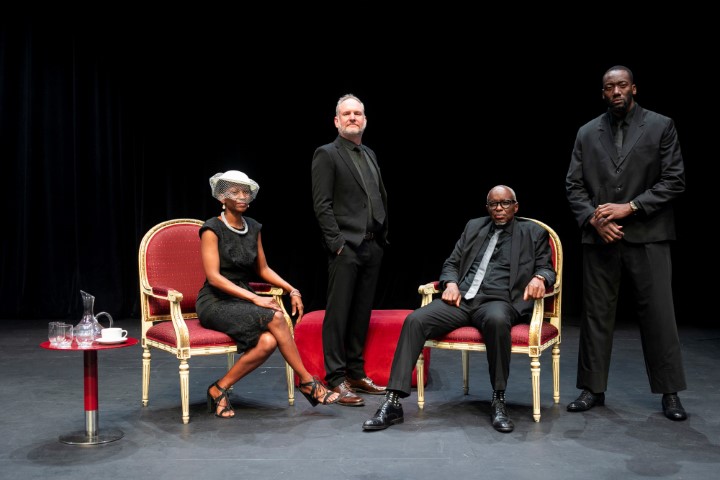
After the procession entry the dialogue follows the script in introducing all the characters expecting Mugabe to make his stage entrance. It becomes clear that Mugabe is haunted by a malignant dead spirit called ‘Ngozi’, whom grace identified as Mugabe’s dead comrade in arms Tongogara. This angry allegedly betrayed spirit never returns throughout the production beyond lighting and sound suggestions. And stern Catholic Mugabe doesn’t attest its veracity. Even Britain never got to pin the betrayal killing on Mugabe throughout the long years of Mugabe’s shout down with Britain over Britain backtracking on its Lancaster House commitments. In South Africa’s own liberation movement history the deaths of Chris Hani and Sabelo Pama at the brink of democracycould never be pinned on the ANC and PAC respectively.
I waited in vain through the production for an illuminating most private snippet of Mugabe’s life in a husband-and-wife scene. Closest one got to even their hobbies is Mugabe’s reference to her shopping habits. But this was a too rare and fleeting comic relief from otherwise stiff rhetoric.
The psychiatrist allows private man-to-man consultation to degenerate to an unprofessional shout-down that is certainly not productive for him. This dragging sound and fury without the director’s physical comic relief also robs the audience clarity of the aforementioned reason why liberation hero Mugabe rejected his absurd yet beloved Order of the British Empire knighthood.
Dare I say the production is worthy for only the scene of Mugabe’s dreary intelligent dogma that stirs the cheering crowds.
Far too long before the end the chase for Mugabe’s spirituality has long is forgotten; without even highlighting more comical and macabre lines of an absurd true-life theatre. But why?
[Cast picture courtesy of The Market Theatre]