






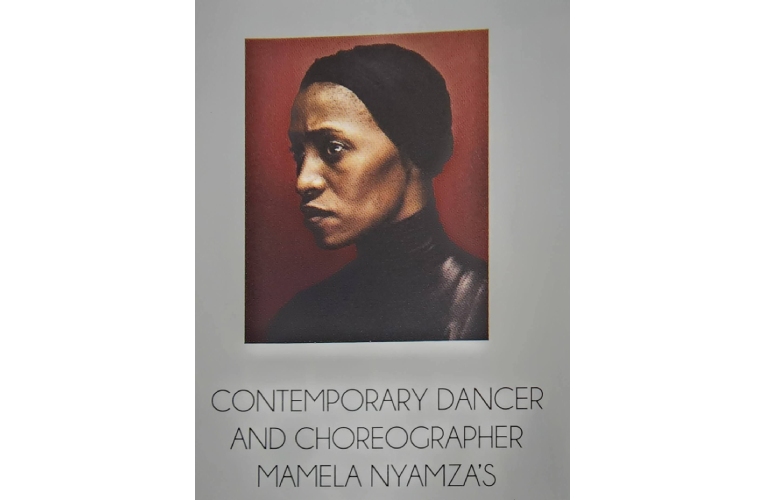
Mamela Nyamza’s Herd/Less: A Brilliant lament for a headless society
Herd/less is about elements of African spirituality, war of resistance and neocolonialism over dispossession of the land. It is about a headless society where people march because they have forgotten how to stop marching.
By Sandile Memela

There are shows you watch. And there are shows you endure. Mamela Nyamza’s herd/less is both – brilliantly so, infuriatingly so. It is 70 minutes of thumping tin cans, glittering colonial frocks, an upright spear that goes nowhere, and a people who have resigned themselves to being ruled without consent.
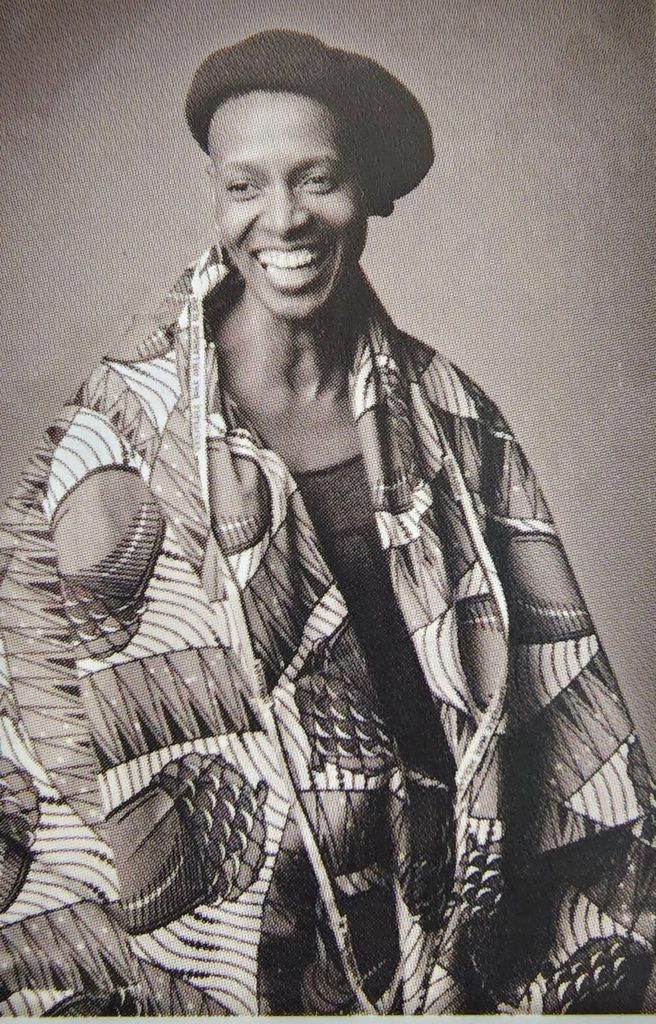
Nyamza, now 50, choreographer, producer and director, has made a career of not wanting to be understood easily. Herd/less is her most opaque statement yet. The title itself is a double pun that she refuses to explain: herdless is without cattle – dispossession – and also without a head – without direction. It seems to talk about the lack of direction in the current South African, continental and global leadership. The people have been left on their own.
That is its power. That is its problem.
The entrance: Makeba moaning in prison
As people, settle in, they are welcomed by Makeba moaning about imprisonment. On repeat. Bahleli Bonke Etilongweni. No. A low, sombre moan, looped, like a woman in a cell. It introduces a sombre atmosphere before a body has moved. Nyamza is telling you: You are entering a prison. Not hers. Ours.
The lights are low. Then you hear it: Huddled together, thumping tin feet. Gestapo army-like sounds. The marching sound of the cans connotes the Gestapo who terrorized and harassed people to keep them under control.
Could be that this points to Germany and the universality of fascist oppression. There is restriction and control. Nyamza has long linked apartheid to other fascisms.
Here the sound design – cans tied to ankles, beating on concrete – is not African dance drumming. It is military, European, orderly terror. It says: Oppression is universal, but its sound is always the same – boots, cans, batons. And colonialism is here to stay.
It demands patience and understanding as they walk through the stage. Very trying, as nothing dramatic happens for …er, a long time. That is deliberate. Oppression is boring. It is monotonous.
The herd arrives: Glamorous, lost
Then they emerge: glamorously dressed women. They are marching to their own music that only they hear. Inside their heads. Rhythmic movements in colonial western garb, looking great in glitterati – petticoats, corsets, wigs that would be at home in Versailles. But their feet are chained to tin cans.
What does the march mean? Where are they going? Someone blows a whistle – sharp, like a farmer herding cattle, or a policeman stopping a pass offender.
There is a full focus on upright spear-holding man. The spear is the centre directing movement. First uttered word in 20 minutes is Voetsek – at the miraculous control of the spear. The insult says it all. Feeble defiance. The spear – African phallic power, resistance, patriarchy – still controls even the glamorous herd. Voetsek is what the baas said, but also what the woman says to the spear now.
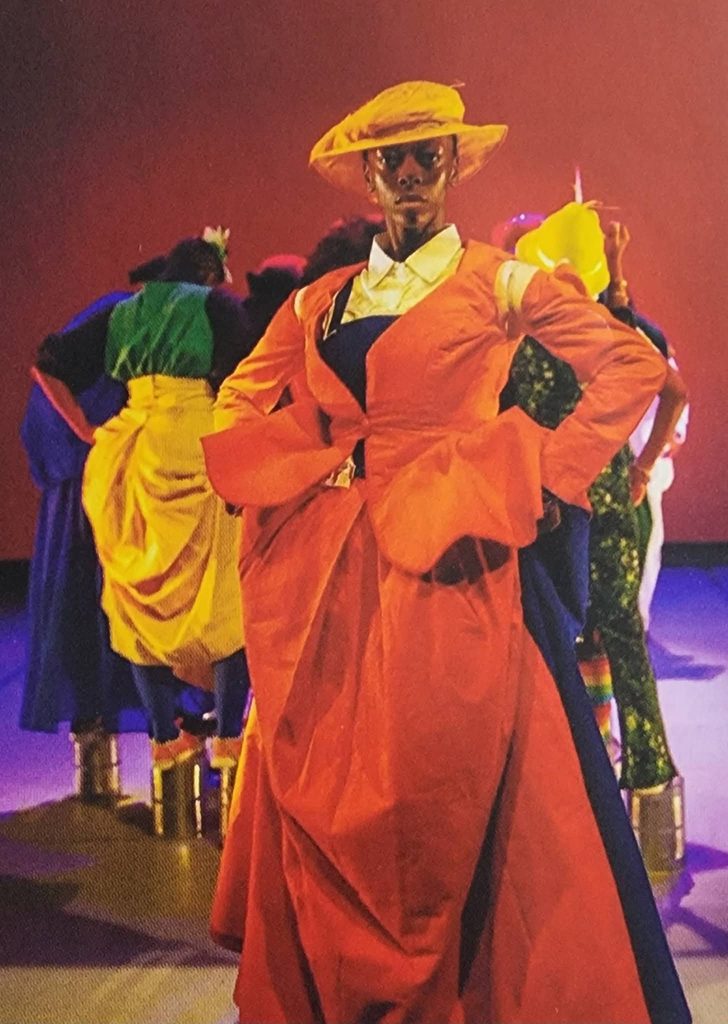
Nyamza gives us gender bender: Male dressed in women’s clothes, and a woman who commands attention and wants to be gazed at. She shows off, a display of elegance with a gun. A lot of music and dance and song but preoccupied with self. The herd is pretty, energetic but pretty monotonous. They are lost, marching in circles.
Sadly the herd seems to have resigned itself to its pathetic situation. We get sense that they have resigned themselves to a place where people rule without the consent of the governed. This is South Africa 2026 – load-shedding of leadership. Leaders march to their own music, glittering, while people wear cans. Disillusioned and apathetic people.
The breakout that doesn’t break
Two women break out of group in ANC and DA colours – black yellow, green and bright blue. Very energetic. For a moment you think: Ah, politics! Opposition! But it collapses back into the same rhythm. The breakout changes nothing. The spear circles everything to no meaningful purpose.
Is this the meaninglessness of the struggle? It is the spear versus the gun. The spear is upright, static, male, traditional authority. The gun is invisible – the state, female power, the Gestapo sound, the whistle. The herd is caught between spear and gun, between tradition and neocolonial state, between culture and religion.
Then, to escape the monotony, they take out kirries and the cross. Fusion of culture and religion. Makes the piece quite political and profound.
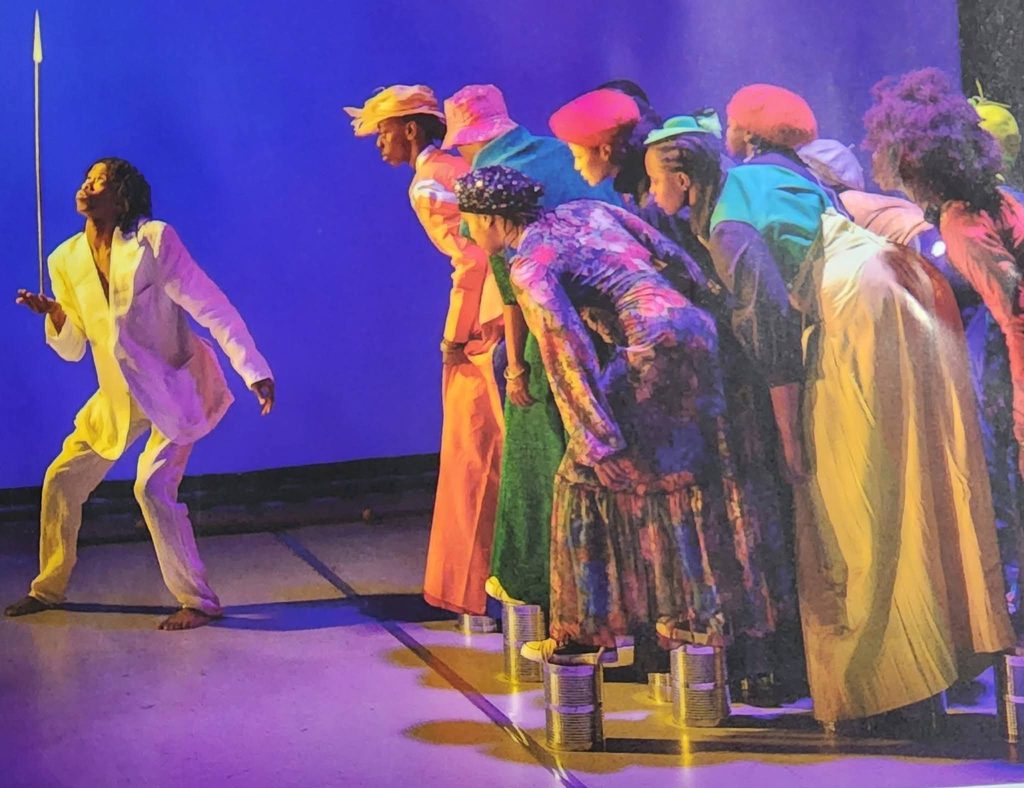
One needs to be well versed in symbolism and history to read it: Kirrie is war of resistance, cross is missionary dispossession. Both are weapons that told Africans they are herdless – without cattle, without land, without head.
Nyamza’s dramaturgy is: Oppression results in loss of language. Nobody can claim to understand the chants, sounds or movement. Does oppression, if it is that, result in loss of language? Yes. When you are herded long enough, you forget how to speak, you only moan like Makeba. You only say Voetsek.
The only relief: Paradise road
The piece is quite demanding. Perhaps obscure and opaque. Nobody can claim to understand it fully. That may be its intention. The good thing perhaps is that the production is so abstract that it is almost opaque. Very few people can truly understand it without the conceptualizer. I guess only the creator understands the concept and her message.
Nyamza either wants to be mysterious or does not want to be open and honest. Perhaps she does this to stay in the game. She may understand what happens to those not afraid to speak. So you play safe by being abstract. At 50, in an industry that discards Black women, abstraction is survival.
But she gives us one gift: Ear-piercing noise only stopped by infectious song Paradise Road. This provided welcome break from the intensity of the performance.
When Joy sings “Take me, take me to Paradise Road,” the audience exhales, laughs, claps. It is the only moment we all understand. Paradise Road is the road away from herd/less – the road where cattle return, where head returns.
Then Makeba returns. Bahleli Bonke Etilongweni. The Makeba now seems to encompass everyone as in prison: everyone is in prison, knowingly or not. Black, white, glamorous, tin-footed – all in prison.
Two permanent figures remain: The spear-holding figure and the aristocratic woman who is just there, shouldering a gun. She is still and composed among the chaos. Could this be the attitude of the aristocracy to the chaos in an unchanging situation?
She watches the herd circle, sips tea, does not move. She is the Patriotic Bourgeoisie we have come to live with – beneficiaries, composed, still, while chaos reigns. The spear circles her but never touches her.
Verdict: Necessary obscurity?
Herd/less is about elements of African spirituality, war of resistance and neocolonialism over dispossession of the land. It is about a headless society where people march because they have forgotten how to stop marching.
Is it good? Yes, if you are willing to work. No, if you want dance to entertain.
Nyamza wants special focus and attention to be true to herself in a headless society. At 50, she does not want to be liked. She does not need approval. She wants to be gazed at on her own terms – even if that means you leave confused.
The problem: When you make oppression so abstract that only you understand it, have you not replicated oppression? The herd cannot understand their herder. The audience cannot understand the choreographer.
But perhaps that is the point. In a country where we are ruled without consent, where marching orders come from whistles we did not blow, where glamorous women in colonial garb march to music only they hear – to understand would be to betray the reality. The reality is we do NOT understand. We are herd/less.
She will now go to Europe. Perhaps Netherlands and Germany. But do not go to be entertained. Go to be herded. Then ask yourself after Paradise Road fades: Who is holding the spear in your life, and why are you still wearing tin cans?
We the living are willing to be led by those who do not know what leadership means.
.Herd/Less was staged as a once off performance at #Jomba Dance Festival on Friday 11 September, 2026, at the Market Theatre and is off to UK, Switzerland and Russia between now and November.