





Superb, nuanced acting embellishes Athol Fugards’ Master Harold and the Boys to another level
The play which features Sello Maake ka Ncube as Sam, Sello Motaung as Willie and Daniel Anderson as Hally, will close this Saturday, June, 28, 2025 at Theatre on The Square.
By Edward Tsumele, CITYLIFE/ARTS Editor
I have watched this production before, once or twice, however watch it with a new cast and new director, in a different venue, it feels different, as if you are watching the production for the first time, particularly if there is good acting, and the directing is super cool. Such as what I felt this week when I attended Master Harold and the Boys, the iconic play created by the iconic theatre director and writer the late Athol Fugard, who passed on a few months ago this year. May his soul rest in peace.
And yes, Fugard might not be with us, but his works, as it often happens with great works of art, is still with us. It has gained a new life of its own. Outliving their creator.
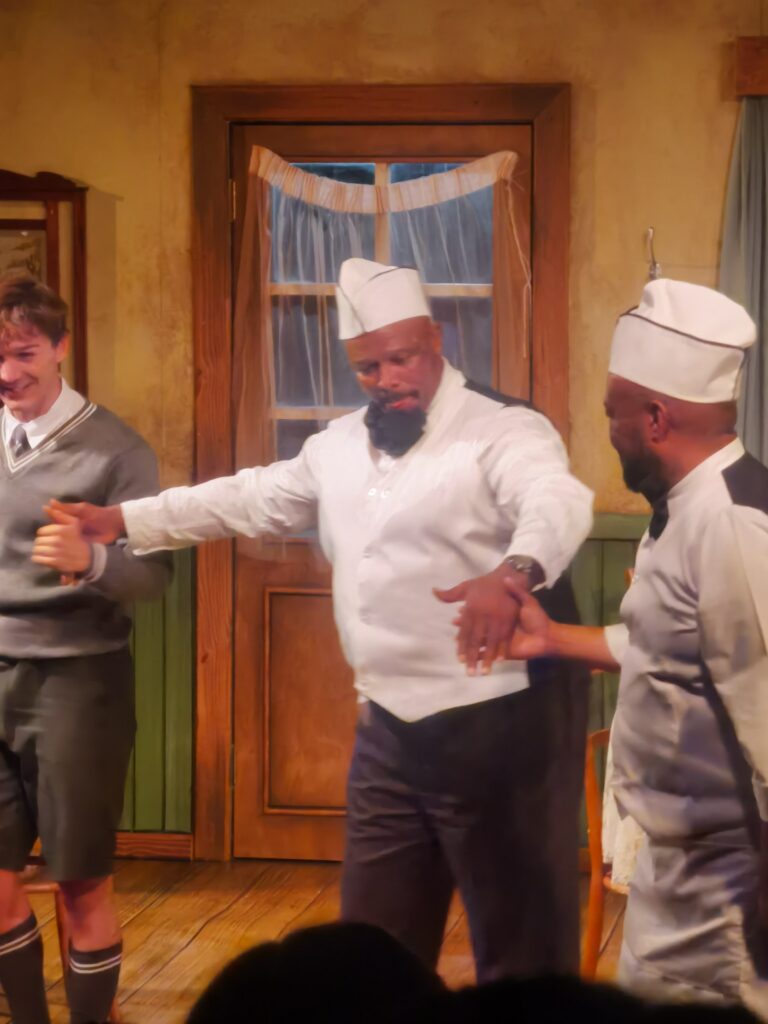
This time, the person who is behind bringing this show back into the public consciousness, putting it back on stage, after the show has toured South Africa and the world over the years, is none other than Sello Maake ka Ncube, himself a hugely talented actor, whose artistic exploits, particularly acting, looms large on the South African cultural landscape, spanning TV and stage.
Ncube through his foundation, in association with Daphne Kuhn, the owner of the intimate Sandton theatre venue, Theatre on the Square, has partnered with impressive theatre director, Warona Seane, who in my books is underrated and underutilised, as indeed she is one of a few crop of woman theatre directors in the country, whose work directorial expertise has injected energy and fresh perspectives in to a number of shows that have not failed to impress the audience.
She has clearly done a good job on this latest leg of Mr Harold and the Boys.
I was however hugely touched by the superb acting of this cast, whose stage presence, mastery of their respective characters, and bringing unique nuances to them, impressed many an audience member. In was left with no doubt but praises for these actors, all three of whom rose to the occasion, to not only give life to Fugard’s script, but injected new energy and exuded charisma on stage, mesmerising the audience.
However, the beginning, going all the way, right till the middle, I was a bit lost. Struggled to connect properly with the production, enjoying only a few flashes of brilliance of acting by the three actors.
In fact, I was starting to feel that my curiosity was going to be left not fully satisfied, and my sacrifice of defying warnings about the approaching cold spell, by going out on a Wednesday evening, was going to be in vain after all.
But boy, just that very moment when I was feeling that the show was going to leave me with mixed emotions, my moment came. In fact it was a moment, that I felt was shared by everyone in the theatre.
It was as if all along, the actors were waiting for this very moment to unleash their energy that would suddenly infect the whole theatre. It was as if that tension, a feeling of not having been given enough of themselves to the audience all along, had suddenly been noted. Maake KaNcube, Daniel Anderson and Lebohang Motaung ambushed us. They unleashed an avalanche of superb acting, complete with nuances that embellished the script to another level of theatricality never seen on our stages for a long time, particularly after the disruptions of Covid-19, since 2020. After that period, theatres struggled to put up shows of the quality of pre-Covid-19 aesthetic quality.
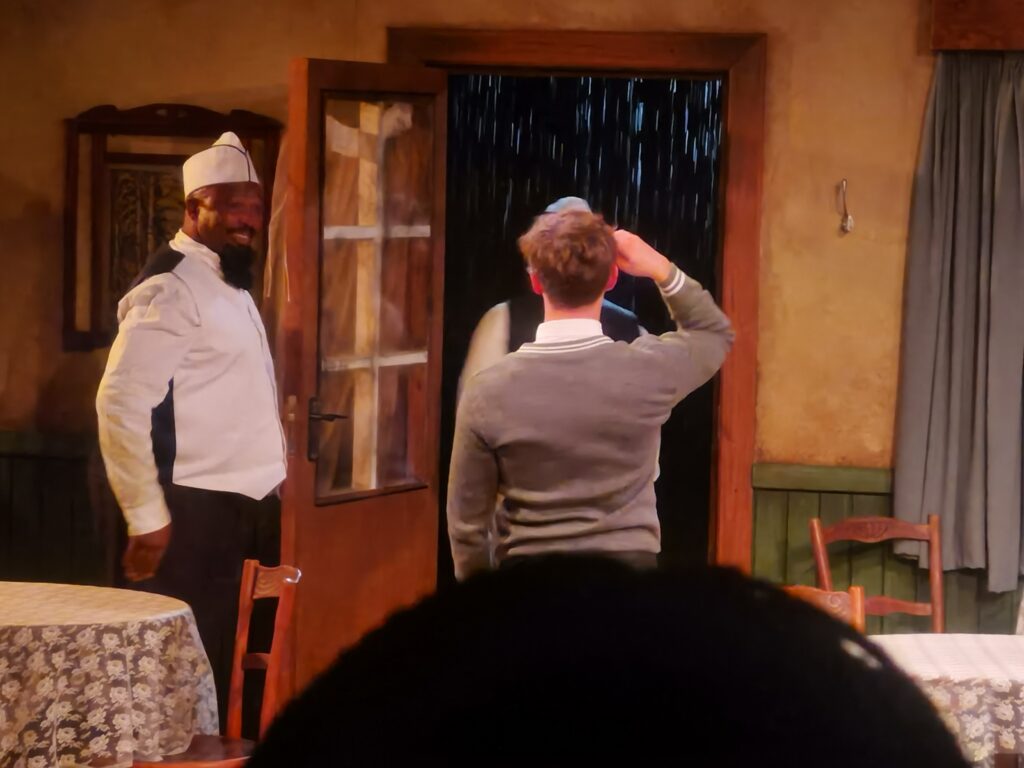
Though things have improved, some are still struggling up to now. But what I witnessed on the stages of Theatre on the Square on Wednesday, especially towards the end of the show that however reminded me that the potential and possibility to go back and recapture the pre-Covid-19 period by our artists still exist.
I really loved what I saw on stage. It was acting at its highest level.
This is a production one must see before the curtains go down, which unfortunately is this Saturday, June 28, 2025. And so hurry up, you might still be able to grab a ticket to see the last show.
My crowd, a team comprising staff from an AD agency and a group of young theatre enthusiast, artists on their own right, actually enjoyed themselves on a weekday evening at theatre. Thanks to Vus’muz Phaka, who insisted that I watch the Mr Harold and the Boys, this time around.
And just to give context of the period in which the play is set, Mr Harold and the Boys cuts deep into what happened during apartheid in South Africa in relation to the unbalanced relationships between white people and black people.
Set in 1950, it was first produced at the Yale Repertory Theatre in March 1982 and made its premiere on Broadway on 4 May at the Lyceum Theatre, where it ran for 344 performances. The play essentially depicts how institutionalized racism, bigotry or hatred can become absorbed by those who live under it. It is said to be a semi-autobiographical play, as Fugard’s birth name was Harold and his boyhood was very similar to Hally’s, including his father being disabled, and his mother running a tea shop to support the family.
His relationship with his family’s servants was similar to Hally’s as he sometimes considered them his friends, but other times treated them like subservient help, insisting that he be called “Master Harold”, and he once spit in the face of one he had been close to. Additionally the play was remade for a suitable audience in 2005.
The play initially was banned from production in South Africa. It was the first of Fugard’s plays to premiere outside of South Africa.
Plot
Servants Sam (a role played Sello Maake ka Ncube) and Willie, (Sello Motaung) both in their mid-forties, are practicing ballroom steps in preparation for a major competition, while maintaining Hally’s (Daniel Anderson) mother’s tea shop on a rainy day.
Sam is the more-worldly of the two. When Willie says his ballroom partner and girlfriend is lacking enthusiasm, Sam points out that Willie beats her every time she makes a mistake.
Seventeen-year-old Hally arrives home from school, and cheerfully asks about the dancing progress. Sam mentors the boy, wishing to guide him through adolescence into manhood, while Willie is the “loyal black”; who calls the white Afrikaner boy “Master Harold”.
The conversation between the three moves from Hally’s school-work, to an intellectual discussion on “A Man of Magnitude”, where they mention various historical figures of the time and their contribution to society, to flashbacks of Hally, Sam and Willie when they lived in a boarding house. Hally warmly remembers the simple act of flying a kite Sam had made for him out of junk.
Hally wishes to write a story about the two of them flying the kite for school, but he feels the ending was too simple, as he recalls how he had sat on a park bench to watch the kite fly, while Sam quietly went back to work. Conversation then turns to Hally’s 500-word English composition, where they describe the ballroom dancing floor as “a world without collisions”; a transcendent metaphor for life.
Almost immediately, despair returns: Sam had early on mentioned why Hally’s mother is not present; the hospital had called about his father, who has been there receiving treatment for complications from a leg he lost in World War I, to discharge him, and she had left to bring him home. However, Hally, indicating that his father had been in considerable pain the previous day, insisted that his father wasn’t well enough to be discharged, and that the call must’ve been about a bad turn, rather than a discharge notice.
A call from Hally’s mother at the hospital confirms that Hally’s father is manipulating the hospital into discharging him, despite the fact that his condition hasn’t improved, so it’s still unofficial, and Hally remains hopeful that the discharge won’t happen. A second call from Hally’s mother later reveals that the discharge is official, and she has brought Hally’s father home.
Hally is distraught about this news, since his father, who in addition to being crippled, is revealed to be a tyrannical alcoholic, and his being home will make home life unbearable with his drinking, fighting, and need for constant treatment, which is more than Hally and his mother can handle, and includes demeaning tasks of having to massage his stump, and empty chamber pots of urine.
Hally vents to his two black friends years of anger and pain, viciously mocking his father and his condition. But when Sam chastises him for doing so, Hally, although ashamed of himself, turns on him, unleashing vicarious racism that he learned from his father, creating possibly permanent rifts in his relationship with both Sam and Willie.
For the first time, apart from hints throughout the play, Hally begins explicitly to treat Sam and Willie as subservient help rather than as friends or playmates, insisting that Sam call him “Master Harold”. It all comes to a head when, in a moment of blind rage, Hally spits in Sam’s face. Sam is hurt and angry about this, and both he and Willie come very close to physically attacking Hally, but they both stop themselves, coming to understand that Hally is really causing himself the most pain.
There is a glimmer of hope for reconciliation at the end, when Sam addresses Hally by his nickname again and asks to start over the next day, and maybe fly another kite, harkening back to the simple days of the other kite. Sam recalls the reason he had made that kite in the first place: Once, Hally’s father had passed out from drunkenness at a hotel bar, and young Hally and Sam had to fetch him, as Hally’s mother was unavailable to do so.
However for me, where the best acting comes through from the actors is when the confrontation between Hally on one hand, and Sam on the other happens. The tension, the anger and the outrage that takes place, make the play real. That is in fact the part of the play that made me to forgive the play for its beginning where I was almost on the verge of being lost to the play.
That part not only did it bring me back into the play, but it made me to realize that this is probably the best cast or Mr. Harold and the Boys, I have watched in many years.