

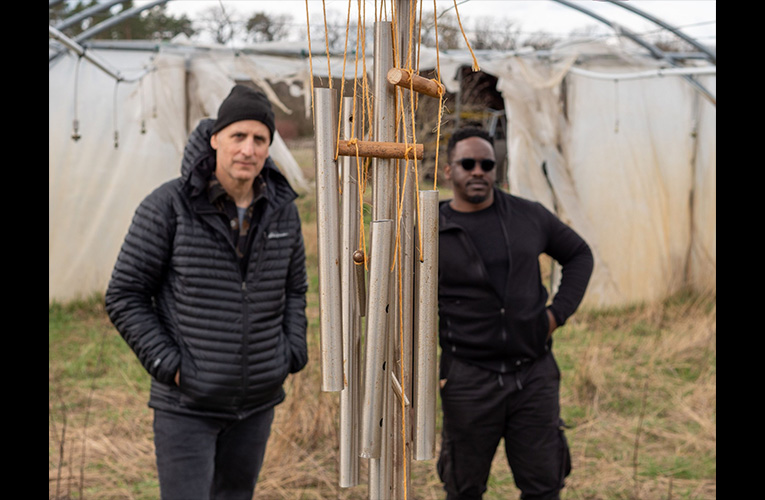
The day the mystical Zambezi Riverdeity Nyami-Nyami‘visited’ Johannesburg, leaving audiences in awe
During the performance at the opening of this exhibition, the two artists interweave the musical performance with a religious processions sprinkling and offering water as if to appease the angry spirit of deity Nyami-Nyami, incensed at his separation by the Kariba Dam from his wife left stranded on the Zambian side of the Zambezi River
By Jojokhlala C. Mei

Thursday 26th June 20205, a freezing dark winter early evening a performed exhibition reverberated throughout the tight Library of Things We Forgot To Remember at 44 Stanley Avenue space in Millpark, Johannesburg. Billed as Nyami-Nyami – A Sculptural Installation and Sound Performance, (by) ‘the Zebra Collective (Artists-in-Residence at University of Johannesburg), with their immersive multimedia installation and performance by the renowned artists duo, MasimbaHwati and Michael Gould.
While Masimba is a sculptor-cum-performance artist, Michale (Mike) is a music Professor at University of Michigan, USA.
On the stark-white new age or futuristic bandstand-like set hang symbolic electric white drums galore from the high ceiling. But keep an eye open for the water-filled glass bowls delicately placed on the white floor with drawings which performance artist Michael Gould says replicate snake movements through sand. Even the ephemeral lighting turns out to be a symbolic as the drowning electronic, object, and vocal howling sounds.
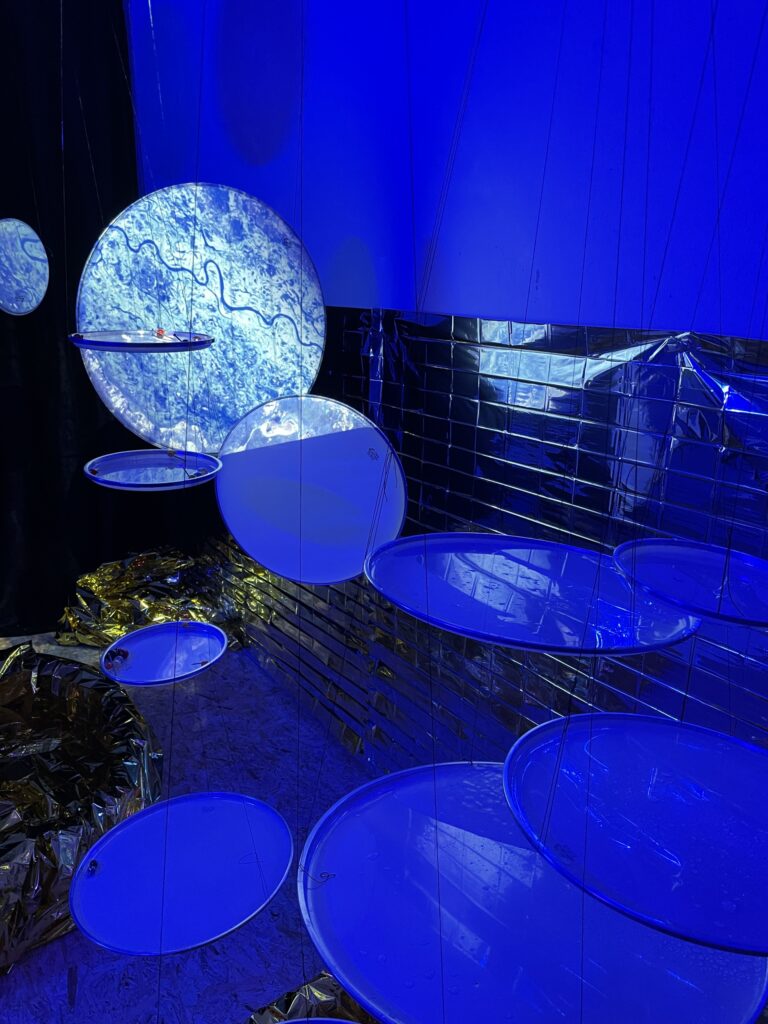
Rapid rhythmic rock-cum-disco drumming and chants break and simultaneously build a suspense which Michael explains after the performance as invoking the spirit of ‘Nyam- Nyami, the revered river deity of the Tonga people, depicted as a fish-headed, snake-bodied spirit believed to protect communities during times of crisis.
During the [Zimbabwean Kariba] dam’s construction, the Tonga people believed they had angered Nyami-Nyami, hoping that its power would destroy the dam and restore their homelands. However, the spirit seemed to vanish, and its power was lost.
Yet, Masimba and Mike recall that sporadic annual tremors continue to shake the dam.
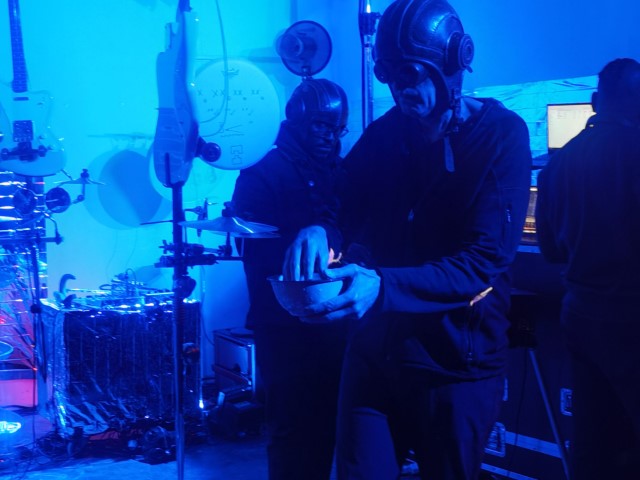
And the two artists interweave the musical performance with a religious processions sprinkling and offering water as if to appease the spirit of deity Nyami-Nyami, whom Masimba says is deemed particularly angry at his separation by the Kariba Dam from his wife left stranded on the Zambian side of the Zambezi River.
Who can forget that below this the dam on the Zambezi River lies the so-called Victoria Falls – one of the seven natural wonders of the world, and for this reason thousands of tourists from all over the world flock to both sides of the Falls and the dam annually.
On a sober note, Masimba echoes the curatorial statement which says: ‘the Zebra Collective summons this spirit once again, not just as myth but as a symbol of resistance and ecological memory. The installation merges sculpture, sound, and digital technology, intertwining ancient Shona stargazing traditions with contemporary sound engineering, including guitars rigged with clock-driven mechanics.
“The ultimate aim of the work”, continues the statement, is to “activate connections between indigenous world views and sustainable environmental practices.”
This Johannesburg iteration invites audiences to engage with the power of ancestral wisdom and reimagine planetary futures, bridging timescapes through sound and sculpture.’
Virtually every adult in the spellbound crowd of about 30 people were transfixed. One viewer commenting afterwards, “It is a beautiful offering. … tell me about the helmets.”
To which Masimba responded they are “protective. … made of leather, my signature practice motif.”
In truth the helmets made the artists look like aliens in fictitious films and comic strips. And two University of Johannesburg students NtabisengMohoang (Development Studies) and her friend Qhawekazi, (Human Resources) lauded the installation-cum-performance as a religious or revival experience.
Ntabiseng even took a bow by solemnly nodding her head to it. But I found no reason to agree with the promoters rather far-fetched claim that:
Nyami-Nyami delves deep into the historical and ecological consequences of the Kariba Dam’s construction, initiated in 1955 … caused 86 fatalities, and drastically altered the ecosystem of the Zambezi River. Today, the dam controls 90% of the river’s runoff, which poses a severe threat to the region’s environment and the 3.5 million people who live downstream.’
Hwati is a multidisciplinary artist whose work bridges sculpture, video, performance, and sound to interrogate memory, ritual, and the politics of cultural transformation. Currently completing a PhD in Art Practice at the prestigious Akademie der BildendenKünste Wien, Hwati holds an MFA from the University of Michigan, Ann Arbor, and is a graduate of Harare Polytechnic. The artist’s dynamic work has captured global attention, was recently featured by the University of Michigan Museum of Art and acquired by the Montreal Museum of Fine Arts. In 2015, he represented Zimbabwe at the 56th Venice Biennale as part of the “Pixels of Ubuntu/Unhu” pavilion. He was the recipient of the Cape Town Art Fair’s Special Projects Prize: Tomorrows/Today for his standout solo show don’t worry be happy. An honorary research fellow at Rhodes University, Hwati’s solo exhibitions include Instruments of Memory at SMAC Gallery and Quantumlogik at Gallery Delta. He is an alumnus of the renowned Skowhegan School of Painting & Sculpture (2019) and has exhibited widely, from Berlin’s HKW to Texas, Brussels, and Johannesburg. Hwati continues to shape contemporary art discourse through a powerful decolonial lens, remixing histories into resonant, future-facing forms.
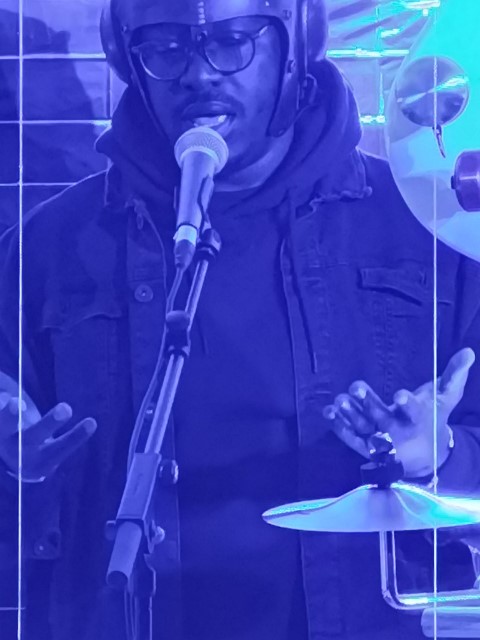
Gould is a Music Professor at the University of Michigan, is redefining the boundaries of percussion, performance, and pedagogy. Based in the Jazz and Contemporary Improvisation Department at U-M’s School of Music, Theatre & Dance, Gould is an internationally acclaimed percussionist, composer, and educator with a global reach. With over 100 educational percussion videos available on playalongmusic.com, Gould’s influence spans generations of musicians. His dynamic compositions have resonated from the Munich Opera and Ballet to National Public Radio, while his collaborative spirit has led to pathfinding work with engineers, dancers, scientists, and poets alike. His latest digital publication, The Drum Diaries, available on Apple iTunes, merges performance with storytelling in an immersive new format. As Music Director for Berlin’s Tangente Dance Company and a Board Advisor for the Percussive Arts Society, Gould is shaping the future of interdisciplinary performance. His multimedia work Remember Me, performed at KunsthausDahlem in Berlin, fuses dance, theatre, percussion, and visual art. Most recently, Gould collaborated with Nobel Peace Prize co-laureate Henry Pollack on A World Without Ice, a climate-focused installation exploring the Earth’s polar crises. To explore more of Michael Gould’s visionary work, visit www.gouldmusic.com.
.Nyami-Nyami – A Sculptural Installation and Sound Performance, closed its South African iteration on Sunday, will open at the National Gallery of Zimbabwe on July 9, 2025.