


The One and the Many exhibition at Javett-UP creates a room for a viewer to imagine what life could be under freedom
By Edward Tsumele and Jojokhala Mei at Javett Art Centre

Javett Art Centre at University of Pretoria pulled out all exhibition stops on an uncharacteristically warmish Tshwane 24 July 2025 evening, living up to its reputation as one of the world’s best warmest modern museum interior spaces.
The opening of the exhibition attracted hordes of people, and the occasion was graced by a band that performed for guests, adding another dimension to the event, ensuring that guests that numbered over 100, had a lovely evening of art, music, food and drinks. Events such as exhibition openings at the centre are never boring, and this one was no exception.

There is clearly new energy that is starting to permeate around the centre, following some period of uncertainty that followed the departure of its previous executives Lekgetho Makola, Chief Executive Officer and the Curatorial Director Gabi Ngcobo the well-respected South African curator whose work has over the years attracted the attention of the international art community, enjoying spells of curatorial engagements overseas.
However, with the appointment of an Acting Chief Executive Officer last year, Jackie Rens, and the announcement of the appointment of well-respected curator Storm van Rensburg as Interim Curatorial Director, a person who has enjoyed leading roles at art institutions around the country, such as stints at Zetz Mocca in Cape Town, as well as Goodman Gallery, among other prestigious art leadership roles, a new energy and stability has been injected back into the centre. This was clear during the opening, which was preceded by a media walk-about, during which time, van Rensburg did not only demonstrate his deep knowledge and insights of the contemporary art scene, his forte, but also showed a deep grasp of the South African art history scene.

He did this by taking the media on an insightful tour, delving into each of the three sections of this exhibition, demonstrating in a way the amount of work that went into conceptualizing, framing and delivering an exhibition that should find favour with art lovers, students of art, historians, thinkers and the general public for the duration that it will be running.
It is a pity that the exhibition is not accompanied by a catalog due to budgetary constraints of producing such a book.
“We are however thinking about creating an online catalog that is going to be publicly available for free,” Van Rensburg said in answer to a question from CITYLIFE/ARTS.
It was clear however that the management and staff at Javett Art Centre have their act together, affirming their commitment to making this place one of the most desirable places to see art pieces of museum quality, art that provokes one’s imagination, enlightening and of course sometimes making one uncomfortable, as art should be at times.
Director Rens and curator Storm van Rensburg were on hand to welcome the full house of entranced guests who included a special entourage from mining giant South32 which boasts a reputable permanent art collection installation here for both admiration, and study by the university students.
But the largest, life-size art piece is the site-specific commission’ by Inga Somdyala, described as – Soaring from the ground floor through the three the tree-story high atrium. The sculpture -speaks to South African seafaring colonial histories. Somdyala’s work visually and metaphorically links the different exhibition themes through a single red sail, anchored by counterweights of sea salt. It slices through the space, connecting the ground floor with the sky.

This work forma a large body of work that constitutes this massive exhibition, which will run till April next year, with the exception of the ground floor portion of the exhi9bition, which will run for two years. This portion of this seminal exhibition, curated by the exhibition’s newly appointed interim curatorial director Van Rensnburg, will anchor the centre’s education programme, that should benefit particularly students of art from institution of art around Gauteng, as well as the general public.
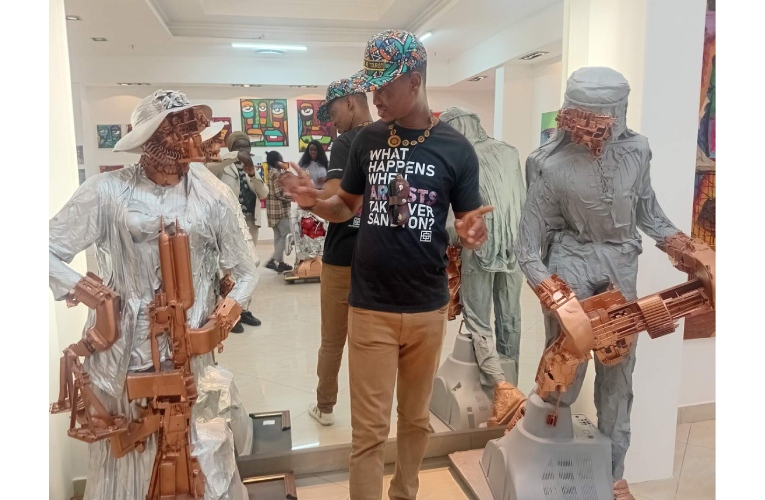
The exhibition is bold, multi-faceted across its galleries. Titled One and the Many, the exhibition features various constellations and groupings of artworks that explore the way in which artists narrate the relationship between the individual and the collective, or the self in relation to others.
The thematic arrangements investigate new relationships and meanings between artists, artworks, genres and periods in art history. Through spatial changes and curatorial gestures, One and the Many aims to open up different possibilities for reading images and artwork.
Six contemporary artists – Stéphane E Conradie, Goldendean, Ledelle Moe, Abdus Salaam, Inga Somdyala and Katlego Tlabela – were invited to have their large-scale artworks be in dialogue with three of the collections in the care of Javett-UP: the South32 Collection, the Javett Family Collection and the Bongi Dhlomo Collection.
“As a centre for research, dialogue and interaction, Javett-UP is positioned as an important public-facing institution in the cultural landscape of South Africa and beyond, and we are excited to open our new season of exhibitions and programming to the public,” says Rens.
The exhibition was conceived and organised by guest curator Storm Janse van Rensburg in collaboration with the curatorial team at Javett-UP (He has since been elevated to Interim Curatorial Director).
“The scope of the collections in the care of the institution allows for nuanced dialogues with South African art histories, and explores their relevance to our time,” said Janse van Rensburg, who brings a globally informed yet locally rooted curatorial approach to the exhibition. “To be allowed to experiment while also paying homage to our rich artistic heritage has been a deeply rewarding journey, and we are excited to share it with our various publics and constituencies. Working closely with the talented, enthusiastic Javett-UP team, the extraordinary artists, as well as the proximity and engagement with the UP faculty and staff has been illuminating and enriching.”
The exhibition consists of three chapters that opened concurrently. The first, ‘Living School’ – which is located within the framework of the ongoing educational initiative at the art centre – will be on view until 2027 in the ground floor galleries. It consists of works by South African artists like Ezrom Legae, William Kentridge, Bonnie Ntshalintshali, Dumile Feni, Louis Maqhubela, Harold Rubin, Ernest Mancoba and Durant Sihlali. The artworks will be arranged in groupings that explore abstract impulses in South African art, musings on spirituality and religion, and the complex relationships and intimacies between humans and the natural world.

The second chapter on view in the first-floor galleries until 2026. Works from the collections will be dialogue with art by Tshwane-based artist Katlego Tlabela. Significant pieces from his history as a painter focusses on luxurious and opulent interiors. His connection to black South African art histories is explored through the inclusion of artists and artworks that are significant to his journey, such as Gerard Sekoto’s Song of the Pick (1946). The voluptuous, sensual work Soft Vxns (2021) by Goldendean is placed in dialogue with works by Mme Mmakgabo Helen Sebidi, Tracey Rose and Adriene Piper, among others. It explores the possibilities of “soft radicalness” – the power of embrace and care. Fragility, the safety of home and making new objects from fragments is central to the sculptures and wall-based works of Stephané E Conradie, which are placed in dialogue with serial works by Jane Alexander, Willie Bester and Sam Nhlengethwa, among others.
A third chapter, on view until December 2025, is located in a beautiful, evocative space that has a panoramic view of its surroundings. This chapter, titled ‘Colossal Time’, explores the passage of time and monumentality in material and metaphorical ways. It includes two large-scale concrete sculptures by Ledelle Moe, whose interest in the female form comes to the fore. A video work by Abdus Salaam titled Rivulets (2024) explores the relation of water to the metaphysical, while Jeremy Wafer’s photographic series Antholes (1998) from the South32 Collection creates a connection to the ground, and explores notions of monumentality and collective actions.
Visitors are be greeted by a new, site-specific commission by Inga Somdyala, which soars from the ground floor through the atrium spaces, visually connecting the spaces within the art centre and creating both a symbolic link between the ground and sky.
“We strive to be a welcoming, inclusive and engaging site of inquiry and learning, and I know this new exhibition is an important contribution to the cultural offerings at UP and the city of Tshwane,” Rens says.
One and the Many is accompanied by a series of programming and events, which will be announced at a later date.
A lot of thinking has clearly gone into this exhibition. For example, in preparation for the new re-imagining of the Javett-UP, the centre was closed for re-installation and refurbishment from 14 June until 3 July 2025. The result is this stunning display of painting and art objects that are not only a compelling viewing experience, delving into the country’s rich art history, but is a window in to the evolution of South Africa, from the political constraints of Apartheid to a free country whose public have the freedom to vote and determine the kind of future they want.
CITYLIFE/ARTS recommends that if you have time, it is worthwhile to visit One and the Many and indulge you imagination into the kind of society that is possible under freedom, with the assistance of this well thought out exhibition. This exhibition creates a room to imagine what life could be under freedom.