

The Road Home: Why local talent was overlooked for the role of Miriam Makeba
By Edward Tsumele, CITYLIFE/ARTS Editor
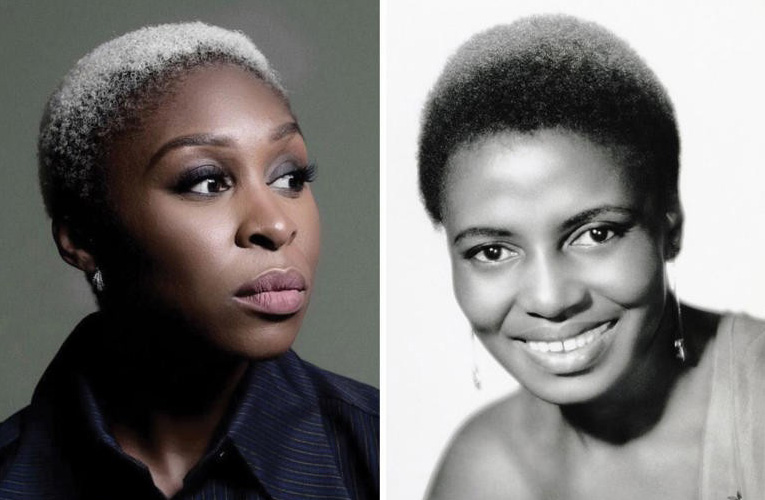
Since the news broke out last week that Nigerian British actress Cynthia Erivo, instead of a South African actress, has snatched the coveted role of Miriam Makeba in the Hollywood musical feature film The Road Home, several descending voices have emerged on social, media.
This is despite the fact that Thabo Rametsi, a local talent has been cast as the late Hugh Masekela on whom his life in exile, much of the story is focused on. This is despite the fact that this R300 million film will be shot locally –in Cape Town, employing a local cast of 68 South Africans and add the 300+ South African crew, this is massive. Perhaps even most importantly, the story is written by a South African, none other Professor Zakes Mda, the South African literary giant known for penning gems, such as Ways of Doing, The Zulus of New York and The Madonna a of Excelsior, among others, alongside impactful stage productions.
A South African story, one of its key people behind the film is local. One of its producers is none other than home grown film mogul Anant Singh. This raging criticism is going on despite the fact that the film will inject a lot of money locally through its different aspects, such as logistics, hotel accommodation, security, catering, the employment of extras and location fees.
Instead, South Africans want the whole thing, and given different circumstances and all things being equal, this would not be unreasonable, given the fact that the country has proven its worth internationally with some of its talent. For example, comedian Trevor Noah, actress Nomzamo Mbatha, DJ Black Coffee, visual artists Moshekwa Langa and Nelson Makamo, Tony award winner John Kani, US based actress Charlize Theron, to name bust just a few, stand out on the international stage, proving South Africa’s worth as brimming of artistic talent.
However, that is apparently not enough to have one of our own taking on the role of Makeba, particularly because The Road Home is being marketed as an international film, meant for global audiences. Is any of our actresses ready for that?
As the debate rages on, it would be helpful to critically and honestly answer the above question. However what we have right now are people complaining at a superficial level, without going deep into analysing international trends when it comes to lead roles for especially films aimed at a global audience.
Instead, some among us are simply complaining about the lead role being handed over to a clearly talented British actress Erivo of the Wicked and Harriet fame, whose acting pedigree has been tested and passed with flying colours globally. I am yet to watch any of the films she has acted in, but surely for her to have been nominated for an Oscar, she comes to this role highly recommended. Besides, just like Makeba, she is elegantly tall, suggesting that she is physically not far off from the image of Makeba.
Even the issue of grappling with the accent, filmmaking has advanced so much that there are competent pronunciation coaches, that I am sure will be roped in to make it easy for her to navigate the local accent. Besides, if it comes to a push, the producers have an option of roping in a local ghost voice artist to speak in the parts that are difficult for a non-native speaker of isiXhosa, for example, complete with its famous clique intonation. And so to just argue that this role belongs to a local actress is being simplistic, and therefore, is clearly to miss the point of understanding how the global film architecture is configured.
The selection of Erivo the Oscar-nominated artistto play this role of our beloved Miriam Makeba, instead of Nozpho Jele, (Not her real name), who is a local celebrity with 500 000 Instagram followers, and who is also talented as an actress at that, has nothing to do with overlooking good local talent. Rather, it has everything to do with economics.
In other words, the 500 000 Instagram followers that our Nozipho has, is unfortunately,nothing comparedwith the global audience, running into millions that Erivo is likely to draw to the cinema outlets, not only in South Africa, but globally.
In other words, and in marketing terms, our beloved Nozpho will not ring a bell in the ears of a construction worker in Tokyo, Japan,or a teacher in Islamabad, Pakistan. But Erivo stands a better chance –very much a better chance than our own. That in short, is the reality of the situation. Numbers talk and global currency is everything in this case.
After all, the investors must get back their R300 million –plus profit, for filmmaking is a business like any other business. People invest in such ventures not to achieve national pride and make people feel good, but to make money.
Would people who are complaining not do the same thing if their own money, let us say, their life’s savings is involved? I can bet my last cent: In the mind of someone investing in a risky business like film at that scale, the last thing in their mind,is to achieve national pride and make people feel good. Therefore, achieving national pride no matter how noble the idea is, will have to wait for another opportunity. It simply will not fly when it comes to an investment of this scale in a film.
This is the same reason why some among us were understandably disappointed when Jennifer Hudson, instead our local IT girl Ayanda Gumede (not her real name) and Terrence Howard instead our local hunk Dumisani Khuzwayo (Not his real name) got the lead roles of Winnie and Nelson Mandela in the 2011 biopic, Winnie Mandela.
Some among us were also equally disappointed when Matt Damon instead of Mahlomola Tsunyane (Not his real name) and Morgan Freeman instead of Refilwe Matome (A fictitious name) got roles as Francois Pienaar and Nelson Mandela, respectively, in 2009’s Invictus.
And so were we disappointed among us when Meryl Streep and Kelvin Kline got leading roles in Cry Freedom (1987).
The same scenario played itself out when British actor Daniel Radcliffe got the lead role in Escape from Pretoria (2020).
Not to speak about Sarafina the movie, when Whoopi Goldberg got the lead role of Sarafina instead of a local actress. And so the past history of who gets to play the lead role when it comes to film about South Africa or South African personalities is consistent with the latest decision to pick on a non-South African to play the role of Miriam Makeba, this time Cynthia Erivo.
And so guys, there is no reason for one to tear their hair in despair that Erivo got the role to play our beloved Miriam Makeba, instead of local talent. In fact, itis not an indictment of local talent, for we have that in abundance, but rather a question of economics. This unfortunately is how the global film industry is configured architecturally – Hollywood first and the rest of us last. After all, money talks folks.