


Veteran portrait artist Reshada Crouse publishes a critically acclaimed autobiography
This volume is an excellent example of ways in which autobiography can yield important kinds of knowledge and understanding, that are excluded from more conventional forms of historical writing, says Professor Brenda Schmahmann, of University of Johannesburg, about visual artist Reshada Crouse’s autobiography Art and the Devil: The Life of an unfashionable painter.
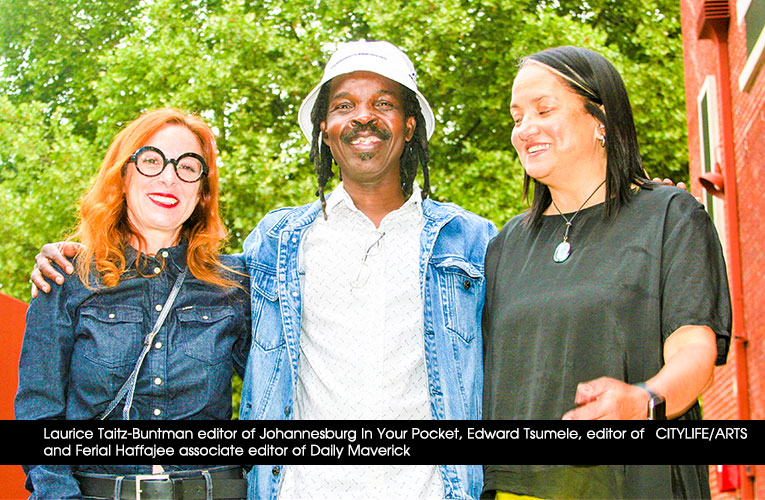
By Edward Tsumele, CITYLIFE/ARTS Editor
Artists often do not write their own stories, often those who write about artists sometimes do so, long after the artist is dead. There is nothing wrong with writers scouring archives, including interviewing those that knew the artist during her life time, in the process, piece together the life lived by a prominent artist.
Research based biography, written about an important artist long gone, true, has its space in art history. However the veracity and authenticity of such a book depends as much on the meticulousness and the availability of resources to the researcher involved, to piece together a credible book about a dead artist. Often resources, rather lack of them, is a limiting factor in producing a credible book about the rich life lived by a prominent artist.
However, despite the issue of self-censoring, choosing what to leave out and what to include, by a living artist, who decides to publish a memoir about themselves while still alive, it is always better to hear from the horse’s mouth, so to speak.
One prominent South African artist, Reshada Crouse has chosen to tell her own story of how she climbed the artistic ladder of her art practice, which mainly focussed on portraits of the famous and infamous of South Africa over the years. Including well-known figures, such as politicians, including those from the apartheid era.
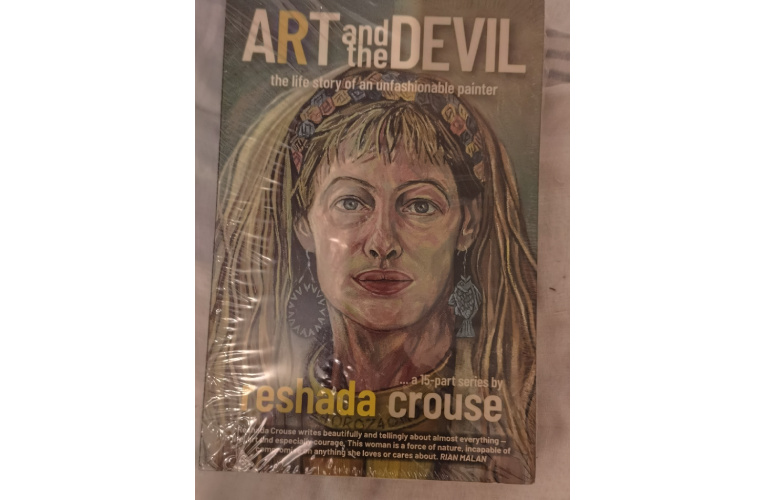
Her book, titled Art and the Devil: The Life of an unfashionable painter, was released late last year. The book, which comes in a coffee table format, is much about her life and art practice, as it is much about the lives of those that she painted over many years after getting commissions.
It is a critically acclaimed book in full colour, which suits those in the habit of collecting art books. This is an important book that at a broader level, is a part of art history of South Africa, beyond the portrayal of the personal life of one artist called Reshada Crouse.
Prominent literary voices are indeed impressed by this book.
“Reshada Crouse writes beautifully and tellingly about almost everything –life, art and especially courage. This woman is a force of nature, incapable of compromise on anything she loves or cares about,” says well known South African writer and essayist Rian Malan on the cover of the book. The cover carries the self portrait of Crouse.
T an art ignoramus, who rarely understands the explanation at the gallery, seeing Reshada’s works, while reading her deep dives into their stories packs punch I had never known. The searing honesty she punches she applies to her life, including parts that nobody expects nobody to be honest about, doubles it,” says veteran journalist Denis Beckett.
Museum director and curator Christopher Till also has a word to say about the book.
“An extraordinary insight into art and life, chronicled through the mind and closely observant eye of a master of both. Her many examples of commissions and competition works are a triumphant pantheon of personal and public life, in a style that is highly individual and immediately identifiable by its infusion of energy and juxtaposition of subjects and events…..,” he says.
These voices of praise about this book are not alone.
“This volume is an excellent example of ways in which autobiography can yield important kinds of knowledge and understanding that are excluded from more conventional forms of historical writing. One may not necessarily agree with everything Reshada Crouse says, one cannot but be struck by the intelligence that has shaped her opinions and standpoints. Indeed, in thinking about how she has navigated her world, we glean reach insights about ourselves as well,” says Brenda Schmahmann, Professor and SARCH Chair in South African Art and Visual Culture at the University of Johannesburg.
So you have heard from those in the know, and therefore, it would not be out of place to recommend that one must consider buying this book as part of one’s book collection. The book is about the life lived and practised by Reshada, but even more broadly, it is a slice of the art history of South Africa at a particular period in time.