


Seeding healing and honouring female ancestry in Our Mothers Gardens
By CityLife Arts Writer
A group exhibition in Saxonwold Johannesburg brings to life the legacy and memory of our matrilineal foremothers, and the powerful knowledge systems we inherited from them to coexist harmoniously with nature, and to heal.
The twelve multi-disciplinary artists featured in the exhibition include Mme Mmakgabo Helen Sebidi, Reshma Chhiba, Lady Skollie, Shanti Govender, Arthur Dlamini, Tanisha Bhana, Kirti Ranchod, and inspiring young talents like Nelisiwe Nkosi and Lemogang Matlhong.
“Madlozi Contemporary Art in collaboration with GAYA Habitat for Art & Healing is pleased to present this significant group exhibition ushering in Heritage Month and Spring in the city.
The project is a collective remembrance, tracing, honouring, and upholding the legacies of HER.

Women’s bodies are sites of memory, labour, pleasure, creativity and transformation, and healing. As landscapes they are scarred but also sacred – not because they are idealised, but because they hold the complexity of lived experience.
Our bodies bear the marks of history while remaining places from which new futures emerge.
This thematic is a principle exploring the sacred and divine feminine across cultures, communal traditions and practices we uphold, and the archetypal mother, deity, wise woman, mother and healer – women as leaders of communities who could coexist with nature as source.

The Garden as symbolic and curatorial framework
Our Mothers’ Gardens is situated within a constellation of intellectual, artistic and ecological traditions emerging from the Global South, where care, land, memory and community are understood not as separate concerns but as deeply interconnected ways of being in the world. Gardens, and seeds, like knowledge, are restorative and incubators for healing collective and individual pasts, for restoration of dignity and the human spirit.
Against the violence of patriarchy, colonialism and objectification, environmental exploitation, and gender-based oppression, the exhibition affirms embodied knowledge, sensuality, reproductive justice, bodily autonomy and self-determination as essential acts of cultural and political renewal. By reimagining the body as terrain rather than territory. Invited artists challenge transgressive systems, beliefs and practices that seek to regulate, commodify or violate women’s lives. This landmark exhibition and dialogue is curated by Beathur Mgoza Baker.

We are the Seeds
The powerful metaphor of the garden within, the communal and spiritual garden is explored, along with the power of seeds, as a metaphor and is articulated and interpreted by the artists through their works.
Honouring the body as landscape inhabiting ourselves, our communities and the Earth.
Questions of care, intimacy and collective responsibility are further informed by the writings of Bell Hooks who understood love not as sentiment but as an ethical and political practice. Throughout her work, hooks argues that communities are sustained through acts of care, mutual recognition and accountability.
This exhibition acknowledges women across landscapes and ancestrally across Africa, South Asia, and the Global South, asking what gardens women continue to cultivate – land, language, memory, political agency, justice, and community. It is also a tribute to the work, agency, and ideas of the author Alice Walker.

Exhibiting artists reflect diverse cultural contexts and tie together a spellbinding exploration of the great foremothers, ancestral elders, healers, leaders and knowledge-keepers who came before us and represent our matrilineal lineage, and a deeper understanding of ‘self’,” reads a statement accompanying the exhibition.
Throughout the Global South including Africa, women have long been key custodians of seeds, water, medicine, food systems, ritual knowledge, weaving, storytelling and land stewardship. The “garden” is therefore not merely domestic—it is political, ecological, spiritual and ancestral. In many South Indian traditions, the Earth is honoured as Bhūmi Devi, the living ground from which all life emerges.

Lineages of resistance & resilience – South Africa
In the South African context, this remembering honours lineages of resistance, and the courage of the more than 20,000 women who marched to the Union Buildings on 9 August 1956 in protest against the extension of pass laws to women. Their collective action reminds us that the struggle for dignity, freedom and justice has always been cultivated through networks of care and acts of political defiance.
Together, the artists invite us to reconsider the garden as more than a cultivated plot of land. It becomes a philosophical space in which relationships between humans, plants, ancestors, ecosystems and future generations are continually negotiated. It is a vital and valued archive of memory, a site of resistance, a classroom, a sanctuary, and a commons. It reminds us – cultivation is never only agricultural; it is also cultural.
We attended a curated artist talk and exhibition walkabout and encountered the work of artist Nelisiwe Nkosi along with Sudhata Jurakan and Arthur Dlamini.
When you enter GAYA Habitat for Art & Healing in Saxonwold, Johannesburg, the garden and gallery welcomes you. The cultural space is emerging as one of the city’s cool places to emerge for art and connection in recent years in suburb to promote culture.
Entering the exhibition for the artist talk are beautiful photographs with stitching on them – works by rising young talent, Nelisiwe Nkosi, an artist producing imaginative work and a visual mind.
Looking more closely at her work you start to realise that these art works carry a deeper message. Even disturbing message that brings you as a viewer face to face with a hard-hitting South African issue that has to be part of our daily conversation in society right now. Gender based violence is a big issue in South African society and as an artist Nelisiwe addresses it creatively but in a personal and direct way.

She takes us through the personal trauma that she worked through and healing producing her art works. Of the four pieces, one piece in particular, creates a haunting conversation within one’s mind. It is an image of two naked bodies on which there are stitches of red wool that resemble shoelaces. You will inevitably start wondering what they even mean.
“These two photographs symbolise two harsh experiences of what happened in to me that I came through and healed. I was hurt badly as a child while playing outside at my home, and I bled profusely, I did not tell my mother what happened. But then my sister informed my mother and she immediately knew what to do to stop the blood, a lot of blood from where I had hurt myself playing with a water bucket. It is the red of that blood that I remember and rework in this piece” the artist shares.


“I know that this pain, and I experienced other experiences of assault in which healing is needed, experiences that affect many others who have not yet spoken out about it. But I create art in a way that does not hurt further those that have similar experiences, but are to build their strength to heal from it. Many women have not yet shared or spoken out about their experiences of violence, especially sexual violence. For me, making art is a way of healing and overcoming the trauma. I get inspiration from my grandmother,” the young artist says.
It is interesting to note that Nelisiwe with regards to her process of creating approaches everything she creates through poetry as a parallel medium, and then her primary medium of expression which is photography. Her artworks are beautifully illustrated and accompanied by her powers which she recited at the artist talk she led. What she feels and writes as poetry is eventually what shapes the artwork she finally produces.
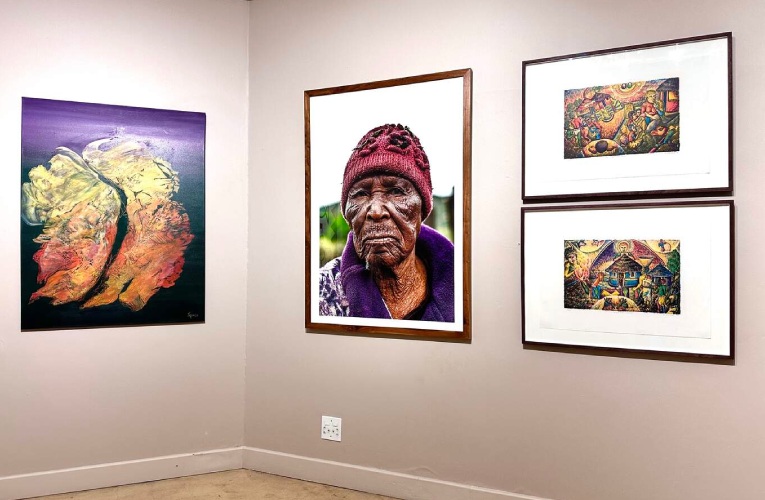
During the walk about, besides Nelisiwe’s works, I was also drawn to Shanti Govender’s giant piece on board, that she created beautifully from flowers from her home garden, which in fact, is part of the huge house that also houses Gaya Habitat. Also quite striking, is a picture made by Dlamini of his grandmother. You can almost feel the emotions the old lady exudes by looking at that image.
Performance artist and painter, Jurakan’s huge art installation ‘The Golden Yoni’ fills up one whole room and lightens up an understanding of how central grandmothers and their physical and spiritual roles are to us. It feels as if it actually belongs there permanently and immerses one in saris, fabrics, and home.
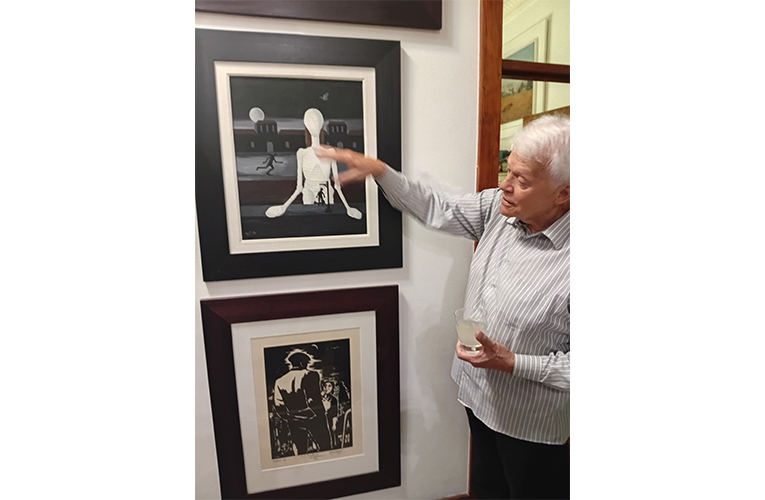
Then, it was time to view familiar images, early works by South African artist and stalwart, Mmakgabo Helen Sebidi, who is part of the show and exhibiting three rare works that were recently returned from Belgium where they were ‘lost’ for several years.
What this exhibition centres is the role played my mothers and grandmothers in people’s lives. The matrilineal figure hovers in every aspect of all the works that are on display here.
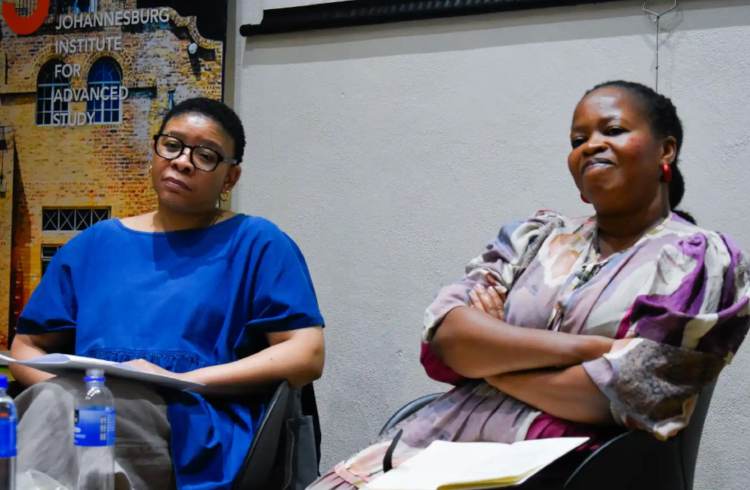
The artists spoke to an engaged group during the walkabout to take visitors through the group exhibition Our Mothers’Gardens, which is currently on at GAYA Habitat for Art & Healing Gallery in Saxonwold in collaboration with Madlozi Contemporary Art Gallery. You can join the next exhibition walkabout on Saturday 19th September at 11h00. They are at 15 Abbotswold Road, Saxonwold, Johannesburg.