


A new guest Fire my Spirit waiting to greet you at University of Johannesburg
This permanent installation created by artist Bev Butkow has achieved the effect of being in conversation with the space by softening the Brutalist architecture of the foyer of Keorapetse William Theatre.
By Edward Tsumele, CITYLIFE/ARTS Editor
If you went to University of Johannesburg Arts Centre right now, a space that has a gallery where regular exhibitions take place on one side, and another building on the other side, which houses a space for performances, the Keorapetse William Theatre, the place has dramatically changed from what you may be used to. Specifically the building housing the theatre has a new guest, in addition to the features that you maybe, used to.
On Tuesday, July 28, 2026, I witnessed that transformation in the foyer of the main building (where the theatre is). On the right, side of the foyer, something transformative, has just taken place. I almost missed the piece of the moment at first. Not that it is not visible. In fact, it is so visible not to be missed. The piece blends so well with the space that in my mind, I concluded that this installation is not what I had come for in the first place. It looks so beautiful, and so neatly complimentary to the space that, in my mind, I must have thought, well it has been there all along as part of the architectural design of the building. Glowing and eye catching, it never occurred to me that this beautiful abstract installation blending so neatly with the wall, and the lights generating a glow that makes this part of the building welcoming to visitors, was in fact the reason why I was there.
Instead my eyes were focussed on two art works that are so familiar, so Bev Butkow, that I did not even think twice to know that these weaved works, pieces of fabric and wool, were created by Butkow, whose work I am well familiar with.
On the right, my eyes soon focussed on a video of a woman artist weaving, with her art pieces sprawled on the floor of what definitely was a studio space of hers. I did not immediately connect the pieces together. The two pieces on the right. The giant art piece hung literally intentionally next to the wall. The glowing one. The other piece across on the other side of the room, next to the coffee and wine station, right at the back.

“Where is the installation?” in confusion and momentary ignorance, I asked gallerist, Julie Taylor, founder of the Johannesburg based gallery Guns &Rain, which has recently closed its physical space in Parkhurst to focus on the online part of the business and to develop other concepts more suited to the market the gallery serves locally and internationally.
“’It is right there,” Julie pointed. I realised that the giant, glowing installation in front of me titled Fire my Spirit is in fact, not an art work that has been commissioned as part of the architectural design. It is, in fact the recently commissioned piece from Butkow by the University of Johannesburg to “soften” the “Brutalist” atmosphere of the foyer of this building, and it works perfectly well.
The other art works, will go down, after this exhibition has run its season, but this giant abstract installation, will remain as a permanent installation. Good for the powers that be, because definitely it adds value and is likely to trigger conversations in those who will visit the space from now on.
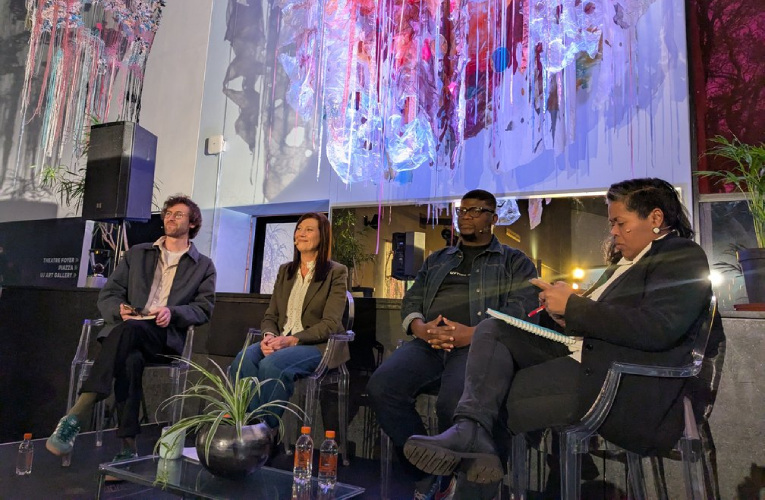
“’The idea of the installation is to create a conversation between the space and the piece. When people come here, they should be able to witness the conversation going on,” said Butkow, prompted to speak about the piece by art critic and writer David Mann, who moderated a panel comprising Butkow, educator and artist Lawrence Lemaoana and art academic and curator , Dr Farieda Nazier.

The artist created this piece at she completed an Artist Residency at UJ.
The discussion first focussed on what the panel thought of the piece in relation to space, generally agreeing that this commission has achieved the purpose of softening the Brutalist atmosphere of the foyer of the building.
However, as the conversation built momentum, it took a wider lens going into the role of public art in society.
For example, an art piece such as the Fire my Spirit Installation, placed in a space within university grounds, raises the question of who has access to see it. That is besides of course academics and students, who form the bulk of the university population.
The rest of those who get to experience a work such as this installation, are of course those the university chooses to invite into the premises, a controlled environment, which for security reasons, cannot afford to open its gates wide for everyone from the streets to enter uninvited. But still, the university community and its guests, technically speaking, constitutes another type of ‘public’, and therefore, Fire my Spirit could be said to be public art in that sense, the panel told us –the audience.
However, Lemaoana pointed out the restrictive nature of ‘public art’ that is located within access-restricted and tightly managed invitations, such as universities, compared to installations that have been erected in public spaces around Johannesburg by prominent artists, such as the William Kentridge piece near the Mandela Bridge in Newtown, for example.


“There is definitely a huge difference in how public art at spaces such as universities and in public spaces around Johannesburg is accessed.
For example, the public art in Newtown Park, has several publics. The people who live around the park, those passing through the park, and the squatters, who look at the art differently. As something they can uproot and smelt for another value,” he said.
Nazier explained that creating a commissioned piece of art, such as the Fire my Spirit, was different from commissioning a piece that is meant for another space.
“For example, this piece is different from a sculptural work for example, as an artist has got to think about how it must fit into a space like this, where it needs to be in conversation with the space itself,” she said.
An art student, who explained that where she comes from, which is Cape Town, buildings dotting the city, they have been told, since growing up, were meant to live for a long time.


Pics by: Bev Butkow and Anthea Pokroy.
“However, when I came to Johannesburg, reading how the history of Johannesburg and its development are tied to the discovery of gold, those responsible for designing buildings, did so for the building to last not more than 50 years. The reason being that they thought Johannesburg was not a place for people to live,” she explained.
She went on to ask whether the architects who designed the building now hosting the Fire my Spirit installation ever though that one day, the building would develop to host an art work such as this piece.
“I am asking this piece because some of the architects are said not to take art seriously as a profession,” she remarked.
Immediately Gordon Froud, a senior art lecturer at UJ, raised his hand.
“Let me answer that one quickly. Actually, the architects who designed this building, and the one across where the gallery is, are also artists.”
University standards
But because this installation is commissioned by a university, it also had to meet certain strict requirements as standard university protocols.
Fire my Spirit
Fire my Spirit operates through a material and spatial logic in which making is not illustrative but epistemic. Built through layering and repetition, the installation treats textile, gesture, and colour as forms of thought. It produces a perceptual field that shifts with movement.
The work draws from an elemental incantation that appears at the opening of Dr. Uhuru Portia Phalafala’s doctoral research on Prof. Keorapetse William Kgositsile:
“Earth my Body, Water my Blood, Air my Breath, Fire my Spirit.”
As Phalafala demonstrates, this formulation does not operate metaphorically but ontologically, articulating a non-dual relation between human and world in which the body remains continuous with ecological, spiritual, and ancestral systems. Within this framework, the elemental is not symbolic representation but a condition of being.
=‘Fire’ in this context exceeds notions of destruction or transformation as discrete events. It operates as a generative force that simultaneously undoes and re-forms, reconfiguring temporal experience through what Phalafala identifies as Kgositsile’s non-linear conception of time – a co-presence of past, present, and future in active relation. ‘Fire’ becomes a medium through which memory is not recalled but reconstituted, and through which historical time is unsettled and rearticulated.


Installed within the Keorapetse William Kgositsile Theatre at University of Johannesburg, a site structured by performance and collective encounter, the work situates the viewer not as observer but as participant within a dynamic perceptual field. As bodies move through the suspended layers, vision is disrupted and recomposed, producing a spatial-temporal experience that resists fixed orientation.
In this way, Fire my Spirit proposes knowledge as emergent, relational, and contingent: it is produced through movement, encounter, and material intra-action rather than abstracted representation or stable form.
So next time you visit UJ Arts Centre, do not be surprised to be greeted by Fire my Spirit. Just greet back.