







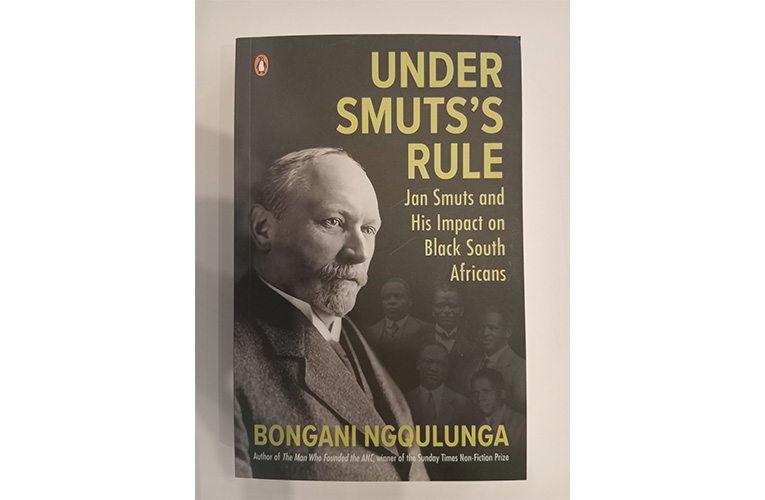
Bongani Ngqulunga’s new book UNDER SMUTS’S RULE: Jan Smuts and His Impact on Black South Africans is informative, well researched and balanced

Reviewer: By Giyani Baloi.
Title: UNDER SMUTS’S RULE: Jan Smuts and His Impact on Black South Africans
Publisher: Penguin Books
The literal space is getting exciting by the day in South Africa, especially with the increasing number of black Masters and PHDs graduates. Oftentimes, their research theses turns out to be books and that further enrich the literary spaces.
Dr Bongani Ngqulunga is the Sunday Times Alan Paton award winner non-fiction for his book, The Man, who Founded the ANC. A Biography of Pixley ka Isaka Seme. He currently works at University of Johannesburg (UJ) as an associate professor in the Department of Politics and International Relations.
His book UNDER SMUTS’S RULE Jan Smuts and His Impact on Black South Africans looks at one of South African’s iconic political leaders of yore, Jan Christian Smusts from a different angle.
Ngqulunga looks at Smuts’s political life, leadership, and its impact on black South Africans beyond his international standing and influence. They say the presence is defined by history, and the future is defined by the presence.
Bongani traces Jan Smuts’s prevaricating tendencies on dealing with a thorny issue of black South Africans in the early 1900s, which later gave birth to apartheid and ultimately created the current condition of black South Africans generally today.
Many would agree that Jan Smuts played a big role in creating the current world order. You can talk of World War 1, World War 2, the state of Israel, the United Nations, among other things. But, at his own home country, he couldn’t help bring about equality, justice, and fairness to black natives. Or was it self-preservation and swart gevaar.
Well, the condition of black people cannot be blamed on Jan Smuts alone. The majority of white South Africans must also take the blame because it is them who supported the segregation pact. In fact, some white civilians were directly getting involved in attacking black people alongside the army and the police. For example, the Bulhoek massacre of 1921, where about 300 church civilians were killed by the police and the army. The white community members got involved there. The 1913 Kleinfontein mining strikes where the community was also involved in attacking black mine workers.
Well, the buck may end with leadership. But, the general racist white community must not be exonerated completely.
Of course. It was like a dog it dog situation, then. If you did not fight your own battle tooth and nail, you would not have your fair share on the dinner table. The black people’s lack of organization, education and assertiveness besides being the majority in South Africa, may have contributed to their mistreatment by their white counterparts.
UNDER SMUTS’S RULE Jan Smuts and His Impact on Black South Africans is very informative, well researched, written, balanced, and a likely to win literary awards.