






Up-Close and Personal with cartoonist Zapiro whose sketch book and pencil rattle the corrupt among the political elite in South Africa and beyond
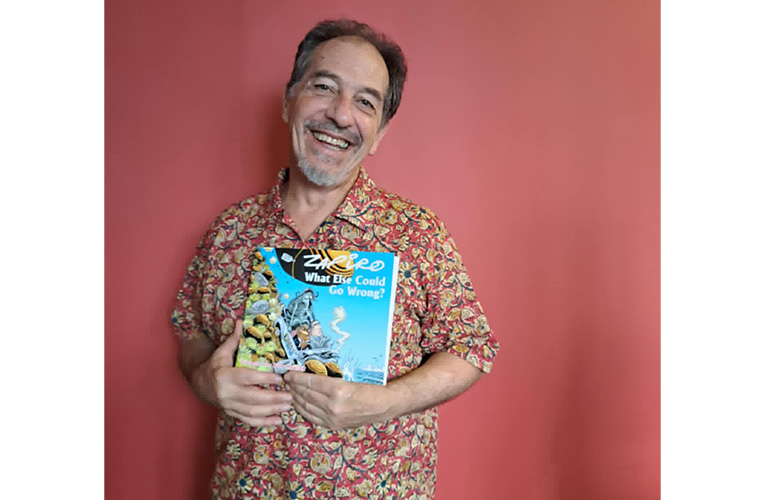
His 30th book titled What Else Could Go Wrong? Is now available at books shops around the country.
By Edward Tsumele, CITYLIFE/ARTS Editor

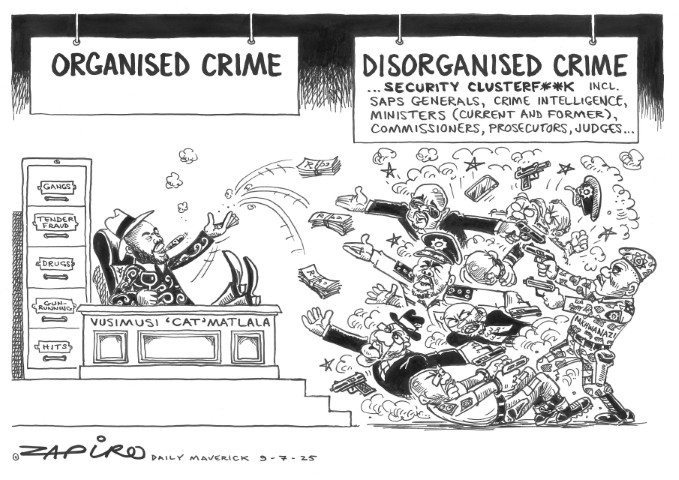
There is a guy who is seated comfortably on what looks like an expensive couch, with a cigar in his mouth. He exudes power, and he projects a sense of satisfaction for having made it someone. This arrogance and confidence comes from the fact that he has captured the powerful in society, winning them over to his side. They are in his pockets, and in fact seem to take instructions from him.
This figure is captioned Cat Matlala, in reference to the businessman, who is currently at the centre of two inquiries, the Mdalanga Commission of Inquiry and the Parliament Adhoc Committee. These high profile commissions, appointed by President Cyril Ramaphosa, are probing allegations first made by KwaZulu-Natal Police Commissioner Nhlanhla Mkhwananzi.
He alleged in a highly publicised media conference in July, 2025, that some politicians, including Police Minister Senzo Mchunu currently side-lined, some prosecutors, some senior police officials and some members of the judiciary are in the pockets of a cartel of corrupt business men, dealing in drugs and implicated in gun running at the centre of what appears to be a toxic intersection of politics, business and criminality.
But then when you look on the captions behind the Cat Matlala figure, you see words that are actually disturbing: Gangs. Tender Fraud. Drugs: Gun Running: Hits. But as you look up above him, there is even a more disturbing text: Organised Crime. But then again, look on the right side of this man, you will see images of several characters, whose faces are familiar, all shamelessly and desperately stretching out their hands to reach the money that is being dangled to them, being offered to them by this seemingly powerful man called Cat Matlala in the caption.
But then when you look above their heads and ignore their obvious desperation to reach the money that is being offered by their benefactor, you then see even a more disturbing text: Disorganised Crime: Security ClusterF….k INCL. SAPS Generals, Crime Intelligence, Ministers, (Current and former), Commissioners, Prosecutors, Judges…
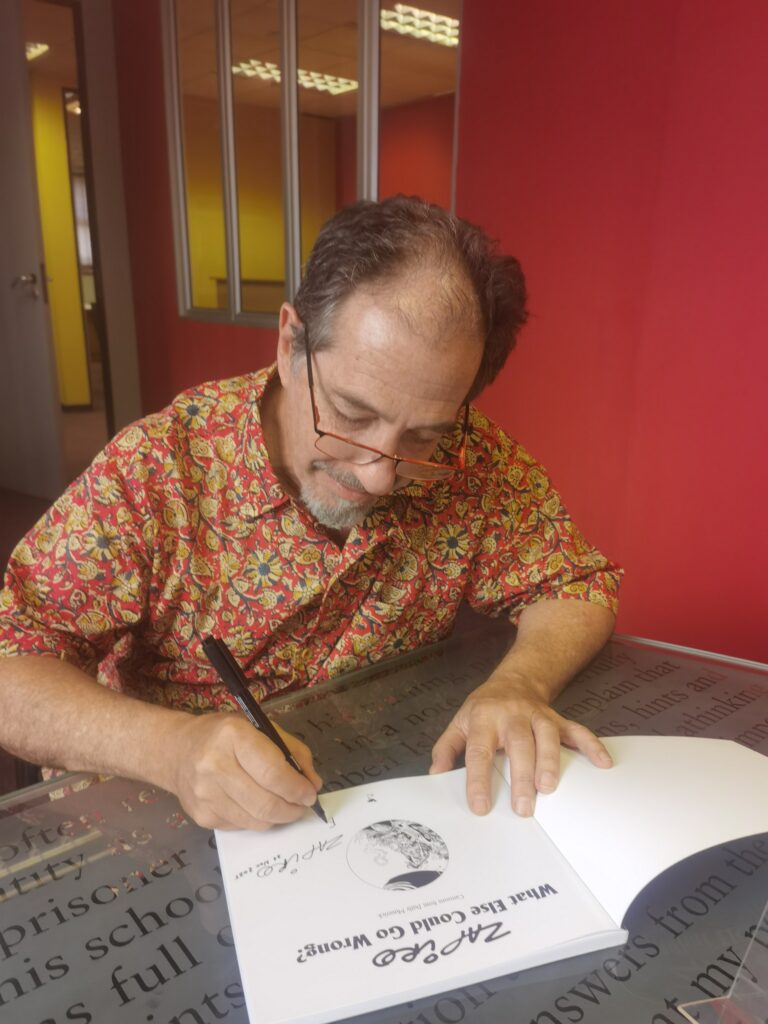
It is after having a proper and reflective look at this cartoon that clarity dawns about what is going on in this black and white cartoon by super perceptive cartoonist Jonathan Shapiro, otherwise in the popular public imagination, simply famously known as Zapiro. His critical eye does not miss the major developments in the country’s politics, business, and crime. He has been doing this kind of work for decades now, and has therefore emerged over the years, as South Africa’s leading visual story teller with the rare ability to immortalise the major events of the day in the country using the visual medium of cartoons, published in various newspapers over the years.
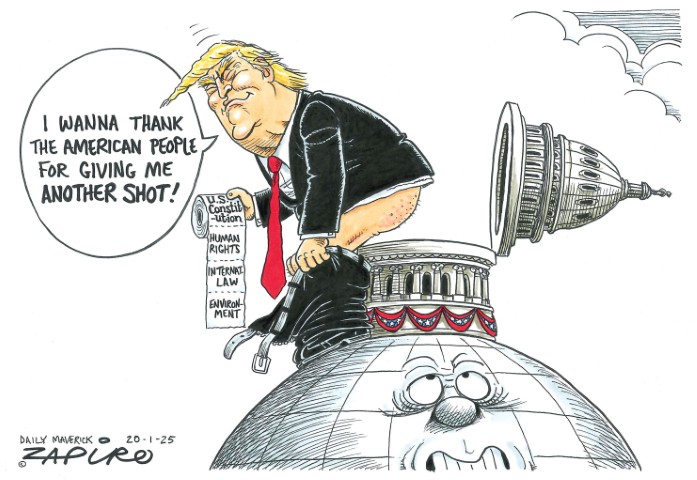
But Zapiro has gone further than only publishing in newspapers, these cartoons that have become highly critical of what is happening in democratic South Africa, by publishing books that capture these moments, and therefore contributing to the narrative of how democratic South Africa has been in the last 30 years.
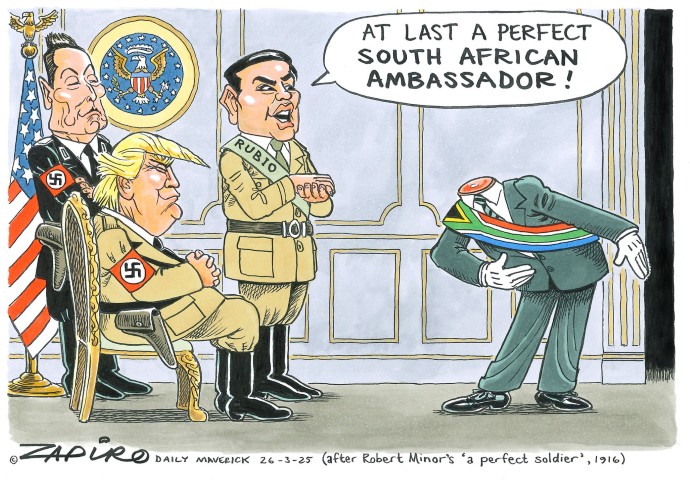
That particular cartoon I am talking about here is part of the cartoons that constitute his new book, which critically dissects, almost clinically, what South Africa has been in the last 30 years. In reality, this latest book, just like the other 29, he has published so far, is an important body of work, that will be useful even to researchers and students of both history and politics researching how democratic South Africa unfolded after 1994. The country had great promise, but only to drag itself into the gutter due to corruption, incompetence and simply lack of effort to make sure that South Africa, not only maintains a stable position as a middle income country, but also move forward to an upper middle income country on the part of those in charge of governance.
For his sharp visual mind and intellect of aptly capturing the key moments in South Africa’s evolution, Zapiro has received both scorn and praise. Those who are at the receiving end of his pencil, sharp mind and super imagination he has made enemies out of them. This is because his pencil and sketch book has made it clear for ordinary people to see that, for example, corruption, is not as a harmless phenomenon with no consequences in society.
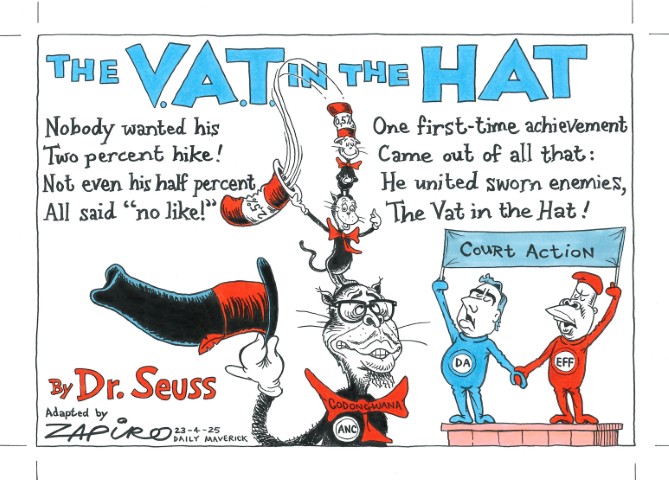
The cartoonist has made it easy for people to see that corruption is a disturbing practice that robs the poor. This has resulted in a situation whereby the crooked have scorned him for his genius, while the public have seen him as a hero who graphically shows the wrong doing by those who wiled people and lack accountability. Therefore the corrupt have often accused him of all sorts of things, even racism at different times in the past 30 years, while the public has hailed him as their hero whose work has contributed in holding those with state power accountable, and therefore contributing to the deepening of the democracy project.
The wrong doers in society are not impressed, ironically including some who were once in the trenches with the cartoonist in fighting for democracy in the 1980s.
This is despite the fact that his struggle credentials, mark him as someone who was on the right side of history when it comes to the struggle for freedom that many fought, including the current rulers, some of whom have become his detractors, simply because he exposes malfeasance in their ranks.
However the general public and analysts with a clarity to see what he is doing as not merely a critique of the ruling elite, some of his rank members have lost their path, getting involved in corrupt activities instead of serving the public with purpose and ethically, continue to support Zapiro’s work. Including buying his books in the past 29 years.
For example the book that sold the most was the one he released in 2007, which sold over 21 copies. That is quite huge by South African standards, especially for a book on cartoons. Perhaps that should not surprise anyone, for in reality, Zapiro has played an important role in mainstreaming the art of political cartoons, taking it from the periphery of public imagination in to the mainstream.
However his journey to where he is today as a celebrated cartoonist, has been long and arduous. Today, he is not only an inspiration to many a young cartoonist, but also has emerged as a political force the corrupt and crooked fear in the corridors of power in contemporary South Africa. His pencil has become one of the most feared instrument by those implicated in wrong doing in especially political circles.
“When I was conscripted in 1982, it was a hard time for me as I could not do anything about it. I could not leave the country. I was helpless. But one thing that I did once I was in the army was to refuse to carry a gun. The army ended up giving me some kind of metal pole to carry instead. I became a laughing stalk during that period. But I loved it. And it was during that period when my activism took root as I started sketching as I had decided that I was going to be an activist. For example, it was while I was in the army that I attended the formation of the United Democratic Front in Cape Town in 1983. I and others were arrested and convicted. We were the first people be arrested while in cars of the UDF, complete, with our UDF uniforms on,” he told CITYLIFE/ARTS in an interview.
When they were arrested former Finance Minister Trevor Manuel, who was part of the leadership of the then just formed anti-apartheid organisation, UDF paid their bail.
“The army was very angry with me. So, in fact I have a criminal record because of my activism,” Zapiro revealed.
However though mainly praised by the general public and political analysts for his incisive cartoons in democratic South Africa, he also has detractors from the ranks of the ruling elite, ironically some of whom shared struggle experience with him, fighting apartheid together.
For example, twice former South African President Jacob Zuma, threatened to sue him for millions of Rand, for simply doing his work, and doing it so well, that the work he created about the former President rattled him and those in his inner circle.
“Ï faced two law suits from Jacob Zuma, first in 2006, just before the Polokwane Conference of the ANC, when he threatened to sue me for R15 million for the cartoon Lady Justice.
And also in 2008, he threatened to sue me for R7 million. His then later demanded instead that I apologise and all was going to be forgotten. I flatly refused, and so did Sunday Times editor then Mondli Makhanya.
“Then 24 hours before I was scheduled to appear in court to be cross examined, the law suit was abandoned. I and my lawyers were actually disappointed as we were looking forward to our day in court. We had spent a lot of time preparing for the court day, and we had all our material together,” Zapiro said.
His confrontation with the former President however did not end there.
“There is a time when someone said they wanted to introduce me to Zuma personally, who was at a function where I was. I refused because how could I would have had a picture taken together with some who was suing.
“And then there was another time when I confronted him at a press conference after he had spoken about the need for freedom of expression and the media. I asked him how he could say that when in fact he was at the time suing me for doing my job. He gave me an answer that hardly anyone can remember anymore. It was a convoluted answer.
“The second time, it was when he was on 702. I phoned in and asked the producer to allow me to ask him the same question, and this time, he gave me an answer that was in fact impactful. He answered that my cartoons were invading his dignity. That was cool and I used that quote at the back of my book cover,” Zapiro said as he laughed, his hearty laughter echoing beyond the walls of the boardroom at Jacana Media where the interview took place.
Zapiro’s latest book titled What Else Could Go Wrong, is published by Jacana Media and contains the cartoons that have previously been published in Daily Maverick during 2025.