






MuseumAfrica curator David Kola ignites dialogue with his curation of returning Cultural Heritage exhibition
By Jojokhala C. Mei
On June 7, MuseumAfrica in the Newtown heart of Jo’burg CBD brought out its Cultural Heritage South Africa collection to exhibit long term, and on Sunday June 15, 2025 of the Youth Day long weekend, curator David Madimetsa Kola led a walk-about, with assistant curator Tshililelwa Konazwau Nemudzivhadi alongside.
I’ve visited and reviewed this museum a few times in the past, and still believe it should be a draw card to all form Gauteng province and beyond, although in 2010 I was swept away by our coveted National Ditsong Cultural History Museum in Tshwane; and before that in 1995, London’s showcase British Museum of strangely few truly British draw cards, where at the gates the squirrels fought furiously for the nuts, I was munching at the gates.
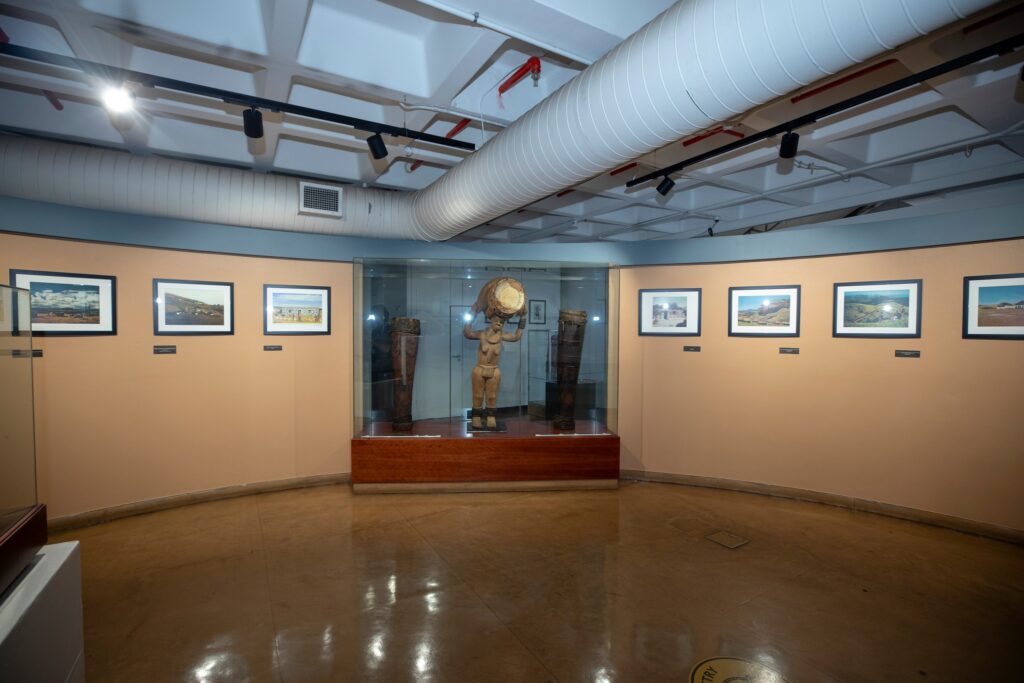
Back to this exhibition. It starts with large print write-ups hanging on the wall of our national symbols supplied by the Department of Sports, Arts, and Culture. Examples are the national flower, the national animal, the national anthem, and so on.
The rest of the exhibition is made up of object artifacts like clay pots; plus screened audio visual recordings of Indigenous music, indigenous Knowledge Systems, healing and divinity, indigenous games, indigenous dressing, and indigenous food processing.
However, Kola pointed out that artifacts of pre-colonial origin are placed in contrast with urban/modern ones. For instance, an artefact of ancient village moruba pebble games is placed below an audio-visual recording of Western games like rugby, which are popularly associated with modernity. You could say archery of Olympic Games-fame is spuriously staged as a modern game too. On another stand is an artifact of randomly ‘thrown’ sangoma healing bones, which Kola stresses many modern South Africans still secretly use. He remembers that eminent socio-political commentator Moeletsi Mbeki has noted that people in Eastern countries of the world (like Japan and China) have radically modernised while keeping their traditional forms and methods of divination, worship, and healing.
Indeed, the traditional Japanese tea-ceremony religious shrine is fitted like a Star Trek futurist space in a high rise luxury apartments photographs in my coffee table book Japanese Style, by Suzanne Slesin, Stafford Cliff & Donnel Rozensztroch and almost 800 photographs by Gillas de Chabaneux.
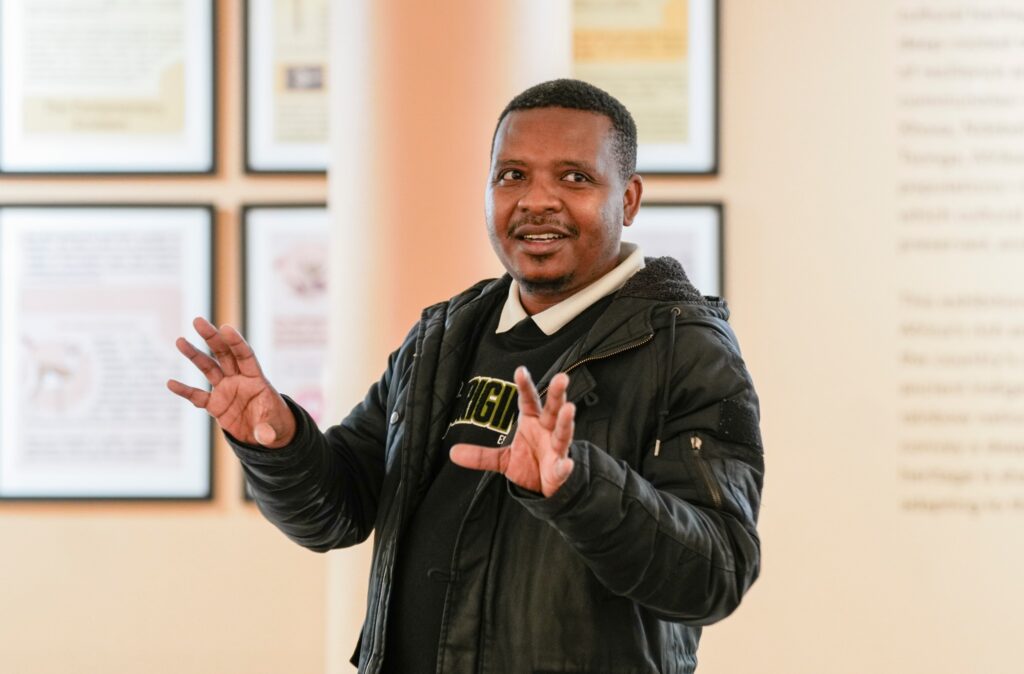
If only Kola’s informative and provocative narration was recorded and played back to exhibition visitors in all the years to come. When I returned three days later to witness and assess visitors’ reactions, I found five Richfield commercial college students from up the road who would benefit from the narration as they grabbed the pebbles to simulate playing the moruba game.
Female dolls in colourful traditional dress hold centre stage of the last section, but sorely missing are the dress and artifacts of the so-called original people of Southern Africa, the so-called Khoi-San, who I find hold their own fort in a separate exhibition elsewhere in the museum. Is this ideal?
Delightfully, the Indigenous Food Processing plaque reads like a citation from the annual prestige Rolex Awards for Enterprise’ also awarded in 1996 to Senegalese Sanousai Diakite for ‘Making fonio husking machines to ease the preparation of this African cereal.’ The museum’s plaque itself says: “… By harnessing traditional techniques such as fermentation, drying, and smoking, and utilizing processing artifacts like mortars, pestles, grinding stones and clay pot, indigenous communities have been able to transform raw ingredients into nutritious, shelf-stable foods that sustain them throughout the year.”
Pity I did not see the young students in their late teens or early twenties read through all the informative text. Maybe it didn’t look catchy enough to draw them in, and alternative senses could be tapped.
This may not be a unique Smithsonian-level exhibition, but Kola wrapped up the walkabout by magnanimously welcoming the presence of MuseumAfrica’s floor staff, who assisted him and Tshililelwa strategically lay out the exhibition, because in reality the staff sometimes act as tour guides. Probably when huge tour groups like schools need to be divided into smaller manageable groups.
.Photographs Courtesy of David Madimetsa Kola of MuseumAfrica.