



The exhibition pays homage to David Goldblatt as it shows existing inequality in South African society
Essentially, what What We Do Not See, has managed to achieve, is to make Golblatt’s legacy, a living thing, a lasting memory that cuts deep into South African contemporary life, uncensored and unsanitised, particularly shining the light on the pain defining this nation today –the glaring inequality.
By Edward Tsumele, CITYLIFE/ARTS Editor
A while ago, pioneering black female photographer Ruth Motau, at a photography discussion event held at David Krut Projects in Parkwood, Johannesburg, bemoaned the fact the late veteran photographer David Goldblatt, seemed to have had unfettered access to black subjects he photographed. She did not however, complain in a mean way, but in admiration of how the late photographer, could easily access people of a different culture, who collaborated with him on his creation of iconic photography of particularly township people.

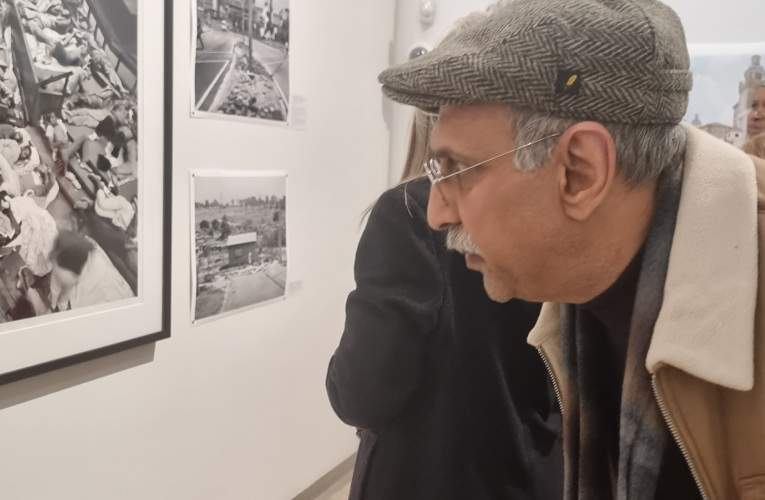
On Tuesday, 4, August, 2026, at the opening of a new photography themed around Goldblatt and his art practice, titled What We Do Not See featuring him and other photographers at Wits Art Museum, I was able to look at close range, some of Goldblatt’s photographs, which capture exactly what Motau was talking about.
For example, I saw an image of a couple, posing for the photographer, they appeared to be at ease, willing him to take the portrait. The photography is so striking, and in many ways, reveals the beauty of portraits when they are created with the participation of the subjects. That couple captured in Soweto, clearly enjoyed in participating in this photography session. They are clearly ordinary people from the township, but the image has been captured in an extraordinary fashion, exuding life in a way that tells you that there was no unwelcome invasion of their privacy. If anything, they enjoyed the moment and therefore, collaborated with the photographer during the session.

This exhibition, features several names of both well-known and those not that well known, but are young people who have embraced photography as their medium of telling South African stories. The narrative are rich – from Soweto to Alexandra, Sandton to Thokoza, and other spaces. The opening attracted unusually huge crowd on a Tuesday evening in Johannesburg.
The turnout was so huge that it has not been seen before in the recent history of a photography exhibition. It is actually an iconic photographic exhibition that features young and fresh minds alongside veteran photographers. Such as Goldblatt himself, Jodi Bieber, Gulshan Khan, Jabulani Dhlamini, Jo Ractliffe, Jodi Bieber, Lindokuhle Sobekwa, Madoda Mkhobeni, Mark Lewis, Sabelo Mlangeni and Tshepiso Mazibuko.
What We Do Not See is framed as an exhibition that remembers Goldblatt in what would have been his 95th year, and explores the idea of home – the structures, places, cultures and relationships that we live within – in and around Johannesburg. The exhibition is well curated by Brenda Goldblatt and Fiona Rankin-Smith. It is supported by the David Goldblatt Legacy Trust.
What is particularly notable ab0ut this exhibition, is the fact that it has been meticulously created around the art practice and legacy of Golblatt, making sure that his name remains an im[portant name in conversations around photography in South Africa.


Interestingly, some of the participating photographers are either the beneficiaries of his mentorship, or enduring photography initiatives that he started to pass on skills to young photographers, who otherwise would not have had such as opportunity because of their limiting social and financial backgrounds. A classic example is the Market Photo Workshop in Newtown, which has trained several young photographers, particularly from the townships over the years. That school continues to attract young photography students, not only from South Africa, but the rest of the continent.
The Market Photo Workshop, which today is one of the business units of the Market Theatre Foundation is one singular project, among other projects that attest to Goldblat’s living legacy, even though he passed on in 2018.
When he passed on, Golblatt left a rich photographic archive, representing a significant visual history of South Africa, from being a country caught up in Apartheid to a democratic country, still struggling to extricate itself from the legacy of Apartheid.
That point is reinforced by the thread that runs through this exhibition –a visual representation of inequality. In fact this fact is overt instead of covert. There is no sublet in the representation of this pain still stalking South Africa today, 32 years after it attained democracy.
In fact the whole exhibition focusses on highlighting contemporary issues that define the dominant feature of South African daily life.
In this exhibition, you will notice the disparity between two neighbouring neighbourhood – Sandton and Alexandra, for example in the section of the exhibition that features Bieber’s work. Your attention will be drawn by Dhlamini’s image of the four room houses in the township. All uniform and created as if the architects forgot that the township is made up of individuals with their own tastes of the kind of place they would call home. Instead they were lumped together in terms of designs, in a one-fits –all design aesthetic as if they were dealing with a people that though alike and shared the same things in life.

Dhlamini has managed to capture through these photographs, not only the horror of uncreative designs, but the poverty inside those houses. You do not need to go inside to see and feel the poverty; by looking at the houses, some of them not plastered, you can actually feel the poverty inside them.
Not everything in this exhi9bition is about inequality and the horror of township life. No. For example, Mazibuko’s images of life in Thokoza, give one a different perspective of what life is for ordinary people in that East Rand Township. In her photographs, which depict intimate scenes of young people in their houses, show a rare sense of defiance. A people who0 seem to be saying, we are not prepared to be viewed by the outside world, as a youth still stuck in the limiting environment in which their parents and grandparents found themselves in during Apartheid.
For example, in Mazibuko’s images, you will witness township style as expressed through fashion. The youth depicted here, clearly do not see themselves as victims of what affected their forebears and parents, but young, confident and proud to represent their township through various expression modes, such as fashion.
Essentially, what What We Do Not See, has managed to achieve, is to make Golblatt’s legacy, a living thing, a lasting memory that cuts deep into South African contemporary life, uncensored and unsanitised, particularly shining the light on the pain defining this nation today –the glaring inequality.
Exhibition Details
Exhibition dates: 04 August 2026 – 24 October 2026 Museum hours: Tuesday – Saturday, 10:00 – 16:00Entrance is free and all are welcome.