








The Cultural and Creative sector contributes billions of Rand to the economy of South Africa, says Cultural Observatory in latest report
Edward Tsumele, CITYLIFE/ARTS Editor

For the longest of time, whenever artists complain that their sector is not well supported by authorities at best, and regarded as some kind of welfare sector depending on government grants, and therefore a drain on the fiscus at worst, their issues are not taken seriously by authorities.
Yes, the creative sector and its cousin of sport in the minds of some powers’ thinking, is entertainment, pure and simple. Of course when Orlando Pirates faces their arch-rival Kaizer Chiefs at Orlando Stadium, at the end of the encounter by the two Soweto giants, some fans will be entertained, after their team has triumphed over the other team and in the process, even dance wildly in celebration of the victory. And also, of course, those who support the losing team, will go home with their tails under their legs, and wishing that nobody will talk to them about the game for at least a week.
Often, when these two teams meet for battle, tickets are snatched up as soon as the box offices opens. So clearly, there is entertainment value in sport. Any sport. Be it rugby, soccer, cricket or hockey. That is clearly obvious as evidenced by excited dancing bodies and t wild shouting that happens whenever one of the teams has won a game against their rival. So clearly there is entertainment value embedded in sport that evokes people’s emotions and leaves them poorer on the pocket.
However, there is another value that is hidden, but which is equally important. The mothers who set up stalls when there is a game and sell their pap outside to feed hungry spectators. The beverages companies taking care of thirsty throats in the VIP Longue, and add many others in the value chain of sport business, then you realise that sport more than entertainment. Not to talk about management and the players employed by vario0us clubs.

The same applies when Sipho “Hotstix” goes on stage at the market Theatre to entertain fans. What is obvious is that people will be entertained and even dance to the music. This means that there is entertainment value. And yet, there is another value embedded in that event that is not so obvious, hidden in plain sight. The economic value of that event. For one, Hotstix gets paid and therefore he is able to feed his family and pay his band.
The thing is for a concert on any stage cannot happen without the sound, often provided by someone who has the equipment and get paid for it. There is also a sound engineer, and for big shows, a stage manager, both of whom get paid.
Not to talk about clothing designers who dress artists and their bands.
Both these two scenarios demonstrate that sport and music are not just entertainment, but business worth a lot of money. However the creative sector is more than these two popular domains.
However until in recent years when a research tang, Cultural Observatory, manned by academics and researchers was launched, financially supported by the Department of Sport, Arts and Culture, the economic value of the creative and cultural sector was simply guess work, as no proper research was ever done to quantify it. For example, the sector’s contribution to the GDP of the country, let alone the number of people employed in the sector
This could be because for the longest of time, the creative sector has been incorrectly and parochially defined as simply entertainment to pass time for those who are bored with their lives. .Fortunately, with the research work that the Cultural Observatory has been doing, it is now possible to see the economic value of the sector. Its contribution is huge.
The Cultural Observatory has just released its latest research report that shows convincingly even the doubters as to how much the creative and cultural sector is contributing to the country’s GDP – including the number of people employed in it. It even sheds light on each sub-sector’s contribution to the economy of the country.
Here are the facts as contained in this report.
“The cultural, creative industries and sports industries (CCI&S) are vibrant and dynamic phenomena in South Africa’s economy. They include an extensive array of goods and activities in traditions, literature, music, visual arts, knowledge-based activities, film, and sports. The activities are a product of human intellect and artistic capabilities. These industries, driven by human intellect and artistic prowess, thrive on experimentation and problem-solving, often leading to innovative approaches. They significantly shape the country’s economic landscape by contributing to its identity, providing entertainment, and fostering leisure. Their importance extends beyond South Africa, championing innovation, employment, and economic development throughout the continent. For example, Africa has a share of 1.5% in the global share of the creative economy and is responsible for about 5% of the global creative employment (UNCTAD (2022). The CCS industries are well-known for generating multiplier effects on other related industries, hence governments around the world have identified the industries as one of the new drivers of local and economic growth. Over time, periodic assessment of the industries has become necessary for responsive interventions that unlock the ever-expanding trade and employment potential of the industries.
This report delves into quantifying the macroeconomic impact of the CCI&S industries on the South African economy using the latest available dataset from 2021. The calculation of economic impact employs a Macro-Economic Impact Assessment (MEIA) model based on a Social Accounting Matrix (SAM). Notably, the CCI&S do not have a dedicated position in the SAM, where they are explicitly displayed in detail. To navigate this glaring challenge, a Satellite Account for the Cultural, Creative, and Sports Industries was created and embedded into the Social Accounting Matrix. A SAM was converted into a MEIA model to quantify the impact of the Cultural, Creative, and Sports industries on the South African economy in 2021. Key findings reveal that in 2021, the CCI&S collectively contributed approximately 4.3% to the national GDP and sustained 7.6% of total employment.
The macroeconomic indicators show the following:
- GDP: The impact of the CCI&S on the GDP of South Africa was R250 billion in 2021.
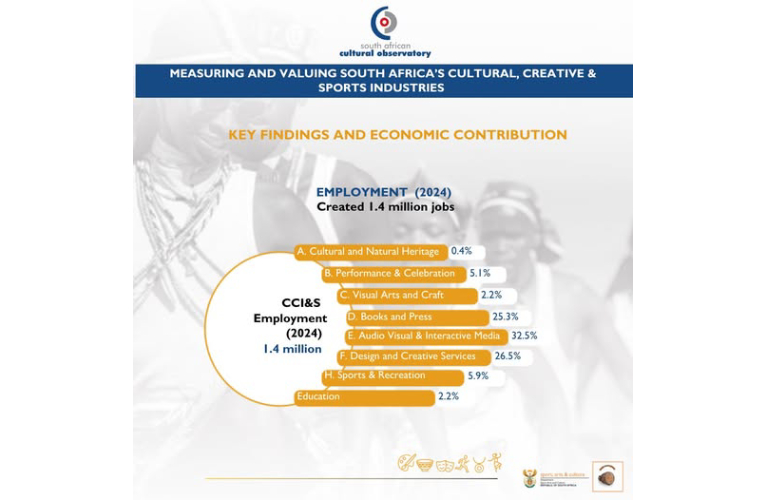
- Employment: The estimated job opportunities sustained by CCI&S in 2021 account for 1 125 866 occupations (direct, indirect, and induced).
- Fiscus: The annual fiscal impact of the CCI&S amounted to approximately R103 billion per annum through direct and indirect taxes. This income can finance different types of socioeconomic services like paying for teachers, hospitals, and low-cost housing.
- Household income: The total impact on household income amounts to R220 billion, of which 19% is accrued to lower-income households. Thus, of the total income generated directly and indirectly through the CCI&S, a significant percentage reaches the poor communities in South Africa.
Notably, the Design and Creative Services, followed by Sports and Recreation, were the main contributors to the overall GDP of the CCI&S in 2021. Both domains contributed 21% and 20.6% respectively. On the contrary, Performance and Celebration, and Cultural and Natural Heritage had the least contribution to total GDP contribution respectively. This can be explained by the negative impact the lockdown and various COVID-19 regulations had on those specific industries. The Sports industry emerged as a significant job creator in 2021, with skilled occupations dominating. About 25% of the occupations were from the Sports industries followed by the Audio-visual and Interactive Media (21%). The results also revealed that the CCI&S mostly generated skilled occupations in 2021. However, a combination of semi-skilled and unskilled occupations was leading in the job creation of the CCI&S industries.
Adding to the foregoing, the government also managed to collect taxes and support households. Taxes that were collected in 2021 are worth R103 billion. Low-income households benefited R41 billion from the R154 billion that went to households. Regarding transformation, the CCI&S still have considerable ground to cover. While all racial groups are present within these industries, it’s apparent that women remain underrepresented. Furthermore, ownership within the CCI&S continues to lack adequate representation from previously disadvantaged groups.
In conclusion, there exist boundless opportunities for the CCI&S sectors in South Africa’s future. As digital transformation unfolds, it’s imperative for the country to position itself competitively on the global stage. This necessitates the implementation of policies to ensure access to relevant technologies for these industries. Support should be extended to facilitate a seamless transition and continual enhancement of their competitive edge. Additionally, educational institutions should be equipped to prepare students for future occupations, ensuring the availability of necessary skills for the creative economy within the workforce.”