



The body as common ground: What Yoga’s arrival on Africa’s biggest stage tells us about culture, belonging and the space between
By CityLife Arts Writer
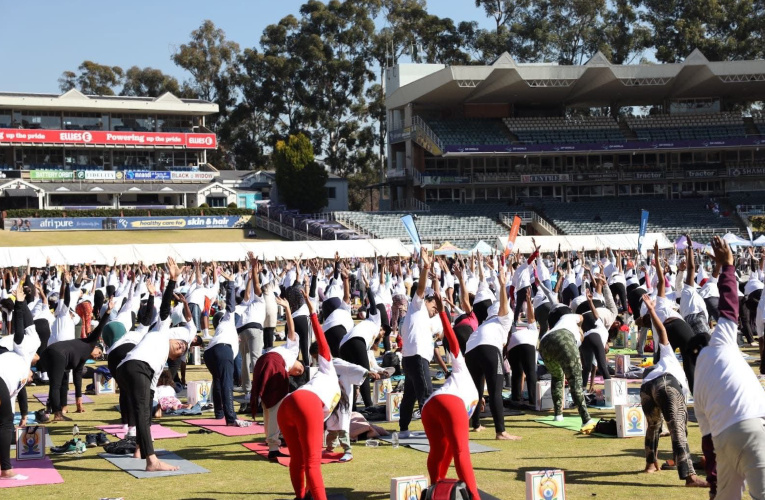
When thousands of South Africans roll out mats at Randburg Cricket Club on 20 June for one of Africa’s largest International Day of Yoga celebrations, they will be participating in something that goes well beyond fitness. They will be enacting a living argument about what shared cultural space can look like.
There is a particular quality of attention that a large group of bodies in synchronised movement produces. Anyone who has stood inside a stadium crowd, watched a procession, or sat in a theatre when an audience collectively holds its breath will recognise it: the momentary suspension of individual separateness, the strange and fleeting sense of being part of something larger than yourself.
Yoga, at its most stripped-back, produces a version of this — not in the competitive or tribal register of sport, but in something quieter and arguably more durable. It is a practice of paying attention to breath, to posture, to the present moment. Performed alone it is meditative. Performed alongside thousands of strangers it becomes, unexpectedly, communal.
On Saturday 20 June 2026, Johannesburg will find out what that feels like at scale.
A cultural form that resists easy categories
Yoga occupies an unusual position in South Africa’s cultural landscape. It is, simultaneously, ancient and thoroughly contemporary; Indian in its origins and genuinely global in its reach; associated in popular imagination with expensive studios and yet, increasingly, practised in township community centres, school programmes and public parks.
This ambiguity — which can feel like contradiction — is actually one of yoga’s most interesting cultural properties. It has not been captured by a single class, race or ideological community. It belongs to many people for many different reasons, which is rare for any cultural practice that has achieved mass adoption.
A practice that can be simultaneously 5,000 years old and entirely of the present moment — that is the mark of a living cultural form, not a relic.
The cultural diplomacy of the mat
The event is convened by the Consulate General of India in Johannesburg, led by newly appointed Consul General Mr S. Koventhan. It forms part of the United Nations-designated International Day of Yoga, observed on 21 June in more than 190 countries — one of the most rapidly adopted international days in UN history.
What distinguishes the Johannesburg celebration, now over a decade old, is how thoroughly it has moved beyond its diplomatic origins. The Indian community in South Africa has deep historical roots — the indentured labour history, the political solidarity of the anti-apartheid years, the ongoing cultural exchange — but the IDY celebration at Randburg Cricket Club is not primarily a diaspora event. It draws from the full breadth of Johannesburg’s demographic complexity.
That is not an accident. It is the result of deliberate design — and of Consul General Mr S. Koventhan’s framing of yoga not as cultural export but as universal inheritance: “Yoga belongs to humanity. It transcends borders, cultures and languages.”
In the context of cultural diplomacy, this distinction matters enormously. A country that presents its cultural heritage as a gift to be received positions itself above the receiving community. A country that presents its heritage as shared human property invites participation as equals. The posture — in both the yogic and political sense — is entirely different.
Performance, cultural showcase and the live arts
The 2026 celebration is not only a yoga session. It includes a cultural performance programme, which in previous years has drawn on both Indian classical and contemporary South African traditions — a combination that produces its own interesting cultural conversation.
For the arts community specifically, the intersection of Indian classical performance forms — Bharatanatyam, classical music, devotional practice — with South African dance, choral and theatrical traditions at a large public gathering is worth paying attention to. These are not forms that often share the same stage or the same audience.
There is also, for those thinking about the broader ecology of South African cultural life, a question worth sitting with: what does it mean that one of the largest free public cultural gatherings in Gauteng this June is organised not by the Department of Sport, Arts and Culture, not by a municipality, but by a foreign consulate? The answer is not cynical — the Consulate’s commitment to accessibility and inclusion is genuine and demonstrable. But the question itself reveals something about the gaps in our public cultural infrastructure.
The largest free public cultural gathering in Gauteng this June is not a festival, a concert or a museum opening. It is a yoga session. That tells its own story about where community is finding itself.
Yoga for Healthy Ageing — and the wisdom of old forms
This year’s official theme — Yoga for Healthy Ageing — carries particular resonance for the arts community, where the work of older practitioners and the transmission of embodied knowledge across generations is a constant preoccupation. Every dance form, every martial art, every contemplative tradition faces the same challenge: how does the knowledge of the body move from one generation to the next when the vehicle of transmission is the body itself?
Yoga’s answer — practise consistently, in community, across generations, without ego — is one that many South African arts traditions would recognise, even if they would express it differently. There is something instructive
in watching a practice that is five millennia old continue to find new participants, new contexts and new relevance without compromising its essential character.
That, if nothing else, is a lesson worth borrowing.
Event details
Date: Saturday, 20 June 2026
Venue: Randburg Cricket Club, Johannesburg |From 09:30
Cost: Free Children welcome | Complimentary parking
Register: https://docs.google.com/forms/de/1FAIpQLSdRtiP8LpCkbW6LKMUrkRIsp9ZOlhEujYysKfOqsFpvG_3gYA/viewform?